

Convenience As A Catalyst: How Circular Mom Club Is Disrupting Kid’s Fashion With Vale Siegrist

Sustainable innovation often thrives in the "friction zones" that major brands ignore, proving that circular economy models can be built through grit rather than institutional backing. Guest Vale Siegrist, founder of Circular Mom Club, shares her journey of building a baby clothing rental service while balancing a full-time tech career and motherhood.
Born from the need for better options than fast fashion and the personal joy of finding purpose during a difficult postpartum period, Vale has created a subscription-based rotating closet for children ages 0 to 4. She offers a transparent look at the operational trade-offs of a solopreneur—from reusing Amazon envelopes to maintain sustainability values to leveraging AI as a "role-play" partner for hard business decisions.
By prioritizing convenience and rigorous intentionality, Vale demonstrates that a sustainable system can effectively solve the financial and environmental guilt associated with modern parenting.
—-
Watch the episode here
Listen to the Podcast here
Convenience As A Catalyst: How Circular Mom Club Is Disrupting Kid’s Fashion With Vale Siegrist
Building In The "Friction Zone"
Welcome back to the show. We are interviewing Vale Siegrist, the founder of Circular Mom Club. It is a baby and toddler clothing rental service that she built in Austin while working full-time in tech and raising her child. She is proving that circular models do not require institutional backing to operate. She has built this business in the friction zone that most brands ignore. Parents who want to be sustainable but cannot absorb the cost or inconvenience of trying.
EPR and circular economy models are supposed to incentivize innovation like this. It does not fit neatly into how EPR programs are designed. They do not necessarily reward packaging avoidance. Nonetheless, she is building something that is growing and is a bit of a movement. I am excited for you to hear her honest take on the struggles as well as the accomplishments of building the Circular Mom Club.
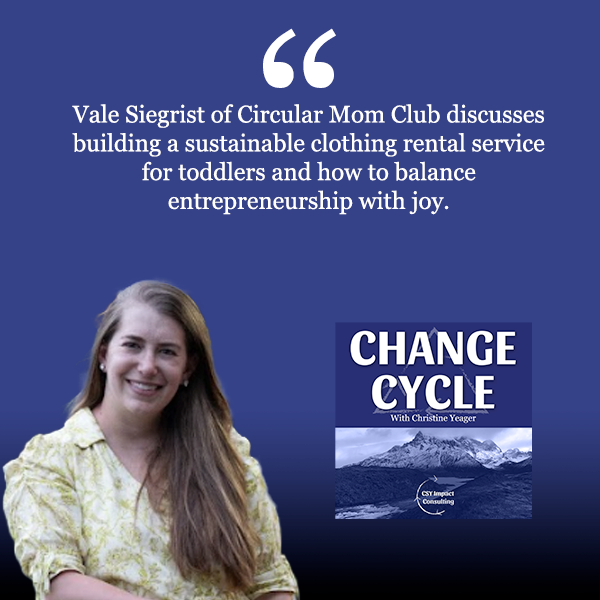
Vale Siegrist, thank you for being here. I am super excited for this conversation. You have been, I think you are building a movement, and I am excited to hear and dig in more to it. As with all of my guests, we like to start with, how do you live with intention?
First, thank you so much for having me. Happy to be here. How do I live with intention? I would say I try to do little things day by day that are aligned to my values or the things that we want to, let us call it, be when we grow up. When you asked me this question, it triggered me to the smallest example of having reusable straws in my house. It is like the intention of every purchase. That is what is bringing me to, and it is the little things that we can do every day too to be a little bit better in the end goal than the date.
I like it. My husband hates the reusable straws in my house. He hates cleaning them.
“They go into the dishwasher. It is not that hard.”
I should probably clean them more often. Little love language thing, he lets me use them, but he is taking them out of all the kids' water bottles, so they do not have to clean them in the water bottles. I get to have the luxury, and that is all that matters. Can you tell me about Circular Mom Club, and also how someone can participate?
Yes, Circular Moms Club, it is a rotating closet for kiddos 0 to 4, where moms can get a subscription and rotate outfits every month. Moms, parents, or grandparents can participate or subscribe through our website,www.CircularMomClub.com. They are going to find the catalog. They are going to have this subscription portion. It should be easy enough to get it from there.
Love it. That is great. We talk a lot about packaging on the show, but we have also been talking a lot about textiles. I love to see this example of reuse, especially as textile EPR becomes more and more popular. You started this because of the joy from dressing your children and your daughter in secondhand clothes. It is fun, right? I used to call it the gravy train because my sister-in-law would send me a box of clothes, and I was like, “This is great. I hardly had to buy any clothes.” We moved away, and my gravy chain is drying up, and not everybody has that.
There is a lot of joy in dressing in these secondhand clothes, both from a financial standpoint and from just seeing the love that some of these clothes have gone through. As you know, not everything goes perfectly. When you are faced with a setback, and that is something that sustainability professionals really do a lot, how do you protect the original joy of building something that is really tied to your values and something you are really excited to see grow from becoming like a liability or a roadblock that feels insurmountable?
Reclaiming Identity And Joy Postpartum
Honestly, these conversations are helping a lot because it is every time that I get to speak about the joy that it brought me in postpartum. If I can backtrack a little bit. Sophie was my daughter, Sophie was like about three months old, and I was on maternity leave, and I honestly find it hard to get up from it. I wanted to go back to work, but it felt like it was not the right. The right choice because I was not well rested. I wanted to spend time with my daughter.
I wanted to take advantage of maternity leave, but I was seeing my purpose as feeling productive or like feeling good about working and doing something for something else. One day, I dressed her up in a very cute outfit, and I started sending pictures to my friends and family. That not only the joy of seeing her in good clothes, but also like the instant dopamine that you get from someone telling you that your kid is cute. It really hit.
I think that is what got me out of that cycle of not finding myself. It got me a reason to want to get out of bed and do something with my day, either saying, scrolling my phone, or going back to work. It really allowed me to create that bond with her. These conversations really helped me go back to that feeling, that joy, and then why I am doing this. As you mentioned, a lot of moms have that secondhand option, but I did not.
I had a few friends who gifted me their hand-me-downs, but like, I am from Argentina originally. I moved with my family in 2012. In 2012, we moved to Miami, 2023, we moved with my husband to Austin. Most of my family is in Argentina, very close friends in Miami, and I did not have that village providing me with those, like very big piles of hand-me-downs. I was faced with the option of buying new or going to thrift shops.
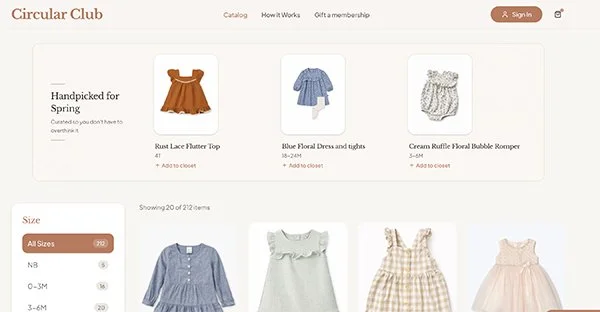
Circular Mom Club: Try to do small things each day that align with your values and who you want to become.
I could not. I needed a better option. That is a little bit of how Circular started. Going back to the question of how I keep that joy is going back to that feeling. It always brings me energy back when times are hard. I remember that there is a mom in the same situation that I was, and that gives me the energy to keep going.
I knew it was so tough because they grow out so fast, and then everybody has the things that matter to them. When you buy the cheapest stuff, it is frustrating for some reasons. You buy the most expensive stuff. It's like other like frustrating, and also not everybody can afford that. I would always try to find, not as I did not want them obsessed with too many similar characters or whatever.
You are looking for a light. When it was like, hand-me-down, I really cared. I was like, “I will take it, whatever.” Anyway, just like a different emotional experience when you are getting these secondhand clothes, especially when you know these kids are going to grow out of them so fast. Reminder about the joy, think it's great.
Breaking The 3 A.M. Fast Fashion Cycle
To add to that, if I may, for a mid experience also came with a lot of guilt because on one side you have these very cute outfits for $40, $50 that they were only like I could not get myself to buy something only for a picture. Guilt really came in there. I did not spend $40 on an outfit, something for myself that I will not grow out of. I went to like, my like cheap mind ended up in Shein. I do not even know how to pronounce it, but it is like, and then it was like, “No, I am not going to keep putting my money towards fast fashion.”
I was in these like, I do not want one or the other. That also, I am seeing a lot of moms resonate with that because again, your other option is going into a thrift shop or a consignment store. Sometimes these consignment stores, of course, have to pay breakup orders, they have to pay employees, they have to pay for things like the taggings, the pricing, and they have to make money. Something that costs $20, maybe you are paying $15 for, like, secondhand or like the amount of time that moms are investing in social media, trying to like sell like individual pieces.
There are a lot of aspects where we are hoping to provide a better solution. I just got another flash of postpartum for like the amount of ads that I was getting, like you're breastfeeding at 3:00 AM and you open Instagram, and all you get are like 50% off here, 60% out of there. I ended up falling for them. You spend more money because you have to get to a certain threshold for free shipping, because who is going to pay for shipping?
You end up spending more, and it is like a vicious cycle because now the algorithm knows that you are going to purchase, and it is only going to show you more ads. I am also hoping to provide moms with a mantra of saying, “I have a monthly subscription for that.” I do not need to fall for the ad, or if I see something that I like, “Let me go and get it on Circular because I am already paying for that.” I did not answer your question specifically, but you said a couple of good things that are like, “All triggers, while you are here.”
I was like multiple breastfeeding sessions, like researching which thing I needed to get, and ended up with the like $20 bath thing. I spend like hours. You have got a lot of hormones going on, and you are questioning everything. You are feeling guilty. You are like, “Am I getting the right thing? Am I buying the right thing? There is no way I could have made it to a store to shop for that thing.” No. I did not have time to do that. I absolutely could not have researched which one was the right choice for an hour if I were standing in the aisle.
You are definitely hitting on a couple of real solutions for people. You brought it up a couple of times, though. If you are willing, I would love to dive in a little around leaning into finding joy when you are feeling depressed. That is brave in the first place. Kudos to you for doing that. I can imagine that continues to hit as you hit roadblocks as you are growing. In our prep, you talked about, like, mid-build, blaming the Circular Mom Club for things that maybe it did not cause. Can you share a little bit about what burning out on something you love teaches you about yourself that success may not have?
Managing Burnout: The "Two Task" Rule
What has this taught me? First, I usually put more on my plate than I should. It comes to how we manage that, because these are all things that I truly enjoy, that I truly like. It comes down to what tools will be leveraged to balance out the schedule, from maybe understanding that it is going to be two tasks a day. One of the first burnout management tools that I use is like I told myself that I was going to be happy and content with myself if I tackle two tasks a day.
I built myself a Notion task manager in a calendar, and I assigned myself two tasks a day. Of course, you are going to sleep, you have a new idea, and you have this rush of making it happen. I will open the calendar and see what the next day is that I have an empty spot for this new great idea, or what can I move from tomorrow to allow space for this new idea? I know I cannot do it all. Sometimes that expectation of doing it all is what is bringing a little bit of burnout.
Sometimes the expectation to do it all is what creates burnout.
The other part is that I know it comes with a lot of privilege, but I think, at this stage, what Circular is that is not paying my bills. I am honestly taking advantage of that because if one day I need to rest, I can take it off. Nothing is going to break. My kid is not going to miss food on the table if I take a day off. The reason why I say that I come from a privileged standpoint is that if someone is tuning in and they are the whole provider, they are feeling burned out, this might not be the right advice for them.
They might feel the need to husband a little bit harder, even though they are burned out, because food is in the middle of like providing for their families, their first priority. That is a little bit of a caveat that I always say. I know that hopefully one day, like we grow Circular to a point where it is my provider for my salary. Maybe I would make different decisions then, but today I have the privilege of saying, "I can close my computer like that, an Instagram post can wait until tomorrow or until I replenish energy."
There is still value in learning, like this idea of what your capacity is and sticking to that and using that, whether it is two tasks or whatever your capacity is. That is something that I struggle with for sure. It is like getting the message out there and doing the work and doing all of the in between and making sure you are allocating the right time for each of the aspects and tasks. Having that diligence, I think, is really powerful, and giving yourself some grace.
I say this, I think more than I thought I would on the show. It can be so powerful. I always thought giving myself grace was being lazy and that, like, maybe I could have pushed harder, worked harder, done something differently, or I made a bad decision that caused whatever. That is too exhausting. I appreciate the caveat, but at the same time, I think it is good to remind anybody that they can like, you should give yourself some grace for when you need it. You are also making me think, and this is probably off topic, of how maybe if you are the sole provider, it is like, how can you build systems so you cannot take breaks?
Maybe it is like, how do you build a sustainable system? You cannot close your computer at 5:00 PM. You cannot close your computer on the weekends because it is a matter of building sustainability. I keep repeating the word sustainable, but it is more like you cannot burn out at the beginning. You are hopefully building a company or a project for a very long time. If you use all your energy in the first weeks, how are you going to get to the fourth one? Those breaks are very necessary.
You can’t burn out at the beginning—you’re building something meant to last.
How are you going to continue to push the heavy boulder? I was saying, I think that said it on the show, the boulder can feel heavy, the hill can feel steep. If you do not make room for the joy, if you do not make room for focusing on what you can accomplish and celebrating that, then it will be hard to keep pushing. We have talked about the circular aspect of your business tied to clothing.
I know you are also trying to weave circularity into other aspects of your business, including packaging. One of the things you brought up in the prep session was this operational friction around shipping packaging and envelopes, finding the right environmentally friendly option for shipping. How are you sitting with the trade-offs and the decisions that you have made? What do you think it would take to really feel strongly that you have the right environmentally defensible choice?
Operational Friction: The Amazon Package Trade-off
Circular is still small enough that I think I can afford to send a letter to the customer and explain, like you are receiving your package, and if any of you used a maximum package because one of our core values is sustainability, and the fact that you are helping me prevent me from putting that maximum package in the trash. As we grow, as we grow in customers, as we grow in revenue, I am going to have a little bit more bandwidth to invest in maybe a tag or maybe I can reuse the packages differently so we can brand it a little bit better.
Honestly, I spent a little bit of time thinking about what the right answer is because I do see an opportunity with all of these Amazon packages going into the trash to reuse them. Also, there is a trade-off with that brand that you are not getting out there, or that polished experience of opening that box. I see a couple of brands on Instagram, how great it looks like when you get that amazing box, and you open it, and it is like a beautiful package on that tissue paper, and that all goes in the trash so fast.
I am still navigating that. I have not found the perfect solution. I am hoping that as I grow, I can invest in something a little bit better. I do like how Rent the Runway and Newly do it, which is you get a very sturdy bag with slips for the male labels. The clothes go back and forth in those big packages. I know that that is a bigger investment that probably takes a little bit more partnership with carriers, but I can see how in the future we can head that way.
You bring up a good point. The small enough to explain, I think that is an interesting use case of consumers who are willing to participate in that. A lot of big brands will say that they are not. You are proving that wrong. There are options when you scale. That is also true. It still keeps your cost down, which is these are these trade-offs. It is like you want to be big enough. It is also important to leave the room to prove the concept out and then scale it. How do you frame the value proposition to your customers at Circular Mom Club?
As a trash nerd, I get it. You are having to sort of change a little bit of behavior with these moms or parents, and you are having to make it valuable from a cost perspective. We just talked about this. You are competing with either somebody willing to spend a lot of money on something or somebody who maybe is getting donations or hand-me-downs in a different way. How do you frame your value proposition to your potential consumers?
Scaling The Value Proposition: Seasonal Flexibility
I do it through the ease of getting new clothes in the size that you need. There is a real frustration with kiddos are growing their clothes so fast. The storage that you have for all these clothes like that is not fitting. “What do I do? Do I sell them? Do I tend to consignment? Do I put them in a phaser group? Who in my mom group is going to want this?” Unless your village is super established, where, like you know who is passing you clothes and who you are sending it to, not many moms have that in and out system.
You have to think about how seasons affect. The value like Circular comes in for those moms that do not have thrift shops clothes, that do not have that village that is passing through and that understand the concept that they are investing $30 per month can save them a significant amount of money and the guilt of not having like you can find guilt in so many parts of this process from those that want to be better at not buying fast fashion to the ones that do not want to spend $40, or $50 in an outfit.
Guilt shows up in many parts of the process, whether it’s wanting to avoid fast fashion or not wanting to spend $40 or $50 on an outfit.
Another very sweet spot for us is that those celebrations or outfits that are only going to be used once. You have that guilt of like, “I am buying something for only one time.” I know that we have Mother's Day is coming up, and I know that moms love to do photo shoots for Mother's Day, but that also can come with a hefty like money investment. It has to be the best man.
To be clear, like the number of times. We have not done that many photo shoots, but I definitely was like, “Just ran over.” I got what I could have hoped for, something that went along with everybody.
If you remember that, like 10:00 PM, you cannot run to any store or thrift shop. Circular comes in and like first, as my whole is that mantra that I mentioned before. It is like, “You are going to have needs across the months.” It was like, “I have a circular for that.” “I have an unexpected, like a birthday party, next week. I have a circular for that.” “I have a lot of outfits. Let me have the circular for that.” Can you believe that I went on a trip last weekend and I got my daughter the wrong size of clothes? She outgrew her clothes, and I did not even notice.
I was like, “I am so happy Sikla is here because she grew her clothes and I did not have distress about going and buying everything new because I just could like exchange her closet with like I am looking at my closet because my Sikla started just here. I could go in and change everything and move on with my life. It distressed me like in that right second. Still working on how to articulate all those value adds. I am hoping to make mom's life easier. That is what I want.
The season thing is a good call out because, if you are getting hand-me-downs sometimes, like your kid is at that size in a different season than their kid. My son went through a couple of years where he, in Georgia, refused to wear shorts because he got mosquito bites. Stan said, “You wear pants, you might not get as many mosquito bites,” which is only a little bit true. Anyway, for years, he would wear no shorts. We have all these like hand-me-down shorts that we could never use. Luckily, my second child is now interested in wearing shorts.
Thank you. You know that you mentioned seasons. I did an Instagram post last week, and it is like, “What happened?” I am from Argentina, and seasons are the other way around. If you are taking the trip to Argentina in January, all your clothes are going to be like in the States in winter, but you are going to go to summer. Like, “What are you going to do? Are you going to buy an entire closet that you do not know if is going to be used again?” You can rent all that and then return it.
That is great. What practical tips for someone stepping into or leading uncomfortable change would you have?
Practical Tactics: Pilot Projects And AI Agents
I would say three. I love this book by Michelle Pollard, and she says, “What is the best that can happen?” When we go through change, through my corporate job, I went through a lot of change. We always think about all the bad scenarios, the worst-case scenarios. When you can see the wind across that bridge, you are going to find that motivation and that breath of fresh air to be able to do hard things. The second thing, and this speaks to my experience with Circular, is that I started with a small pilot.
When again, like thinking about my corporate job before we launch a nationwide initiative, we always pilot the school first. When launching Circular, I started with a small pilot with a couple of friends. I would find an idea. I launched a little bit more. Now, when the website was ready, when I got all the feedback, I was able to launch Nationwide, which allowed me to feel more comfortable with the offer that I was putting on the table. That was my second rise. My third one is that I have been using AI a lot.
When change happens, sometimes you need that partner to bring some ideas to role-play hard conversations and to help think something through from different angles. If you are managing change with an employee, you can say, “What if they tell me this? What are you going to tell me that? What should I say?” If you are, again, not to say it will not be ideal, but like if you are having all these thoughts at 10:00 PM, you are not going to have your boss to coach you through this. Having an AI agent that is available to you can be a great resource.
Just thinking through, like, what are those pushback conversations just on its own is incredible like activity to do and then brilliant bringing in AI because they will definitely think of things that you had not thought of right like it is easy for you to think of a couple of options but then to like use that as a prompt to say what other types of topics might people push back on brilliant especially as a solopreneur. Unless you start a podcast and force people to talk to you, there is no one else.
I am not going to add that to my plate, Christine, but I am happy to come back and talk anytime.
Thank you. I am just going to recap a couple of themes that I heard across the conversation. One thing that I really liked that you brought up a couple of times is this reminder about joy and finding joy in the little things, finding re-grounding in the joy that you are feeling. Even going as far as to say, “That dopamine hit that you get when people are complimenting your podcast or your show or your child.”
I used to have these friends, I had these friends that another one, she was a consultant, and then another couple of other friends, all working as well. We started something called the Happiness Accountability Partnership. Which is such a nerdy thing to do. It was basically a text chain where we would just like help each other find each other's joy. You reminded me of that, like, I think getting those text messages sometimes, the responses that were just like positive, like, “Is that what you really want? If that's what you want, then that is great. Go do that.”
Without any judgment. It is so helpful to anchor in that finding joy. Thank you for that reminder. The reminder to use that to push through the difficult times, to reground on that. Use that joy as a tool, as well as just for fun, to experience joy. I love the little things day by day as part of your intentionality. You even reiterated it with the like, can only do two tasks for this. Having this almost rigorous intentionality, I think, is something that a lot of people strive to do.
Nonetheless, that is really like a good reminder, tactical reminder, I think of this, like, “What can I do today?” Not necessarily at an added pressure standpoint, but as more of a decision-making standpoint. On the flip side, I think you said something around the lines of not putting too much pressure on this idea that if you put too much pressure, then it becomes insurmountable. You cannot do it all. Leaving that room for things to maybe like adjust your prioritization or just what gets done that day, or what have you.
That this idea is not going to be everything that it needs to be, like it has its role in your life, but it is not everything. It is not the only thing. A couple of things around your value proposition, and just like how you are explaining things to your customers. You are like reiterating the circularity aspect of this in all of the ways that you see you are very consistent with this message, and you are not assuming that your consumer cannot handle it.
You are being very transparent about it, and I think that more people should do that. More people should put their belief that if they want it, they will come and they will be willing to hear this message. Prioritizing your value proposition and ease. Convenience seems like it should not be sustainable, but what you are talking about here is that convenience can be sustainable. In fact, it might even be more convenient with a little bit of practice.
Having that monthly subscription just means that you are committing longer term, but having that ease is actually more convenient because it is going to show up next month, and you can make the change if you need to. This was a great conversation. I really appreciated everything you shared, and thank you for being so open and honest about your journey and how you got to create the Circular Mom Club. Is there anything you want to close with?
The Final Takeaway: Convenience Can Be Sustainable
Thank you for that recap. Thank you for having me. I roll down, convenience can be sustainable because that is definitely one of the things that I am aiming for. If someone who is tuning in is trying to either pursue entrepreneurship, pursue change, or pursue sustainability, I think it is what you said is about all the things that we can do on our day to day, and it is just little things that are going to help long-term. Thank you for a fantastic conversation, Christine. This was wonderful.
Thank you.
Important Links
About Vale Siegrist

Vale is the founder of Circular Mom Club, a baby and toddler clothing rental service based in Austin, TX. A full-time tech professional and mom, she built Circular in the margins of motherhood after realizing parents shouldn't have to choose between being sustainable and being practical. She's on a mission to make circular fashion the obvious choice for modern families.