

How Certified Compostable Packaging Drives Real Circular Economy Impact With Meghan Ibach
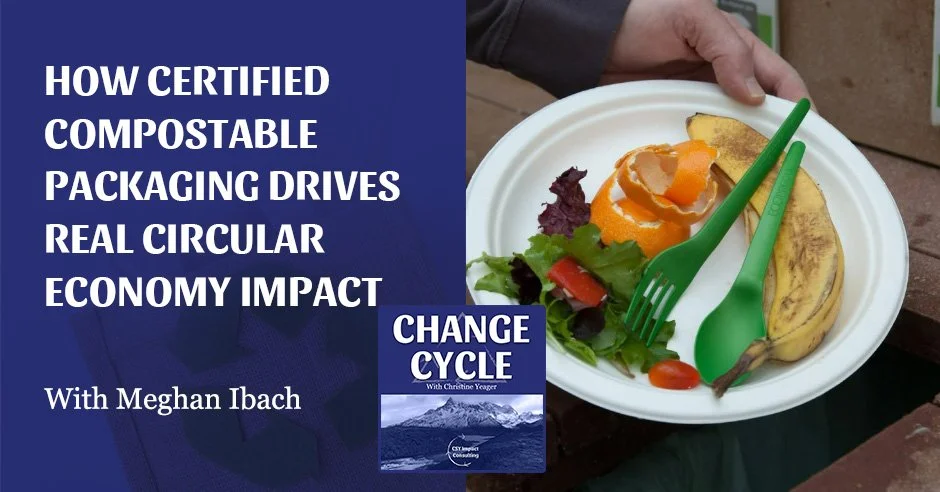
Making certified compostable packaging work in real-world organic streams takes strategic coordination across the entire circular economy supply chain. Host Christine Yeager connects with Meghan Ibach, Product and Zero Waste Specialist at Eco-Products, to examine how design decisions directly impact downstream composting operations. Meghan sits at the exact point where certified compostable packaging either works or falls apart. She works with compost manufacturers, haulers, and venues to pull non-compostable material out of the stream before it becomes their problem. Together, they explore why food service items make traditional recycling difficult and how compostable options capture critical food waste streams. They also address real-world lessons from regional policy shifts, color-coded bin standardization, and the science of microbial breakdown during the curing phase.
---
Watch the episode here
Listen to the podcast here
How Certified Compostable Packaging Drives Real Circular Economy Impact With Meghan Ibach
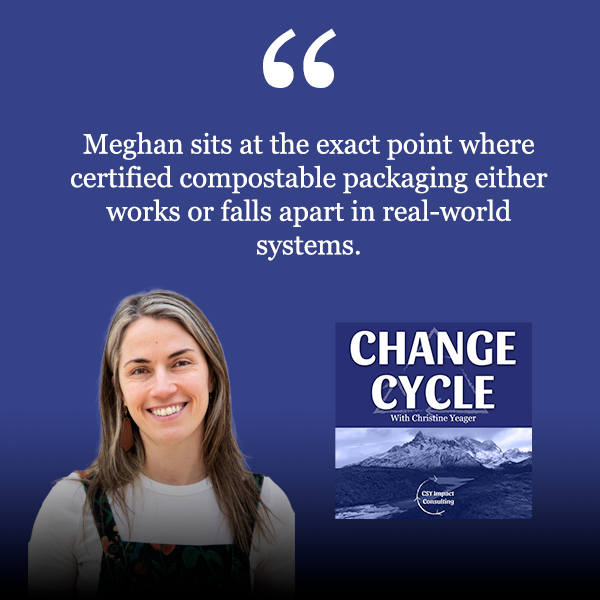
This conversation is with somebody who is making changes across the composting system. As the product zero waste specialist for Eco Products across the Rockies, Pacific Northwest, and parts of the Southwest, Meghan sits at the exact point where certified compostable packaging either works or falls apart. She does not just sell into the organic stream. She works with compost manufacturers, haulers, and venues to pull non-compostable material out of the stream before it is their problem.
That is a tough position to be in because compostable packaging is one of the few material categories where a producer's design decision directly determines whether a facility downstream can accept the load at all and where EPR, Ecomodulation Credits, and Real-World Compostability do not always agree.
She has worked at nearly every point in the supply chain, which means she can tell you where the linear-to-circular handoff actually breaks rather than where the marketing says it does. She is here to share with us some fun facts about fungus, pun intended, but also to just share how she brings her energy to something that I am also passionate about, but it is hard to compete with her passion for compostability. I really enjoyed this conversation and learned a lot, and I hope you do too.
Thank you so much, Meghan, for being on the show. Super excited for this conversation. For those who have been listening, I love to talk about compost. I am excited to talk about compostable packaging.
Thanks for having me.
We always kick off with how do you live with intention?
I am a very busy person, and I am always planning. I always have things going on. I just go from one thing to the next. It has taken a lot of work, but I really try to slow down and appreciate the small things I do, stop and smell the roses. I literally will stop and smell all the flowers I probably can. I think trying to take things slow, not hyper-planning everything, having some just windows of spontaneity, time open has really helped me level set and reset.
That's great. I am often the one who is telling people to look at the flowers, and I am usually trying to tell them what flower it is.
I am working on that too.
Actually, I got the iNaturalist app. I do not know if you have that, but it is like the Merlin app, but for plants. If you log the plant, then you can. This is a side note. Almost all the plants I logged in Maine recently were all invasive species, and it was disappointing. Just be aware. If you do get the app, you might be disappointed. You can log them as part of research, like the Merlin app. Anyway, I am obviously interested in sustainability. We cannot be bird and flower nerds. For those folk who do not know, although I cannot imagine because I feel like your brand is everywhere. Can you just share a little bit about Eco Products?
Eco Products we are a manufacturer of mostly certified compostable packaging. We do have a line, a small line made from recycled content, mostly post-consumer recycled plastic. We just launched aluminum cups recently. We do have a small line of reusables. Reusable to-go containers and cups. We just launched those. The bulk of what we do is single-use certified compostable packaging.
Bridging The Gap Between Packaging And Composting
I know you read my bio, but I work on end-of-life solutions. I am technically part of the sales team, but I am one of five people around the country who work with the generators, haulers, and composters to try to keep our products out of the landfill and, most importantly, capture food that would otherwise go to the landfill and get it processed in compost. Great.
I was at a conference recently that shared a lot of consumer insights about packaging and sustainable packaging claims. One of the things that was at the top, it was based on purchasing data. It was like, these are the packaging claims that drive the most purchases, actual transactions, versus, we've seen a lot of consumer data out there that is like, would like to make this statement and like, pull this package because of it, but I do not actually pull it. I do not actually buy it. This was actually transactional data. The claims that performed the best there were like five that were at the top, but two of them were close to the top.
I do not remember which one is number one, was recyclability. That this package was recyclable and then compostable, that this package was compostable. Consumers really like picking up a compostable package. They feel really good about it. There is this intrinsic feel-good moment. As you're working with composters, and as we know, A1 Organics in Colorado will not accept compostable packaging. Can you talk a little bit about that and how you navigated it? I know there was a big shift that happened. Tell a little bit of the history and how you navigated that shift and change.
Why Food Service Items Struggle In Traditional Recycling
There's a lot of complexity with compostable packaging and a lot of emotion and feelings. I have been to a lot of conferences where the room is packed because people want to talk about it, whether they're for it or against it, or they're just curious. There are benefits to compostable packaging just coming from plants, especially when they're made from, like, the discard of an agricultural process, like molded fibers, which is typically sugar cane, like we call it bagasse. I also think there's a place for certified compostable packaging, really, because in terms of food service packaging, very few items are actually recyclable.
Progress over perfection wins every time when building resilient circular economy supply chains.
They're either weird thermoform shapes, or they're utensils. Utensils are just not. They're hard to collect, they break, nobody wants them. Other kinds of boxes, like a molded fiber container, might have chicken bones and grease and buffalo sauce. There is a lot more opportunity to compost packaging than there is recycling, just because of those food elements and the shape elements. There are a lot of reasons why composters still might not be taking compostable packaging. With A1 Organics and what happened in Colorado for years, A1 was receiving, they were taking care of it.
That was like one of their tags, was like, "We'll take care of it." They were the only processors. They were not actually calling. They had a step between the generator and the processing part. They were relying on their hauler partners to manage the contamination, pull things out, which some have that business model. Some just a route density, bucket grabber, tip and go. It was really hard for the haulers to manage contamination. In my opinion, communities really started to take composting for granted.
Rebuilding Trust Across Regional Composting Infrastructure
Boulder has an amazing zero-waste policy and really tried hard to reduce the entire city's waste by relying on composting as a solution. When you do not have checks and balances, you need stopgaps. Frankly, there's a lot to it. Compost product manufacturers, I think it's really important that we, as manufacturers, get our products certified, tested, vetted. We label it well. The whole industry, in the past, I think we did a disservice by making compostable products look very similar to fossil fuel-based products. If you think of it like the first corn cup, it's just clear, and it looks plastic.
It looks exactly like a PET cup. Colorado has made some strides, and the same with the state of Washington, in passing really good labeling legislation that is really trying to differentiate between commercial products. They have a certain color that non-commercial products cannot use, which is helpful. It is all about clearing up confusion at the bin and at the business. When I am purchasing for my business, it's hard to tell what's certified compostable and what's not. On the flip side, compost facilities.
Again, I have been to probably like two dozen compost facilities at least. I have never met two that are the same. They are really unique. Their time, temperature, moisture, their feedstocks change and are different, and their equipment is different. That can dictate the size of the pile and how much microbial activity there is. It's really important not to just assume a compost manufacturer can accept compostable packaging, but work with them to say, like, "What does work in your system and what are you willing to accept?"
Obviously, the value of compost we want to make sure we, as citizens and residents and people, recognize the amazing benefits and value of these resources that are getting turned into an amazing soil amendment. We want to make sure compost manufacturers do not feel like we're just throwing them a bunch of trash, which A1 had a lot of trash. At that time, they got like a TV and boots and hoses and dog poop and dog toys. They're like, “We need to simplify our message and say, ‘If you can eat it, it can go,’" which I respect. I get that that's what they had to do.
We talk about wish cycling all the time. My friends still are mad at me when I told them about that. They're like, "Can't I just throw this in the bin?" I'm like, "No, you can't."
I just told my dad. I was like, "Dad, that's called wish cycling." He was like, "I know, sometimes I do not know if they can make it, but I just put it in."
I'm like, "That's the problem. Just like wish." Now there's wish composting.
Understanding Microbial Breakdown In Commercial Systems
I get it. We get this question all the time, like, "Why cannot I put these in my backyard?" That's a fair question. As a person who knows the composting process intimately, I have to always step back and say, you hear about compost, you think backyard, and that's how compost works. Our home compost is a cold process. There's microbial activity, but it's very slow, and it takes a long time. That's why your pile might take a good solid year to turn into that soil-rich soil amendment. The commercial process is so much larger. Once you have that volume of material, thermophilic bacteria really start to ramp up in the right conditions. That's where our products, at least right now, are mostly designed to break down. They need more heat. They need more microbes.
I always joke that if it can hold liquid, then it probably cannot be composted in your backyard. It's not enough.
We're working on it. It's hard.
Standardized bin colors prevent waste contamination before non-compostable materials hit commercial processing.
It has to be able to break down in that very unregulated environment. Whereas, and then it also has to hold liquid, which is given maybe hot liquid. That's hard.
I have so much respect for our product development team because they have to create. They're creating these products and these shapes and these things that they have to work with. I've been in the food service world. For many years, I've engaged with compostable packaging, and it used to not be great. Leaky coffee cups. When you have 200-degree coffee in there, and it's leaking and burning your customer, that's a really big problem. Our products have to perform for the user and for the business, but then also perform for the composter. That's a respect for the development. It is a tall order
Also, you brought up the color. I had been noticing more of the green on your all's packaging. It made me also think about it. I do not know if you've heard of the Petaluma projects that happened in California. They had a purple bin that was reusable. It is interesting how powerful, as long as there's consistency, something simple like that can be. I'm actually really frustrated because my bin here, the trash bin, is blue and the recycling bin has a black lid. I'm like, "Why?" It confuses me every day.
In the Denver area, the number of colors these businesses, like haulers, are using, and the city of Denver's recycling is purple. I know my recycling is yellow and my trash is green. That drives me crazy. I'm actually like, I have a hard time with groups and passionate environmentalists and people who are trying to streamline things. There's some signage that, like, yes, would be very helpful if everyone in the country used. I hesitate with that idea because of commercial packaging and because it is so niche. It's not a niche.
Eliminating Bin Confusion Through Smart Color Coding
It is just unique. Different communities are able to compost different things. I would not want streamlined signage, because obviously, streamlined would need to be as basic as possible and adhere to the strictest rules. I do not actually love streamlined signage per se. You could say the same thing about recycling. Markets change what some places can recycle. PET cups, others cannot. If we could streamline the color, and like you can only use green for organics and blue is recycling, and black is trash, like yeah, and purple is reusable.
Purple is reusable.
“Let us go.” That seems basic.
We could talk about this for a long time, but I think I've shared many times on this show, and I think I even said it earlier in the show, that composting is one of my favorite forms of the circular economy because, especially done well in an industrial environment, there's very little value lost. We also shared some of the controversy earlier. What role do you see compostable packaging playing in compost as a process?
I always like to say, because I am a sustainability person first, driving and pushing to more reuse systems, reuse and refill, is where we need to head. I love seeing more and more groups that are bringing, making that a reality and like large businesses that are putting in the work to make reuse happen. There's always going to be, and at least for a very long time, there's going to be gaps in the service items that can be reused. Also, there's just going to be places where disposable is just going to be the option. In my belief and what drives my everything, or it drives a lot of my.
I got a lot of beliefs and a lot of things that drive me, but what drives this is the idea that all the disposable items will be made from plants and certified compostable. Again, emphasis on certification. There are a lot of companies out there that are the things are brown and they look good, and they have leaves on them. Again, we need to stop. We need to make it a strict look that is more consistent and has at least the same messaging on the product that can help the consumer know that it is compostable.
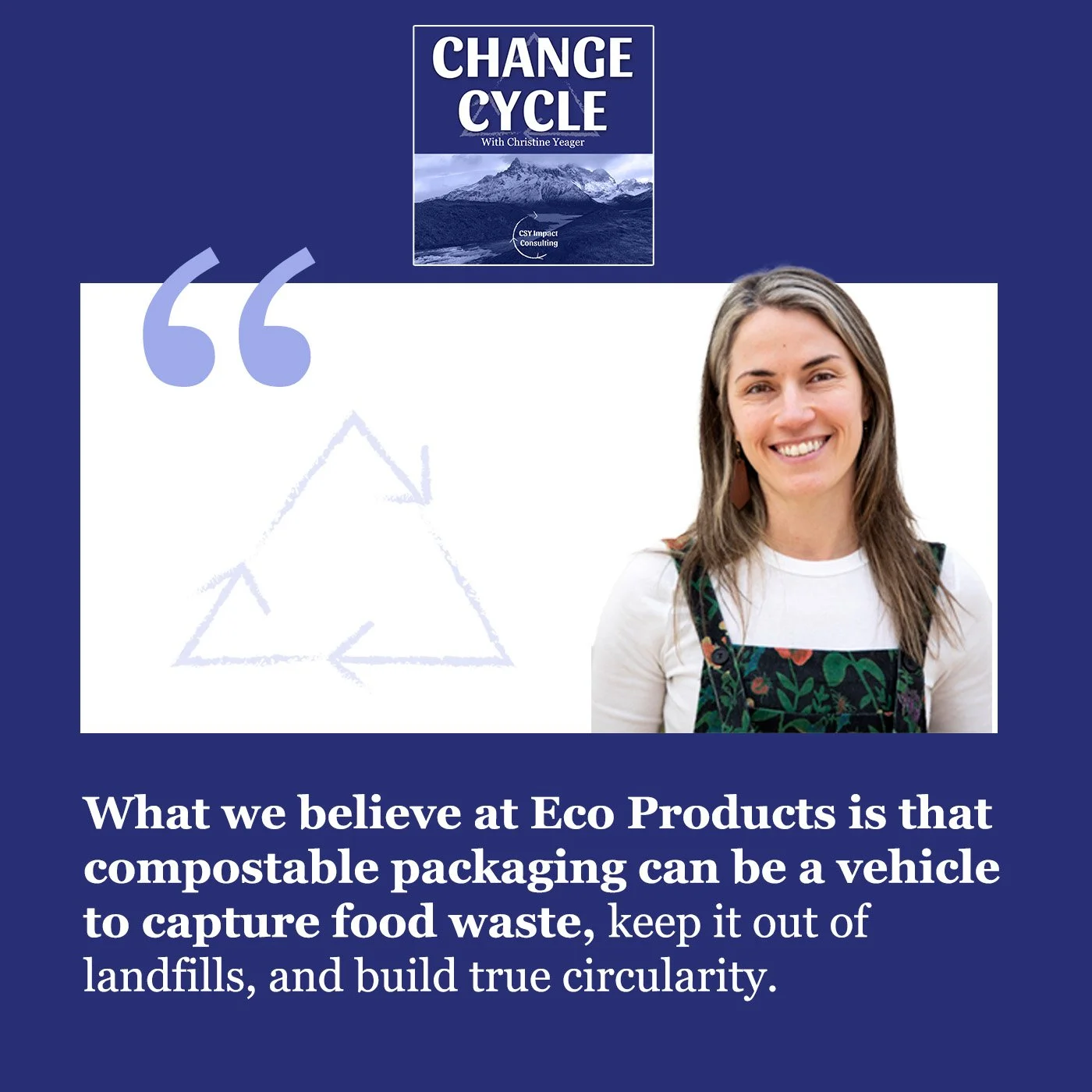
Also, working with and making sure it works in compost systems because compostable packaging, like the front-of-house, post-consumer stream, is nasty. It's gross. There's a lot of food. There's a lot of wasted food because people either over-served themselves or they got over-served. They just were not feeling it. It was not that good to them, or they're at an event, and they're like, "I'll try a bite of that. I'll try a bite of this." They just get full. Again, I come from the food service world. I have seen whole sandwiches being thrown away, and just like, what we believe at Eco Products is that compostable packaging can be a vehicle to capture that food.
That is the most important part. That's what composters want. They want the food. Food makes such amazing compost. If it is not going to be fed to other humans, which is also really important, and if it is not going to be fed to animals, which is tricky. I have seen some animal collection things that I'm like, "You're putting pork in that bucket that is going to the pigs," which makes me very uncomfortable.
Also, if you have done it right, that's a great use of wasted food, but otherwise, composting is an amazing opportunity to turn those resources back into an amazing soil amendment. Keep it out of the landfill. I really do think compostable packaging can help make that circular, that system circular. Especially, like I said, a lot of food service packaging just is not readily recyclable. The end markets do not really want it. The end markets still do not know if they want berry containers. Those are PET, but they're weird-shaped, and you could put them in. You should not.
Sometimes you cannot, and sometimes you can.
It's like, are they really wanting a clamshell that's greasy and full of chicken bones? Are they really wanting a utensil? They're not. There's a place for it. Again, that's where Eco Products. We have five people around the country who work with composters and haulers. Again, I do not want anyone, especially composters, to feel like they're being overburdened by this material, this feedstock that's just stressing them out. They do not know if it's actually going to work. Is it going to break apart into a bunch of microplastics because it's not actually compostable, etc.
Working with the composter to understand what they accept and then going back upstream to the generator level to be like, "Generator, stadium, arena, coffee shop, restaurant, events, whatever, museum, you want to have this program. Let's make sure everything is either reusable or accepted by your composter, and then you can go from there." Again, you need to have those checks and balances. You cannot. It's not a one-and-done situation. You have to train your staff regularly. You have to train your employees and your guests. You need to have really good signage. I'm a big fan of, like, the shadow box.
I like to call it the shadow box, but like you've seen those, it's like a little box of the window, and it actually has the specific product in there. It's like, "This is in my hand." That's blurry. "This is in my hand. This goes here." Above the bin, I love that. That's like what I recommend to everybody. Also, you need to have, again, some checks after because someone's going to throw in a wrapper, gum. Gum's hard to remove, but like someone's going to throw in a plastic bottle or diaper. You have got to check it, which is hard for businesses. I've seen it work. We see it work all the time, and it is happening around the country, even though it's a lot harder than the landfill and just throwing it all into the one bin.
Zero-waste mandates only work when local systems create closed-loop buyback programs for finished compost.
You said you’ve seen it work a lot of times when sustainability professionals are trying to convince someone of something. What are some things that you've used to convince the hauler or the compost manufacturer that Eco Products can be taken or that you will handle it? Is there a way to handle the contamination or whatever the point may be?
Proving Product Breakdown With Real-World Field Data
I work a lot with composters. I've actually helped conduct field tests at multiple sites, both with our products and also this third-party baseline of products. There's a whole organization called the Compostable Field Test Program. It's under the Compost Research and Education Foundation, which is CREF. The CFTP, the Compostable Field Test Program, they have an open-source database of field testing information, and showing what their ultimate goal is, to say like, "If your compost facility, type in your parameters, like what's your moisture content? What's your time for active composting?”
“What are your other feedstocks, etc.? What temperatures are you reaching?" You could punch that in, and it'll say, a PLA cup will, that PLA will do a great system. Molded fiber will take a little bit more time, which is typically what happens. Molded fiber takes longer. PLA and bioplastics, again, certified compostable, are typically the fastest to break down, which surprises a lot of people. If you think of it, molded fiber is a lot more like carbon. I always forget this word. It's like lignin, but it is more of a carbon material. It's pulp. It's a starchy pulp that has been dried.
There's no glue. Starch. The fibers of the paper themselves act like a glue.
They're sticky. It holds together. It's like paper and, honestly, paper. Paper and fiber take longer in most compost facilities, and if you think of it like compost, you have wood, wood chips, and wood things. At the end of the compost process, there's always woody over because thermophilic bacteria break down the food and other nitrogen much faster. Mesophilic bacteria are typically present. I told you, I love compost. I like to marry it out on the compost. In the cure phase, when compost starts to cool off, the thermophilic bacteria, which is the reason why compost gets so hot, are their activity that makes the compost hot.
They start to die off, and then mesophilic bacteria start to proliferate. That is actually what starts to eat the carbon material. If you are a compost facility that has a lot of time and you are able to let your compost cure, you are going to actually like those woody overs. Without me, there would not be overs because they all are together in the pile. That woody material will start to get smaller and smaller. There is fungal growth on the wood, which is great. Everybody wants fungal growth.
Compost facilities. Everybody wants the fungus. The fungus is fungus. That is the chef's kiss. That is what makes the world go around. Not every compost facility has the time or the ability to hold their compost, which again is part of the problem. The molded fiber in the paper, you might still find bits in that cure phase, but if you give it enough time, I am digressing. What was the question that I have?
The question was like, how do you convince people? Your answer was that you show them.
The data and science, field testing if they want to. I will help them. I will physically help you because I think that I am not trying to ask you to do a lot of extra work without me. I will help you. On the operator side, there is a lot of convincing. For you big CEOs and leaders of businesses, it is dollars and cents. Sustainability can cost more money. There are a lot of reasons. It can. The true cost of throwing all of our precious resources into a tomb and packing it in and just growing a mountain of trash. The true cost of that is enormous and going to cost future generations, who knows how much.
Your businessman, businesswoman, you do not necessarily have to justify some of that. We always try to help with the right size of the bin. If you can lower your trash bin, reduce it if there is no food in it. It is not going to be nearly as stinky. It does not necessarily need to be picked up as often. You might even be able to get a smaller bin. There can be some, at least, like cost sharing, I would say, because then you are going to find any savings there. If you are not already composting, starting a compost program, it will cost money, and it should. It is a service.
I do find some businesses that are like, "Why should I be paying for that?" It is literally a service, and you already pay for trash. What I also think is helpful on the flip side is that a lot of times people have to ease in. Adding things, each line item to the budget. It might take a couple cycles. Especially if you're switching from single-use plastics, which are subsidized and are cheap. They are cheaper. They are subsidized by the oil and gas industry as one.
Compostable packaging is still more expensive, although I think there is more of a cost parity than ever before. If you're not already composting, add that line item of service. I do find some businesses who want to make a difference. They want to do better. There has to be some of that intrinsic goal, because otherwise it is hard to justify the cost difference and the work in sorting and making sure. You're sourcing the right things. They just find success slowly building it into the budget as each year goes by.
Do you ever see people want to buy the end product?
Yes, although we need a lot more of that. That was actually one of A1's biggest problems is they had this influx of all these municipalities that had zero-waste programs and wanted residential composting, wanted commercial composting. It was all going to A1 because A1 was literally like almost the only game in town. At that time in 2022, we did not have other compost facilities that were really at scale. A1 is just being given all of this material that they're expected to process that is full of contamination.
The municipalities. It's expensive. A1's far away. Compost is so heavy, organics are heavy, and the finished compost is heavy. You cannot go too far without it being really expensive for transportation. A1 has this finished compost that has got a little bit of glass in it. It has got some film plastic in it. They're doing their best, but it was contaminated, and none of the municipalities wanted to buy it back. Honestly, if that had changed and more businesses, more places, just bought it back and used it, DOT, roadside projects. There are places where we could put minimally contaminated compost with less issue.
I wonder if A1 would not have made a big change in 2023. They were full. They were maxed out. I do see some businesses buying compost back, but I think we need more. That's the true circularity is like, "We generated this material and we had this amazing support in our community of a composter that turned it into black gold, but now we're going to put it on our landscaping or we're going to do a, we're going to buy a truckload and have our employees come with buckets and everybody gets to take compost home or, etc." I would love to see more of that.
That's great. What assumptions or things do you think that a lot of people assume or think about the circular economy that we should probably abandon?
The whole silver bullet thing, which I think there are probably a lot of sustainability professionals that know that it's not just one answer, but I think society wants there to be one answer. Especially in the United States, it's like, "There's a pill for that. There's a shot for that." We need everybody on board. We need small change, big change, top-down, bottom-up. You and me individuals, we are like a little scratch in the whole bucket, but our decisions do fill out to others. Obviously, and I'm sure you get this a lot too, like I'm very passionate about composting.
I do have a lot of friends that are like, "I'm sorry, I threw this away in the trash." It's like, I am not judging people. I am not coming in and being like, "You do not compost. What is going on?" I have multiple people in my life that have come back to me and said, "I started composting." It's like walking and living with your intention and doing the best you can, demanding change from businesses and expectations. You vote with your dollar, and the businesses that are showing me that they are trying. They are taking steps in the right direction.
Certified compostable packaging acts as a vehicle to capture food waste and keep organic material out of landfills.
I will go there before I go to a place that does not show me that. It's like the one solution will fix everything. The other thing that needs to die is this whole all-or-nothing mentality. I like to say I used to work at a university dining program, and I did a ton of education and outreach. Just like sustainable living, I realized, like myself included, like in college, there are so many vegetarians. Everybody's a vegetarian at some point, like maybe vegan. As people get older, they might change. They start eating meat, they start eating animal products, and then they're not vegetarian.
They're not vegan. Again, some of my friends, I've seen this where it's like they used to be so die-hard. "Do not eat meat," and then now they're eating, getting their meat from Walmart and getting it as cheap as possible. That's a whole other story. Everyone does have a budget, but I think there are ways to live with intention where you're maybe vegetarian a couple of days a week. Maybe you're vegan one day a week. Maybe you only eat meat on the weekends. There are ways to make sure you feel good and eat well.
I will just add, because I am actually very passionate about the meat thing, which is higher-quality meat that is grass-fed, grass-finished. There are better certifications out there than others. There is some research to be done there. If you can aim to, when you eat meat, try for higher-quality meat, grass-fed, grass-finished beef, type thing, like pasture-raised.
Moving Away From All-or-Nothing Systemic Thinking
It's more expensive, but then if you're able to balance that with a vegetarian diet on other days where legumes and grains and vegetables are not as expensive, that's a way to blend it, or even blending, like make meatloaf with again, high-quality beef and mix it with mushrooms, and mix it with mushrooms and grains or whatever. We need to break off this all-or-nothing approach that is like, "I'm this, or I'm that." No, you can actually be in the middle, and that's okay.
We decided to cut back on meat and actually eat grass-fed. I did not know to look for grass-finished, but nonetheless it's generally supposed to be less inflammatory. If you have health issues and you're eating this higher-quality meat or bison, like I have a friend who does not eat meat very often, but when she does, she eats bison because of the anti-inflammatory properties, and it is not as hard on her heart and things like that.
I agree that it does not have to be all or nothing. Sometimes, we do. We would like to bring our recycling back from the mountains. I know we can stop at the dump, but we just usually do not have time, so we just bring it back. When I'm traveling, I cannot always do that because I've flown there. It's like I have to be okay with it. I do not have to go spend a couple hours on my vacation looking for a place to drop my recycling.
I know. It is so hard for me. I have had my friends make fun of me like we were in Tahoe once and I was living in North Carolina at the time and they're like, like ten women were like, "You love food and we love lots of vegetables. We just had all of this compost," and they're like, "Are these organics?" and they're like, "Are you going to fly home with this?" I was like, "Oh my gosh." Another trip I actually found. We were in Wisconsin at my friend's lake house, and I found the pilot project in Chicago, and I had time.
I had an extra day in Chicago, and I found, and I convinced a woman to let me put a box full of organics into her bucket. It was a pilot project. I did not quite realize what was going on. I was like, "I do not want to skew the research," because it was like they were trying to figure out, like, "Can we make this viable?" She looked at me, and she was like, "Is there any contamination?" I was like, "No." We literally opened each salad container and each Ziploc bag, whatever we put it in. I was like, "I hope my girlfriends did a good job." Sure enough, there was not a single PLU sticker. There was nothing. It was all perfect. She's like, "You can go in the bucket." I feel you, but I will actually.
It’s good.
Once you know, it's really hard to unknow. I want to know, but it's like if I have to throw organic food in the landfill, it just hurts.
That is so funny. I do also have people that side-eye me. They're like, "Are you judging me because I'm recycling wrong or whatever?" I'm like, "No, I'm not judging you. I know it's confusing." I also have people who would like to come to me with sustainability questions that are totally outside of my area of expertise. I'm like, "I don't know, let's go find out."
That's a great question. I'd love to learn more.
I'd love to go down that rabbit hole.
I know. Honestly, I know just enough about energy to be dangerous, but that is a whole other world that I would love to get more into. I do listen to some podcasts like new battery design and new storage. I'm like, “That's a whole other world where I'd love to pick someone's brain and learn more from them.”
You just gave me an idea. I do live down the street from NRL. I should see if I can take a tour.
There are so many smart people and passionate people and stuff like this show where we're trying to get information out there. Let's inspire each other and just choose your lane. Choose your lane. We do not have to be an expert in everything, but find something that you're passionate about and become an expert in that. Let all these inventions and inventors do their thing.
What is some practical advice that you'd give to somebody leading change in this space?
It's actually really good to be uncomfortable and push yourself. Women, especially, we tend to only apply to jobs that we are so amazingly qualified for. Men do that too, but women do it to a much higher degree. Trust yourself, trust your gut. You'll figure it out. There are so many things I've done over my career that I did not actually know what to do. The day before, I was researching and learning quickly. It's good to be uncomfortable when you're pushing your limits and pushing your boundaries.
I just envision it as expanding your foundational knowledge and who you are. It can be beautiful. It can be scary. I also just love the unknown. I did not know I would be in this job and doing this line of work. I luckily did not give up on trying to do something within sustainability. I did not make a lot of money for many years. I was just hustling and trying to make it work. I just kept gathering knowledge and gathering experience and learning from other people and learning from situations. Leaping into the unknown a few times, which was scary, but it really worked out.
I love that. You said hustle. I am in this book club, a leadership book club where we read leadership books, obviously. We're reading Hustle Harder, Hustle Smarter by 50 Cent. He talks a lot about this idea of you cannot just hustle smarter. You have to hustle hard and smart. You have to work hard. I'm very early in the book, but nice. You're living like 50 Cent.
That resonates with me. I love that. I know there are so many years where I was like, "I am tired. I am hustling so hard," but it is working smarter. It's like, how do you find ways to not do everything hard?
This was so great. I'm just going to rehash a couple of the great points you brought up and make sure people walk away with. I feel like we got some good nuggets from this great conversation. First of all, love the reminder to stop and literally smell the roses. We are often moving so quickly. I am feeling that very much right now. Just like trying to be still for a minute and notice the beauty around us, it is so important. You shared with us this idea of taking composting for granted.
When I saw that stat about compostable being one of the top consumer packaged goods, like labels that people are willing to pick up, I think it resonates with that same concept that people love composting so much, and they do understand it conceptually, similarly to how they understand recycling. I do think they take it for granted. They just think that they just pick up the cup or the paper or whatever that's compostable, that that's enough. Understanding what your system can process, just like with recycling, becomes really important.
Buy back your compost. Wherever your organics are going, go buy a bag. Get a truck, get a bucket, order a yard, whatever it can be.
Create the demand. Also see the fruits of your labor. Also loved the conversation around labeling it well and that you called out that not just the ownership is on consumers or municipalities, but it's really on the whole chain that everyone needs to align on what to label and clear up the confusion at the bin. That comes with multiple layers. It has to be different in different places.
Hopefully, we can get to a more consistent place as things change. I know EPR is not necessarily going to give us that, but it hopefully will send us in a good direction. Also, love the reminder that reuse first, but then if it has to be disposable, ideally, it would be compostable. That includes training your staff, training your employees, signage, and that everybody wants fungal growth. It's going to be my new.
If there's one thing you take away from this whole conversation is rules.
Fungus rules. I like that. Also good reminder that it does not have to be all or nothing. Although now I want to grow fungus in my yard because I have this tree that keeps popping up and I'm like, "Maybe if I could get a fungus to eat it, that would be great." To stay in your lane, which is such a good reminder. Some people, one of the reasons I started this show is because I think a lot of people get intimidated by all of the different topics that come up in sustainability. I wanted to make it a little more approachable, knowing that my focus is obviously circular economy, but the more I can learn from others, the more I do not have to move into their lane. I can learn about the things that are interesting and then become an expert in my area. Thank you.
I love that.
It was a great conversation. Thank you for your time.
Thanks for having me. Great to see you.
Important Links
About Meghan Ibach
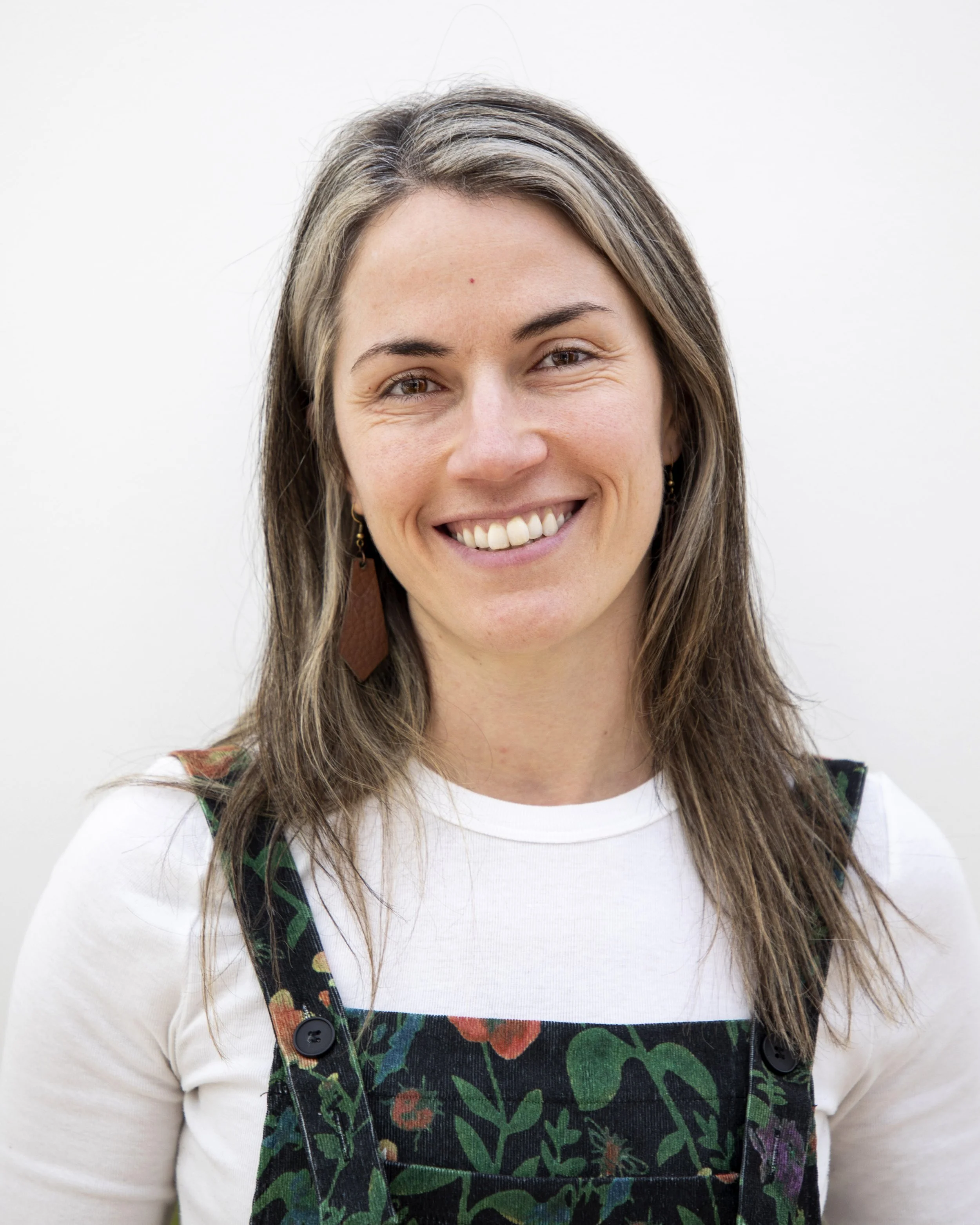
Meghan is the Product & Zero Waste Specialist for Eco-Products, covering the Rockies, Pacific Northwest and parts of the Southwest. She helps businesses build circular systems that include certified compostable packaging and reusable takeout containers. She supports compost manufacturers and haulers in ensuring contamination from non-compostable materials are removed upstream from the organics stream. She loves the complexities of our waste system and what it takes to go from linear to circular, and has many years of experience at each point in the supply chain.