

How Waste Processing Drives Circular Economy Scale With Brandon Lapsys
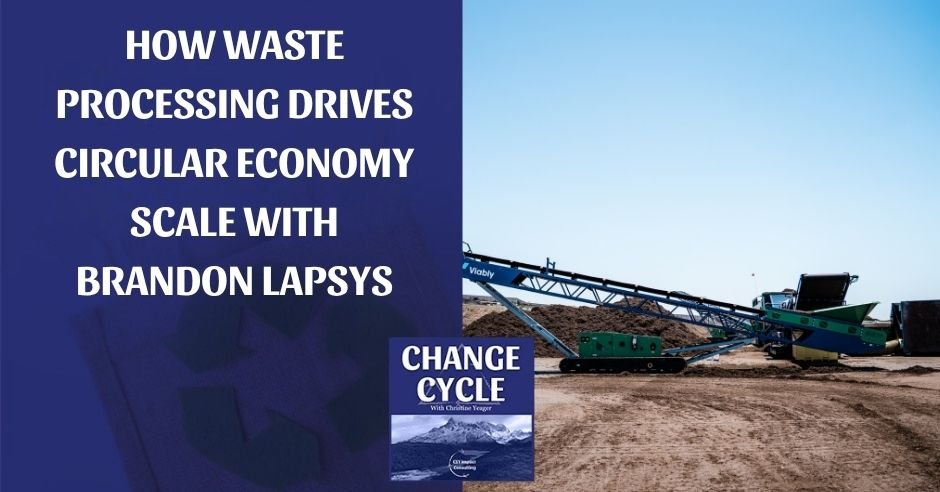
Scaling circular economy operations requires turning sustainability strategies into capital expenditures that businesses can actually execute. Host Christine Yeager connects with Brandon Lapsys, CEO of Viably, to unpack what it takes to drive real change in the waste and recycling industry. From investing in talent during economic uncertainty to navigating permitting delays, building sustainable momentum demands focus and discipline. They break down the friction points in establishing responsible end markets for recyclables across North America. Brandon provided practical advice for leading change, including focusing on a few key initiatives at a time, making decisions without trying to please everyone, and staying anchored to the company's vision and mission. Discover how aligning policy, processing technology, and leadership strategy can transform operational friction into a competitive advantage.
---
Watch the episode here
Listen to the podcast here
How Waste Processing Drives Circular Economy Scale With Brandon Lapsys
I am interviewing Brandon Lapsys. He has helped build Viably from an equipment distributor into an integrated processing solution company, which means he sits at the exact point where sustainability strategy turns into a capital expenditure someone has to sign off on. His background spans municipal solid waste, organics, food waste, and these are all streams where recyclability is a function of what a specific facility can economically sort, not what a design guideline says. He is working with companies to really bring solutions to waste diversion challenges. In our discussion, we talk about how to lead through change, how to lead through helping companies change, and how to consider your employees as you are growing.
---
Thank you so much for being here, Brandon. I am super excited for this conversation. As always, I just like to start off with, how do you live with intention?
Focusing On Daily Wins To Build Long-Term Momentum
Thanks for having me, Christine. I am looking forward to being here. How do you live with intention? Try to do the right thing. I tell my team. I have used this phrase in many of our town halls. If you take care of the days and make each day a good day, all of a sudden you have a good week. If you take care of the weeks, you have a good month. Eventually you have had a good quarter. Before you know it, as fast as all of our lives move, the year is gone.
Take care of the days. Start with each day and just have some basic goals. Even if it is a simple to-do list of what you want to achieve each day and try to do it with your family in mind, your people in mind, the company you work in or work for, and the environment around you. It sounds very simple, and oftentimes people try and make it harder than it is.
It feels hard, I think sometimes. It is a really good reminder. Take care of the days. I love that. A lot of times I feel like I have not done enough in a day or in a week. Taking a moment to step back and recognize that is a great reminder. Thank you. Do you want to share a little bit about Viably and what you all do?
Viably is based in Denver, Colorado. We are predominantly a master distributor in the waste and recycling industry. We provide tailored solutions for our customers and clients, which range from small private companies to large public waste companies and municipal entities. We help folks in a number of different ways with different waste streams. We provide equipment for composting, equipment to be used in landfills, and transfer stations.
We can help you with a single waste stream and a problem on how to solve it, how to process it, sort it, and separate it. We can design a purpose-built waste treatment plant, for example, for construction and demolition waste. If you have a large volume of that waste stream and you want to know the best way to process it, recover all the recyclable commodities in that waste stream, and ultimately divert from landfill, we can help with that too. We are very active in the waste space across the US and Canada.
Big transformations happen one day at a time. Focus on taking care of today's goals to build long-term momentum.
Thanks for sharing. We did some prep work and, even though you just shared a lot about the waste stream, you started out talking about the importance of investing in people and that, especially when we are faced with an uncertain economy, talent can be the place to start to help avoid or improve that uncertainty. What does that investment actually look like when budgets are tight? How do you protect it when the pressure is on?
Protecting Talent Investment When Budgets Get Tight
It's easier said than done. We have grown here at Viably. We have had people come, people go. We try to make great hiring decisions. You do not always get it right. No one does. We talked a lot about this in our most recent quarterly meeting as a leadership team, and we just needed to spend more quality time with the people in our organization very early on because we are in a fast-moving world. Technology is constantly changing. The industry that we participate in is constantly changing. Really trying to do our best and bringing our folks along.
Helping them understand our business, why our customers do what they do, what it means when a customer's facility is not operating because we either cannot get them a part or we cannot provide them service fast enough. When you really focus on that early on and in the first year of someone's employment with us, the goal is to have long-term tenured folks. We also are very open to and invest a lot in continuing education. One of our core values is evolving, and I am a lifelong learner. I want all of the folks here to be lifelong learners, whether it's taking a free course offered by a supplier, a vendor, a customer, or something that is more regimented over a longer period of time.
We like to invest a healthy percentage of our dollars in developing our folks here. When you do that, you also create great recruits. Some of our best people here have come from employee networks in different walks of life and from different industries. What's special about the waste and recycling industry is once you get into it and you find your niche or you find your space within the industry, within the company you work for, it tends to suck you in for life. You have a lot of fun doing it. Trying to cultivate new young people to come into this industry is also a focus of ours. I do not think the war for talent or talent scarcity will get any easier in the future.
It's true. It does suck you in. Once you start talking about recycling, I always say it gets nerdy quick.
It does, yeah.
When you launched Viably, you said that in some cases you had to keep the fire stoked constantly. Can you walk me through what that looked like on the hardest day? In sustainability and circular economy, a lot of times it can feel like it is hard to move forward, and being able to focus on what's driving you, what the passion is, is a real skill I think you have to develop in this space.

We launched Viably. It will be three years this September. We had a number of great legacy employees that operated under our prior flag and brand. It is a huge shift and change to operate under a different brand and different colors. The whole idea was to operate under a different way of thinking, to become a larger solution provider for the industry, find different brands and partners to represent, and bring more to our customers.
Building a brand and building a DNA and a culture within that brand takes years. It is not something you do in one year or two years or three years. I would say we have even done an okay job. We could have done and can do a better job of continuing to build our brand awareness and our DNA and ultimately what we're doing in the industry to be that solution provider that helps folks further their circular goals within their business or contribute to their piece of the circular economy. I guess I'll end there. I do not know if that answer landed well or fell flat.
No, think when you're building a culture, what was the hardest part of building a new culture in this space, and what do you think has resonated with your employees?
Treating Organizational Culture As An Ongoing Practice
Culture is something you have to work on every day. What I have shared with my folks for a number of years is that it is a journey with no destination, and it is a sword that you have to constantly keep sharp. I like to give the samurai reference. A samurai is only as good as their sword. If their sword is not sharp, they are not going to be very effective. Our brand and our company can only be effective if we constantly build on and work on our culture. Not all days are easy because when you're dealing with people and personalities and trying to constantly introduce change that you think is better for the organization, better for your customers, better for the environment, it's hard work to get people to go on that journey with you.
Culture isn't a destination you reach. It's a daily practice that keeps your organization sharp and ready for change.
I have noticed a lot of people love recycling. A lot of people do not trust recycling, do not trust that things are going to go where they should go. It can be hard to get them to participate. They're like, "I like the idea of it. I used to feel really good about it, but now I learned that," whatever fact they learned. That derailed them, and now they're not interested. Do you find that, and have you addressed that in your work?
You're a hundred percent right, Christine. A lot of people are skeptical of what happens to the stuff that goes to the curb. I put my garbage can out on Sunday night. That's one of the things we're trying to do. Just in my early time spent with employees here in their first three to six months, just educate them more broadly that recycling is a good thing. This is what happens to it when it leaves your curb. Here are the challenges along the way.
Rebuilding Public Trust In Recycling Systems
Here are the markets that exist and can be further developed for recycled content. A big opportunity to continue to improve is to start with young kids as early as elementary school. Why do we recycle? What is recycling? What are materials around you every day that you can recycle? There are a lot of adults that are my age or older generations that do not really have any thought other than, "I just need to put my garbage out every week or my recyclables out every week, and it's leaving, and magic happens." There's so much more that goes into it.
Especially the end market. That's one of the things that extended producer responsibility is trying to create. A push towards responsible end markets. You shared that that can be a core friction in the circular economy. Where do you think that the biggest gap is in markets? Where do you think change needs to happen?
Aligning Policy With Processing Reality
You can build the fanciest, most advanced recycling plant in the world, but if the end markets do not exist, what's the point of trying to take the commodities that are recycled out of the waste stream? A big friction point for the industry is that there's not great alignment sometimes, or oftentimes even today, with policy versus processing versus solution providers like ourselves.

You can have a policy, but you also have to give a good opportunity for haulers or waste processors that are looking for the latest technology to recover more and recycle more, an opportunity to put those recyclables back into the market. There are also lots of competing interests, whether it's alternative energy competing with clean biomass that exists more prevalently in certain geographic regions of the US. There are lots of examples. Again, lack of understanding.
There are great end markets here in the United States. We also have to be committed to leveraging those end markets, even if it costs us a little more, as opposed to, "I can send a certain part of my waste stream offshore." Getting policy and producers and recyclers all aligned on keeping finished products here in the US and continuing to develop robust end markets, I think, will further the circular economy's goals and keep more out of landfill. It is going to have to happen because there's going to be less and less landfills in the next 10 to 20 years. The waste will have to get processed.
Any examples of how you've been able to find new and innovative end markets in the United States?
There are constantly customers that we work with looking for new end markets, whether it's different biomass markets in the construction and demolition waste stream. We have a customer that recycles windmill blades, which is a huge problem. There are not a lot of end markets. He developed a new structural product for that waste stream. When you put people together and you start to collaborate on different ideas of where materials can be used or reused and not necessarily let policy or red tape get in the way of that, you can open up more and more potential markets for materials.
It comes back to a bit of science, a bit of data, not anchoring to "This is how we've done it for so long," or, "Here is the law and legislation or the policy or the procedure that was put in place so many years ago." We have to be open to trying new things, even if it means rewriting policy or procedure, or it's a new bill in the House or Senate or wherever you live.
I was surprised to hear that sometimes the things that are blocking advancement in this space are just like, almost like you need to create a policy that just allows permission to do things. It just makes it no longer allowed to do something in order to open the door for a whole new way of processing, maybe compost or something like that. Sometimes these barriers are very minor, and people do not even know that they're part of their city ordinances or what have you.
Overcoming Permitting Bottlenecks In Recycling Infrastructure
You're a hundred percent right. There are a lot of barriers that exist because something was written into law decades ago, and people cannot take the next step forward, and they see a path to getting where they think they can be with increased recycling rate, diversion from landfill, a better finished product. A big challenge right now in our industry, and has been for years, is the length of time it takes to get a permit. On one hand, you may have a government authority that wants to see their constituents hit a certain recycling target, but they make it impossible to get there if it takes years to get a permit to build a facility to process the waste to hit the recycling target.
Advanced recycling tech means nothing without robust end markets. Policy and processing must align to close the loop.
It makes me think of Georgia. I used to live in Georgia. I now live in Colorado. In Georgia, there’s a big shift in the homebrew beer industry. They started advocating for changes just to make it more available to actually brew beer at home. That became a bigger market now. In Georgia, you see a lot more smaller beer operations like craft beers. There was also this challenge where you were not allowed to sell food. I do not know.
There are some weird things about, like, just structural things that just limited growth in an industry that the industry then banded together to make a change so that the industry could grow. You are seeing that come to life in Colorado as well. There is a lot of industry involvement in making a change to some of these seemingly unimportant structural barriers that become crippling. Who would have thought that the permit length of time would be the challenge that makes it impossible to overcome?
I agree. I think you are seeing more advocacy groups. You're seeing more trade associations on behalf of their members, and the industry is starting to really do more. I am encouraged that with some fresh perspective and some younger generations and some new blood coming into this industry, but also coming into government that helps put the policy and procedure in place, you're getting people to think differently and think beyond what was done in the past. Hopefully that means good things for recycling and increased recycling rates in the future.
In the sustainability world and circular economy world, there are sometimes people that you come into contact with, and it is, you have to change their mind. In our prep session, you shared that you try not to fight internal resistance, but there are changes that you're driving, right? You're redirecting waste from where it was going before to a viable end market. Can you share some examples of, or just some guidance or advice on how you change people's minds? What data points do you use to move a skeptical person, either a person in the supply chain or a customer or what have you?
It starts with data. It starts with opening their eyes, and a specific case study that comes to mind is we worked with a customer who bought a pretty advanced C&D plant. It helped that he saw the future of landfills shrinking or going away and the airspace that he had becoming more and more valuable. He started really thinking about the end markets and exploring where he could find homes for that material, and combining our expertise and processing and helping that individual think through what is the plant or series of equipment.
I can put in a plant and work together to ultimately achieve the goal of diverting from landfill, creating commodity ABC that can potentially go into either established end markets or some of the end markets that he has actually developed because he was able to invest in the recycling infrastructure and show the regional players. These are the commodities that I can create with my recycling plant.
Are you interested in talking more about using my commodity or combining it with a different commodity to make a new product, which is also being done by this customer and other customers of ours? As far as internal change, there are always folks that do not like change. You just have to continue to anchor to the vision and mission and why we're doing what we're doing and spend time listening to people's concerns or resistance and working through it.
Has there been any specific data point that you think is most successful at changing minds? I know that at Coke, if you wanted to change anybody's mind, you needed to use consumer insights. What people were always after?
Consumer insights are always helpful. At the end of the day, I have told our folk here for a long time, I do not write your paycheck. I do not write my paycheck. Our customers do. If we're not listening to our customers and their needs and responding and acting accordingly, then why are we a company and why are we trying to do viable things as viably in the marketplace? We have to listen to what our customers need and then try to do our best to adapt to and support their needs.
This is all very helpful advice for people leading change in the sustainability space. Maybe could you just give, like we try to bring into the show, practical advice and tips. If you had just narrowed it down to like three or so practical tips for someone stepping into or leading uncomfortable change, what would it be?
Leading Strategic Change Without Trying To Please Everyone
Number one is you're never going to make everyone happy. You can make a decision where 50% of people agree or disagree, and then 50% of the people may care or not care. You're always going to have someone unhappy. You cannot be stuck on, "I have to please everyone and make everyone happy." You have to get insight from your customers, your colleagues, your suppliers, your vendors, all the stakeholders, and make the best decision and try to implement it or run with it.
Also know that you're going to make mistakes and learn from those mistakes. Pivoting and changing as you need to would definitely be one tip. Second tip would be, and I have learned this, and we've learned this. Focus on a few things, try and do them well, and then go to the next view. Even with us internally here at Viably, sometimes we have great ideas. We can ideate with the best of them. We then get lost.
We're trying to implement too much change at once, trying to do too many things at once. Boiling it back down to one or two or three things, whether it's a quarter or an annual initiative, etc., and trying to be disciplined. That is also harder and harder to do in today's fast-paced world and change, because, like I said earlier, listening to our customers. What do they need? If we're constantly having to adapt for their needs, it creates internal turmoil and internal shame that we have to constantly evaluate. How do we achieve it to stay relevant and hopefully be on the leading edge of what we're doing?
That is one of the hardest things because it can feel sometimes like we do not have enough time. We need to be moving faster. Yet if you're trying to do too much, then you do not achieve anything. You're like, "I cannot make any progress because I am not, I am too, I am spread too thin." That gets back to, I think, the point you were making earlier about understanding the vision and the mission so that you can at least know you're moving that thing forward so you do not lose the passion and the drive and get burnt out.
You can't please everyone when driving change. Focus on two or three high-impact initiatives and execute them well.
Change is tough, and running a business in 2026 is not easy. There's uncertainty in the world, there's constant change in the world, and that leads to a certain level of challenge when you're trying to implement your own change against change that's unwanted or unwarranted and out of your control.
I am just going to say back a couple of things that I think you shared that were really valuable. One is I love this idea of breaking it down to take care of the days as this building block. If you focus on one day at a time, be in the moment, it can help make sure the rest of the year is better. If you're not too overwhelmed by all of the things you're trying to do, but you're just focused on making a great day. My kids wake up in a bad mood. I play Good Day by Nappy Roots to reframe.
That's an old song by an old group.
Yes, I know.
I'll steal that tip because I have young children too, and children can get moody. They really can.
You also shared about fostering this sense of education. I do think about sustainability and the circular economy, and all of this work does come with it. I like to say it comes with a lot of homework because things are changing constantly and there is so much information out there to absorb. There are so many trade-offs in the sustainability and circular economy space to navigate. It is a great reminder to foster this idea around education and how you're using that to develop talent. Also, a reminder around US end markets.
There are a lot of end markets out there that are being developed not in the US, and EPR is trying to fund more investment in the United States to drive an end market. The key thing I think that you brought up is that it is going to require a lot of collaboration. If your company is interested in looking for ways to divert, you might have to come up with your own end market and/or collaborate with others that are working on something, and then redirect and make that viable for your waste stream. The waste industry, as you shared, can be a very welcoming space.
The recycling and waste industry can be a very welcoming place, and you get excited and like nerdy about it really fast. It can also be hard to collaborate because you're dealing with every state that has its own requirements. Every municipality has its own requirements, and it can feel difficult to navigate all of this nuance. It is great to hear examples of collaboration coming together and finding new pathways. We talked about just that example of the permit length. There are so many of these little examples of little things crippling progress in the recycling industry.
The idea of being focused on what's locally the challenge and trying to make change where you can. You cannot make everyone happy, which is very true all the time. You really cannot. I'm learning that more and more every day. It's a good reminder. Something that I struggle with is being focused and disciplined, and how powerful that can be in helping make progress and then celebrating that progress as you're going along. That was a lot of great insights. Thank you.
You bet. Thanks for the recap. It's a good industry to be in. If you do some good every day and get your people focused on doing some good every day and why we're doing it, the industry will hopefully be a little better every day. We'll see people recycle more, learn more. You have got to want to be curious if you're in this industry. You have got to know why recycling happens and how it happens, and whether there is a better way to do something. It really does not matter what role you have in the industry because every company has people at all levels and in so many different roles and job titles that are necessary to make the engine that is the industry go.
Somebody once said they're hoping that eventually it's just how you do business, and eventually, like you create enough of a circular economy that our jobs do not need to exist anymore because it's baked into the business. That's, think, the hope is that it becomes just a license to operate. It comes from the willingness to divert your waste from the landfill.
Continue to educate people and hopefully naturally create more muscle memory and just societal normality in terms of, “I’m going to find the bin and put the bottle or the hand, or I’m just going to jump in the trashcan. I’m going to seek out an alternative.”
What you guys are doing is like working to divert because we need it at a macro scale. It needs to be the way that everything has a path out of landfill and that it's not just on the person throwing it away, that it's on the way you operate.
Habits have to be created in the entire value chain, not just by one stakeholder, but by all. Yeah, definitely.
Thank you. It was a great conversation.
It was great to chat with you, Christine. Thanks for having me on, and best of luck with the show.
Thank you.
Important Links
About Brandon Lapsys

Experienced executive leader in the waste and recycling industry with extensive knowledge of C&D, MSW, organics, and food waste processing systems.
• Has played a key role in the growth and evolution of Viably from mobile equipment distribution to integrated processing system solutions across North America.
• Strong background in sales, operations, strategic planning, and customer solution development for waste processing facilities.
• Experienced in the design, implementation, and support of turnkey recycling and waste processing solutions.
• Active industry leader and long-standing member of the Construction & Demolition Recycling Association (CDRA), serving in multiple leadership and committee roles.
• Recognized industry contributor, including receiving CDRA’s C&D Member of the Year Award (2020) and President’s Award (2024).