

Scaling Circular Fashion With AI Data And Smart Logistics With Phoebe Tan

Host Christine Yeager connects with Phoebe Tan, Founder and COO of Taelor, to break down how AI and circular fashion are transforming apparel economics. Most rental and resale models fail because reverse logistics and cleaning costs destroy profitability. By leveraging AI styling and tracking garment lifecycle signals, Phoebe built a system where customers only buy what they love while generating rich post-purchase data. You'll learn how Gen Z's shift toward secondhand markets is accelerating double-digit growth for rental models. Discover how continuous operational improvement and data transparency create long-term enterprise value in circular business systems.
---
Watch the episode here
Listen to the podcast here
Scaling Circular Fashion With AI Data And Smart Logistics With Phoebe Tan
Welcome back to the show. In this conversation, I interview the founder of Taelor. Phoebe Tan runs the operations behind an AI-powered men's clothing subscription and rental service, applying fifteen years across category management, supply chain, operations strategy, and finance to a category most people still treat as disposable. In that combination, fashion fluency paired with a finance discipline puts her at the friction point the circular economy keeps avoiding.
Reuse only scales when the unit economics work, and most rentals and resale models have quietly failed. The Textile EPR is arriving in California and beyond. The uncomfortable truth is that a circular model built on logistics, cleaning, and reverse supply chain can burn more resources than it saves if the operators do not count them. Phoebe has built her company on the opposite premise, using the least resources to generate the biggest business impact.
She is doing this with the idea of gathering data as an asset alongside the physical assets of the clothing. She is here to show us how to pivot from selling more units to profiting from the same garment repeatedly and profiting off of the data and insights that you gather from a consumer who is reusing your product. I really enjoyed this conversation. I learned a lot. I hope you do too.
---
Thank you, Phoebe. I am so excited for this conversation. What you guys are doing is so innovative and exciting. I like to talk about how EPR sometimes stifles innovation. It is great to see what you guys are doing and to hear about the future. Before we dive into that, I want to hear. How do you live with intention?
Living With Intentionality And Minimalist Focus
Thank you so much for having me, Christine. That is a great question. That is so important, whether it's my personal or professional life. For me, it's pretty simple. You have to know where you're going before you start a journey. With intention, for me, it means yes, have a clear goal. Clear intention, goal. Where am I going? What am I trying to achieve? We all have finite energy and time, so I need to prioritize where I spend the most time and energy, because that will drive the most impact, whether it's a short-term or long-term goal.
I always live with that formula. The goal, impact, spend more time. It's pretty straightforward. It works for me, whether it's personal or professional life. As a founder, it's very easy to get tied up in every single issue that shows up, especially in operations. We talk about firefighting. That is having firefighting work, and it's great, but it is not sustainable. It's really important for me to focus on why, what drives the need, and what moves the need and what makes the biggest impact. It always works.
I like to know where you're going. Speaking of knowing where you're going, tell us more about Taelor and maybe a little bit about how you knew that this is where you wanted to go.
Driving uncomfortable change requires transparent communication, clear data signals, and celebrating small team victories along the way.
Thank you for that question because it's quite personal. I've been living a very minimal lifestyle. Everything that I own and everything that I have, whether it's my interior, my house, or personal belongings, I like to use until the end of its life. It gives me a lot of satisfaction. People who know me know that less is more. I like to live minimally, and everything that I have is very precious. With that, I have been using clothing rental services like Rent the Runway for decades, and the business model works perfectly for my lifestyle.
I can rent clothes, look fabulous all the time, wear different styles, and I do not have to own them. It also works out from a financial perspective because every single dress item that they have is like hundreds of dollars. It does not make sense for me to buy all the time. My co-founder and I met at Chicago Booth, where we got our MBA. This is like decades ago. A few years back, we decided to start our first venture together after being in a corporation for the past 15 or 16 years. We decided to explore the rental space. When we first started, we learned that this is definitely a growing space.
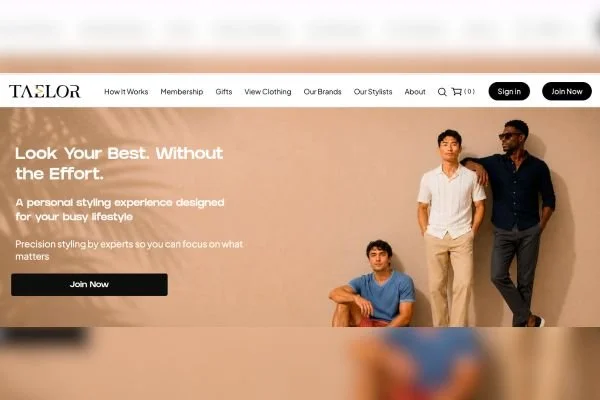
The circular economy, circular fashion, and the demand in the consumer demand and consumer behaviors are also changing, especially among Gen Z, and they want to buy. They also want to sell. We definitely see a channel in the fashion industry, the circular model, and that's when we realized this is a space that we want to explore. Why men? Actually, a lot of people ask why men? Two women tackling the men's workspace, simply because the problem that we want to solve is really to make looking great seamless, leveraging AI, leveraging the data. That is why we started Taelor.
Designing A Seamless AI Men's Rental Model
Taelor we are very similar to Rent the Runway in terms of operating model. The problem we are solving is very different. For women, we want to wear different clothes, different styles, and that is why rental works for us. For busy men, they want to look great. They do not know how. They hate shopping. They hate laundry. They come to us, and we style them. Taelor leverages AI technology, and we actually style customers. They do not have to shop. They just tell us what they're looking for and their occasion. We start them head to toe.
We send them multiple outfits a month. They wear the coats. Anything they love, they can keep, and they return the rest, and the whole process repeats. Meanwhile, we are gathering amazing, valuable customer feedback, which is also very important for us to feed the data back to the clothing brands to help them make better decisions. Design decisions, production decisions. We solve both sides of the market. The demand, the consumer side, and the supply and the clothing brand manufacturer sides, making the industry better.
Thank you for that overview. You talked about AI. It's the topic of, I wouldn't say the day, but of the times. In our prep, you talked about how the future of AI does not necessarily belong to whoever has the biggest model, but maybe whoever has the best proprietary data. You talked about the great data that you're generating through this unique model. What signals are you capturing today that you think will help insulate the growth of Taelor long-term?
Building A Proprietary Post-Purchase Data Moat
That's really important. That's a note from Taelor. If you think about the traditional retailers, they all have data. Big retailers like Target and Nordstrom have data about what customers buy. They have data about products that are best sellers, a lot of transactional sell-through product performance information, and that is it. The biggest challenge for that is it's really hard for them to know what happened after the customer purchased the products, and how many times they actually wore them. Are the clothes sitting in the closet?
After wearing it and washing it, are the products still in good condition? After purchasing, customer behavior they do not know that. They also do not know who their customers are. Truly, their age, how happy they are with the product, how they influence the brand or the product with their family and friends. With Taelor, because our user journey is so different because of the circular user journey, customers come to us. They experience new clothes, they experience used clothes, and they actually wear the clothes, and they give us feedback.
Circular Fashion Data: Gen Z views thrifting and renting as smart, value-driven choices, driving rental segment growth 9x faster than traditional retail.
First of all, we know who they are because they are members. We know what they do, we know what they do for work, we know where they live, we know how old they are, we know their body measurements, and we know what fits them best. We know what some of the fit issues are; shoulders are always too tight. We also know what they truly love, because they actually wear the clothes and how many times they wear them. The feedback they give us is that we often say it's unbiased because they love the product. They wear the product first. It's almost like they tried it on.
They love it so much that they want to buy it. For us, it's like zero returns. Because they buy it, there is no return for us. In typical e-commerce retailers, the return rate is super high. That's one of the issues. For us, there's no return because they only buy what they love. When they buy what they love, they tend to wear them more frequently, more often, and hopefully until the end of the product's life. We get our feedback not only when the products are brand new, but we also get feedback when the product has been rented one, second time, third time, 10th time.
We get our feedback through the product life cycle from the customer, the users. Internally, operationally, we obviously have to wash the product so we know the true quality of the product. That data and those signals are very telling for product development and product design perspectives. For example, we will know if certain fabrics perform better than others. That will help the brand and the manufacturers to know that this fabric works really well. Customers love it. It will help them to, for example, expand their product line using the same fabric. We really hear feedback from our vendors saying that this is very valuable data inside. They do not get it from typical e-com retail channels.
That's incredible. I've been noticing a lot of, like, when I do a return or even just like some of the reviews now on websites, it talks a lot more about body shape and how it fits or does not fit. It's only certain companies that are able to dip their toe into that level of information, to your point. I noticed a lot on Amazon that there are a lot more reasons why you're returning. They're trying to get a day.
I can always tell, because I am a data nerd, I often fill out all the surveys. You can tell that the industry is interested in richer information about past purchase data. Which is great. For most new businesses, they're really focused on driving up consumer or customer demand. In our prep session, you shared that that was not necessarily your biggest hurdle. Can you talk a little bit about what your biggest hurdle was, why, and what you learned from it?
That is something that we learned, especially when we first started. Of course, we look at the market and consumer behaviors, which I mentioned earlier. Consumer behaviors are changing. They behave very differently than the past generation. They're very value-driven. That's why you see more and more companies and marketplaces coming up. They allow them to trade, to buy and sell. They buy something that is in their mind. Can I resell it? There are a lot of resale marketplaces out there right now, which make it possible. That's the demand growth there, which is very clear right now.
The challenges for us are how do we create a sustainable and profitable circular model long-term, and with the demand continuing to grow? We learned that we have to continue to improve the operation, really focus on operational excellence, leveraging the technology, the AI, to help us to streamline the user experience, styling journey. As I mentioned earlier, that's really important. Think, compared to the traditional retail model, I really believe the new user experience is very different. The new user behaviors, they're looking for value. They're looking for a better user experience.
Optimizing Unit Economics In Circular Logistics
To be able to achieve that, I think how we model our business, the operation part, is super, super important. That's not only efficient and impactful in terms of user experience, but also profitable. We look at the unique economics. Focusing on driving operations is excellent every single step of the way, from picking the order to sending out the order to the customers. When they return, we have to deal with processing the return.
AI agents allow lean teams to streamline customer service and inventory workflows without sacrificing high-touch personalization.
We have to deal with washing the clothes. There are a lot of steps to make the circular model work and be successful every single time. That is why we continue to invest in the technology infrastructure, leveraging AI to help us to be more efficient, to be more precise in terms of crafting the right user journey, and the right user journey means he has, it's impactful, and the customer is happy. They stay with us. At the same time, it's profitable for our business.
That key aspect is profitable, right?
Exactly. That's super important for a scalable long-term business.
You're doing what the industry needs, is to design value around sustainability, circularity, and reduction of waste. Just curious. Do you all use reusable shipping containers?
We actually tried out different solutions. Our packaging, right now, we use a poly-bag. We tried out the reversible, reusable poly-bag. We sent it out. Customers can reuse it. We continue to experiment with different packaging options. One thing we learned. Customers actually do not like to get the cardboard packaging anymore because there's so much Amazon packaging. Everything is cardboard. They are like, "I do not want to have more empty boxes sitting in the house." They actually appreciate the soft packaging, the polybags. I think we continue to explore better options at the same time, maintaining the customer experience.
It's funny. My husband is constantly complaining about breaking down the boxes. Unfortunately, our house only has recycling every other week. One day that will change, but for now, it's always full. I get it. Thank you. The operational aspect of circularity is so big. I always think about being at a company like Coca-Cola. A lot of times you're sitting there strategizing about all of the things. The reality is it does not matter what it says on paper.
You have to actually go do it, see, and feel the barriers. I appreciate that. You did not come from a. I do not know. I did not mention it, but you generally came from a family that washed clothes. You have to get into this whole aspect of where do you get the washing machines? What kinds? How do you make it super optimized? You talked about economics. Maybe we can dive into that. How do you make the economics work at scale?
That's a question that we ask ourselves every single day. That's how we build the culture of the company. That's also how we build a team. That's also how we set up our workflows, our processes, our system. That's a question that we ask. Anything that we take on, the team knows that at Taelor, because it's super important. The good thing is we are in the era of AI, which makes it possible to streamline many things with AI agents. AI agents help us to improve our efficiency and productivity in many things.

Circular Fashion Data: Operational execution and unit economics dictate circular fashion success far more than consumer demand.
The company is definitely leveraging AI across functions. That is a mindset that we have, whether it is the data analytics team, pricing team, marketing, or even operations from an inventory perspective. How can we leverage and use the AI agent, especially customer success too, to help us to be more efficient? That is ongoing. It is an ongoing process, iteration, and implementation for us as we speak. I think that will definitely change the business model, which is very data-driven. Also, you have humans assisted by AI agents.
Deploying AI Agents To Scale Operational Efficiency
In the past, you may need, for example, ten customer service agents to serve, I do not know, 10,000 customers. In the new model, in a new environment with AI, you only need one, maybe one customer service agent, using the AI agent to process all the tickets. This is true across the board, not just customer success, which is why we are implementing it internally right now. That is definitely a very important strategy for a company to improve their unit economics at scale. That is one that is definitely a main strategy for Taelor.
Secondly, I think I mentioned operations, efficiency, and excellence. That is something that we also incorporate in our culture. Continuous improvement is super important. We have a learn-and-improve mindset with the team. How can we continue to improve every single workflow, every single process? That is part of the culture, the team culture. That is why we train our employees to think that way and then give them the tools and resources that they need. When they take on the IT initiative and project and implement any new programs.
That is what they have in mind. With the right mindset and culture, the technology, I think, will make a longer-term impact. Of course, at the same time, if you look at the unit economics, you break it down. The unit economics. There is a revenue and cost component because our business model is subscription. Customer retention. Really focus on what will make the biggest impact. For us, we have a very clear growth strategy. How can we continue to improve our customer growth? Our vision is that customers, they come to us. Taelor becomes a one-stop shop. They come to us.
They use the styling service. They do not have to think about fashion. They look fabulous all the time. They can also buy the clothes if they want. Tomorrow we can style them with other things. We are introducing accessories customers have been asking for. Do you have shoes? Do you have belts? We can introduce more products, more services like grooming, consulting services, dating advice.
Becoming a one-stop shop for them, that will help us, of course, expand our revenue streams capturing our customers. Taelor became a brand that, “If you do not know what to buy, if you need to figure out what you need, come to Taelor.” Taelor became a trusted brand. At the same time, yes, we continue to streamline and reduce our cost elements. That will make it very sustainable and improve our unit economics in a scalable manner.
When you said one-stop shop, I thought it was just clothes.
No, it can be anything. Do not we all need more than just clothes?
Traditional retailers only see sell-through data. Circular rental models capture true product lifecycle usage and customer preferences.
Yeah, absolutely. Do you ever have trouble bringing brands in? Is the value proposition on the brand side easy? Are there certain things that you use to help sell them?
A lot of brands know that the second-hand market is growing. You can see that with Nuuly, a new part of Urban Outfitters now. Nuuly, the rental arm, actually is the fastest-growing business segment for them. That is very clear. Many brands know that. For them, they look at us as a new channel. They have their own retail channel. Many of them do, and some of them have the wholesale channel. Now there is a secular rental and second-hand channel. The view is like, it's a new fast-growing channel.
It's almost crazy that they have to start it on rental or second-hand business in this segment. They can just tap on us. They are very open to testing out this new channel with Taelor. For many of them, it is a no-brainer. This is a new channel. It's a growing channel. They are open to testing it out with us. As we get started, they see the value. They see the value is different from other channels compared to what they have on their own e-com site compared to the traditional wholesale channel.
Taelor is very different. The data that we share with them is definitely very valuable. It's very different. You do not have to launch so many different styles and so many different products to get very limited customer feedback. If you ask the guys around you, that was the last time you went to an e-com site and wrote a review. Maybe one person will tell you yes. Not too many of us like to go to a site and provide feedback. You're doing that great. Not many of us like to do that.
I'm like a rare person. I started on reviews too, because I'm like, “These people need positive reviews.”
They will thank you for sure. For Taelor, you think about it because our circular model lets us say we we we we we launched ten products and then they get rented multiple times. Even just ten products, you get rented multiple times. You get so much feedback over time, 5, 10 times. It's very different from traditional e-commerce. They see that only after they are onboarded with us. We say, "This is very different." With that success story and use case, we share it with new brands. They are curious about this model and say, "This is what you get. This is what other brands have experienced and why it is successful for them." It's not hard to convince them. We have many brands that come to us directly.
That's great. You've mentioned a couple of times that Gen Z is different, and I've noticed that in my own nieces and nephews, like my nephew. He likes to come to the United States and go thrift shopping. He lives in Canada. In like, yeah. I know this woman who is in college, and she went to Greece and went to the thrift stores while she was there. I was just curious, because you've mentioned a couple of times that the data supports this. Are there data points that are supporting these observations?
Capitalizing On Gen Z's Shift To Secondhand Fashion
Yes, for sure. If you see the second-hand market, it's definitely growing by double digits as compared to the traditional brick-and-mortar and even e-commerce. Talking about 9%, 10% growth. The second-hand market has grown nine times faster, in terms of growth, than the traditional fashion industry. If you just look at Nuuly alone. They are quarter over quarter. They are over a year's growth from a quarterly perspective. It's like 50%.
Living with intention means knowing where you're going before starting the journey and focusing energy on what truly drives impact.
It is their fastest-growing segment. Rental and second-hand. It's very clear, and then you also see, yes, there are a lot more second-hand marketplaces and apps available right now, which make it possible. You mentioned your nieces and nephews, thrifting. The older generation will probably feel ashamed if they go to a thrift store. Young generation, if you're proud about it, “It's a smart thing to do. Why pay $200 when I can buy $20?” Actually, pretty smart. It's very value-driven. No, that's definitely young data supporting the trend.
Cool. Now I can start confidently saying that. Thank you. Just to close on one final question. A lot of people that tune in are sustainability professionals driving change. That's the whole concept, and you are driving change. I was just wondering if you could give some practical tips for someone stepping in to lead an uncomfortable change.
Leading Teams Through Uncomfortable Organizational Change
Change is hard. You're telling someone, “This is not right. This is right.” Changing behavior is definitely hard. What I learned from my previous professional experience as a leader and now as a founder, and then from human nature, is that we do want to make an impact. You say people hear that all the time. "I want to make an impact. What do you want to do? I want to make an impact." Before you make an impact, you have to know why. Explaining the reason behind a change, I think, is really important, and being very transparent and honest. I do not think you have all the solutions.
I do not think your team members expect you to have all the solutions, all the answers. Be honest, be transparent with them, and include challenges, because it will help them. It will instill the mindset. They help them think more than you just give them the solution, tell them what to do, and just follow the instructions. That is not sustainable in my experience. Help them think about a problem and why. It's very important to focus. When I talk about focus, the intention is so important because you can do so many things. It can be busy. Easy to be busy, to be a founder, to be a leader.
In the morning, when you wake up, open the email, open my Slack, there are so many messages you have to go through. It's easy to be busy, but that's not the point. It's important to prioritize, really focus on what's impactful. That's how I lead. That's how my team thinks, because they can be busy too, but not impactful. I really focus on what's impactful. At the same time, I think it's equally important to celebrate small wins. It's impossible to do all ten things at the same time. To focus on the most important team at the same time, break it down.
Celebrate the small wins, whether get this thing done or it doesn't achieve our goal, but this is done. Today's the time limit. It's done. Celebrate small wins with the team. That it's very impactful to motivate them to continue on. Of course, you mentioned data. You love data. Me too. Otherwise, it's really hard. You have the intention. You have the right mindset. You have really strong execution. I think for strong execution, you have to incorporate data. Otherwise, you are very busy for nothing.
I think data is very important. Be transparent with the data. Share with the team, whether it's good news or bad news. At least we can make quick decisions and pivot if we need to. Let's get back on the right track. The quicker you can get back on the right track, the data tells you, giving you the signals, helping you to make the right decision. You can get back to the right track, and then at the soonest, the quicker you get back to the right track, the quicker you can meet your goal. These are the things that I think have been working for me personally. It's also working for my team, whether it's getting a project done successfully and impactfully, or how they train the employees as well.
That's great. Thank you. There are a lot of really good nuggets just right there, but I'm going to just summarize a little bit of what I heard during the full discussion, because I think hopefully the audience can walk away with a lot of really good tactical and hopeful things. First of all, I loved where you started with knowing where you're going. It's so easy to get burnt out. It's so easy to feel scattered, especially in this world of lots of demands. It ties nicely into what you said sort of at the end, with it's easy to be busy.
It used to drive me crazy when people would be buzzing about being like, "I'm so busy," as if they're the only ones. I'm like, "No, we're all busy. We all have a lot going on." When somebody asks me how I'm doing, I try to never say I'm busy. I say that maybe I'm overwhelmed or stretched too thin, but I'm not just busy. Everybody's busy. Everybody has a lot going on. Hopefully I will try to get more of it. I'm doing okay. Sometimes it's just a lot. That means you have to prioritize further, just as you said. That was a really great nugget.
Hopefully people can use that to change other people's minds too, who feel like there's just too many things. If we know where we're going, then that'll help ground the path forward. I also appreciate the data on Gen Z mostly, not just because I can validate what I've been saying, but also because it ties into something you were saying at the end here about how data is important. I've heard so many times executives show up to a meeting with a data point of one. It's like, "I saw this one time," and then that changes the total trajectory of the organization.
It is so frustrating for the people who have the data, have the information, and then it usually is not. It's a trajectory in the wrong direction. Data and data around Gen Z and then data that you're cultivating as a moat. A lot of people talk about it as a lake. I love the idea of it being like an insulation for long-term growth. It's just a beautiful way to think about the way you're cultivating, bringing together this data.
The other point about Gen Z is that I can be hopeful because they're growing the second-hand market, and maybe that generation will make a major dent in diverting waste from landfills, especially in the clothing space. Clothing circularity is so fascinating, probably because I'm not from the clothing industry, but also because of how much it's growing and how different it is from the traditional waste industry. It's super exciting to see all the work that you're doing and all the work that's to come. Thank you for all these great insights. I really enjoyed the conversation.
Thank you. That's a great summary. Impressive.
It was all the things you said. Thank you.
Thanks for having me.
Important Links
About Phoebe Tan

Phoebe Tan is the Founder and COO of Taelor, a leading men's clothing subscription service that provides personal styling and curated rentals, powered by AI. Phoebe is that rare professional who can talk fashion and finance with equal expertise. A sharp strategist with a twin focus on profitability and sustainability. And a minimalist with a proven record of using the least resources to make the biggest impact on business. Phoebe sees entrepreneurship as not just about building a successful business—but about creating positive impact for people, society, and the planet. With 15+ years of leadership in category management, supply chain, operations strategy and finance, she has a proven record of driving efficiency, unlocking profitability, and cultivating partnerships at the C-suite level. At Taelor, her mission is clear: to reshape the fashion industry with a circular model that reduces fashion waste.