

EPR Policy Realities: What Lawsuits, Vetoes, And MRF Bottlenecks Mean For Packaging
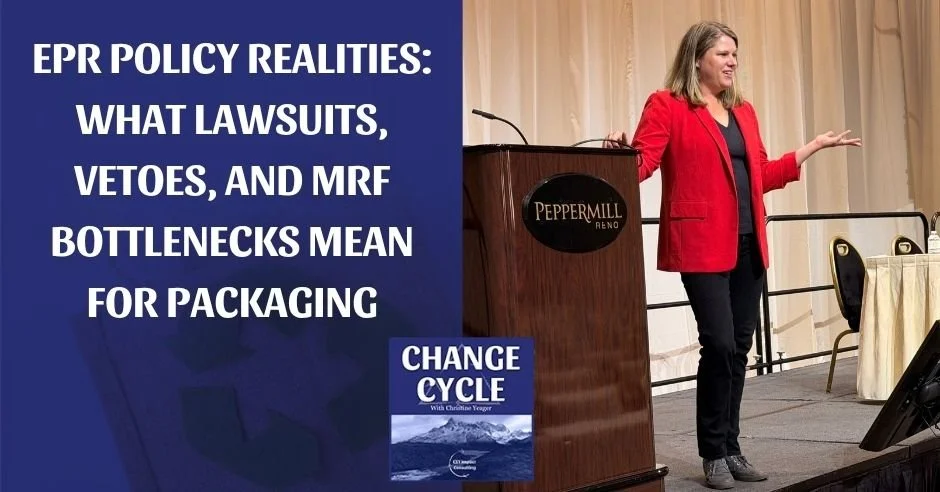
Navigating modern packaging regulations demands a direct look at practical EPR policy realities. Host Christine Yeager cuts through public skepticism to unpack what is genuinely happening across courtrooms, state agencies, and material recovery facilities. She breaks down the latest legal challenges in Oregon and Colorado, explores Governor Newsom's recent California vetoes, and examines why sorting infrastructure must catch up with aggressive collection goals. You'll gain operational perspective on the delicate balance between private stewardship initiatives and mandatory producer rules. Whether you're tracking state deadlines or balancing packaging investments, this breakdown provides clear clarity for circular strategy.
---
Watch the episode here
Listen to the podcast here
EPR Policy Realities: What Lawsuits, Vetoes, And MRF Bottlenecks Mean For Packaging
Closing The Perception Gap In Modern Recycling
I’ve been on a few stages. I went to Climate Week in New York. I was at a plastics industry conference. I spoke in Reno in a room full of pipe manufacturers. Not long ago, I was in San Francisco in a room full of folks focused on EPR. It was an EPR think tank. In almost every one of those rooms, someone pulls me aside afterwards and asks some version of the same question, “Is any of this working? My neighbor, my brother-in-law, and my kid’s teacher all tell me recycling is a scam.” Here’s what I tell them.
The public’s conversation about recycling and the conversation inside the industry are almost completely disconnected. Outside, people think nothing is happening, but inside, I’m watching resin companies, pipe manufacturers, beauty brands, MURF operators, and landfill operators share stories about recycling products, using recycled content, and having discussions about the fee rates per pound, sortation capacity, and what’s getting counted as recycled. That’s not a group of people that are giving up. It’s a group of people in the middle of a very messy process of changing recycling infrastructure in the United States.
This session is a deep dive session. I’ve got three parts I want to talk about. One, a quick news update. Second, I want to talk about the courts and what’s going on in lawsuits across the country, not from a legal perspective, but from what I’ve seen and heard. Third, a little bit about what I’ve been speaking about and what I’m learning as I go through these speaking engagements.
Key Legal Terms Shaping Producer Mandates
Per us for the solo episodes, a quick vocabulary check. Dormant Commerce Clause. The Constitution gives Congress the power to regulate commerce between states. Courts have read that states can’t pass laws that discriminate against out-of-state businesses or put an excessive burden on interstate commerce, even when Congress hasn’t acted or put in their own law. That second part is the dormant part. It’s the main argument against state EPR laws in California and others. The case says a producer selling nationally shouldn’t have to rebuild its supply chain around one state’s rules.
EPR Policy Realities: Navigating packaging regulations starts with clarity on legal frameworks, from dormant commerce claims to private delegation.
A preliminary injunction is a court order that pauses enforcement of a law while the case is being decided. It’s temporary and comes before the final ruling. In Oregon, the injunction only covered members of the association that sued. Delegation to a private Producer Responsibility Organization. In most states, a Producer Responsibility Organization is a private nonprofit that is producer-funded. It writes the program plan and sets fees, and then the state reviews and approves. The legal question is whether the state has handed government power to a private body without enough oversight.
Executive Vetoes And California Regulatory Shifts
You’ll hear that argued under due process as non-delegation and in Colorado also under the First Amendment as compelled funding. Voluntary industry action. This is not a legal term, but it’s another thread. It means anything companies are doing in circularity or other areas that no law is necessarily requiring. This could be recycled content pledges. This could be take-back programs. It could be an industry consortium. The open question in this space is whether voluntary action and EPR are competing or complementing each other.
A quick news roundup. Governor Newsom vetoes California’s recycled content claims bill AB 2253 on September 28th, 2026. The bill would have required recycled content claims to follow the FTC green guides and set allowable calculation methods. In practice, it would have limited mass balance accounting. Newsom said he shared the goal, but cited economic headwinds, meaning tariff and trade pressure, and said he didn’t want to add complex compliance requirements.
Mass balance as an accounting methodology for recycled content survives in California for another session. Producers using chemically recycled content with credit-based claims can still do so at this stage. If you’re making those claims, I do recommend documenting the chain of custody now because this fight might show up again.
The public talks about recycling as a myth, but industry leaders are deep in the messy work of rebuilding our infrastructure. #CircularEconomy
Newsom also vetoed SB 1180 on governance of the Plastic Pollution Mitigation Fund. The fund collects $500 million a year from producers through 2037. SB 1180 would have set rules for how it’s governed. Newsom’s reason was not wanting to complicate SB 54 implementation any more than it already is. It’s not saying that the money doesn’t still need to be collected. It is still part of the fee and funding mechanism. You will still pay if you sell plastic into the state of California. You are still paying that fee layer. The rules for how it’s spent are not being governed by a bill, but instead by the program plan and CAA.
Maine’s EPR program got zero responses for the Producer Responsibility Organization or the stewardship organization role when they put out their RFP. That RFP closed in August 2026. CAA declined, citing misalignment with the RFP scope, not misalignment with the EPR legislation. Time will tell how producers are going to come together for implementation of the Maine EPR.
The World Wildlife Fund and SC Johnson funded some analysis through RTI. That’s the Research Triangle Institute. It estimated that a single federal framework for EPR could cut annual local government waste management costs by 49% to 53% compared with the state-by-state approach. It could also cut producer compliance costs roughly in half.
Another poll of more than 4,200 adults found 87% supported federal EPR once it was explained to them. Most adults don’t know what it is. There was similar support across party lines. Why does this matter? This is just a study. It’s not saying that there’s going to be a federal bill. This is a producer and an NGO making an efficiency case together for a federal approach to EPR. This is something many people in the industry have said in passing. This is the first time we’re seeing a public action taken on convincing others that this is the right path, in the United States anyway.
EPR Policy Realities: Collecting tons of post-consumer material only works if sortation facilities have the capacity to process it cleanly.
The Imbalance Between Collection Goals And MRF Capacity
An analysis in resource recycling by the CEO of Goldfinch Environmental found that 5 of the 6 EPR states it covered don’t have enough sorting capacity for the material they already collect. Oregon is the exception. It’s close to breakeven. The deficits elsewhere run from roughly 1/3 to nearly 2/3 of what’s collected, and they get worse once you add EPR’s collection goals. What does this mean?
EPR can fund collection faster than anyone can build sortation. If the fees go into bins and trucks before they go into MURFs, the public will see more material collected and not much more recycled, which would feed the narrative around recycling being a scam. That’s why, if you look at the program plan, it has very different areas in which they are investing beyond education and collection, but it’s important that it maintains.
In mid-September 2026, New Jersey officially delayed its recycled content mandate deadlines. New Jersey gave food packaging a five-year exemption from its post-consumer recycled content requirements. The Association of Plastics Recyclers objected publicly because this impacts demand. When demand is impacted, it decreases the motivation to increase supply. Producers are getting a relief, but recyclers lose a demand signal they were counting on to justify any investments they were making. Watch and see if this is something that other states use to point to, as this may or may not slip in their own deadlines.
State Litigation Updates From Oregon To Colorado
CAA’s California program plan, having incorporated comments, is due to CalRecycle in October 2026. The 2027 fee schedule is also due in October 2026. We should see some new information come out. To go a little deeper into the Oregon lawsuit, the judge’s decision upheld the law, but in late September 2026, the National Association of Wholesalers brought forth an appeal. To reiterate, I’m not a lawyer. This isn’t legal advice. If you need an interpretation for your company from a legal standpoint, talk to counsel. I’m giving you a little bit about the mechanics, the timeline, and what it means for decisions.
California's recent legislative vetoes remind us: regulatory adjustments won't eliminate the underlying fee layer for producers. #Packaging
A quick recap of what you may have missed. In July 2025, the National Association of Wholesalers sued Oregon over its Recycling Modernization Act. They had five areas where it was deemed unconstitutional. In February 2026, they won a preliminary injunction for some of the claims. In August 2026, Judge Michael Simon ruled for Oregon on all of the claims that were brought forth to trial.
The Commerce Clause was rejected. The court found the National Association of Wholesalers experts hadn’t quantified the burden on interstate commerce. Due process and private delegation were rejected. The court pointed out that producers can form a competing pro or use the exemption of producer-led recycling. CAA isn’t an unchecked monopoly. For the money argument, the National Association of Wholesalers pointed to $145 million collected against $56.5 million spent. The court read that as ordinary reserve building and a program’s early years.
The February injunction is lifted. Any National Association of Wholesalers members that hadn’t reported now must report. On September 24th, NAW filed its notice of appeal to the Ninth Circuit. Its arguments haven’t changed. Distributors don’t design packaging, and fee methodology is still confidential and decided by binding arbitration. “The facts we established at trial haven’t changed,” is what the NAW’s CEO said. The Ninth Circuit appeals usually take more than a year from notice to decision, so we probably won’t see any movement on this until 2027.
Colorado has two cases. The National Association of Wholesalers v. Ryan in federal court in Denver was filed July 30th, 2026, before the decision that came out in Oregon. The state responded September 16th, 2026, and there are further negotiations expected in October 2026. The difference for the Colorado lawsuit is that they’re bringing forth an argument related to the First Amendment. It says, “Making producers fund a pro that also spends on policy advocacy is compelled speech.” That’s a different theory from Oregon. The Oregon wind doesn’t automatically carry over to California.
EPR Policy Realities: Voluntary collection pilots prove that difficult materials have viable end markets when sorted effectively.
There’s also a state court case. ILMA from the Lubricants Industry filed in Denver District Court in March 2026. It raises due process, non-delegation, and the First Amendment. An injunction motion has been reported with no ruling. Either way, the program hasn’t paused. These are pending legislation. California’s lawsuits are still hanging in the balance, and they’re being sued from both directions. There are seventeen state attorney generals arguing around the Dormant Commerce Clause. Also, there is a hearing set in January 2027 for that one.
California is also being sued by NRDC, Oceana, and Californians Against Waste Foundation. One other comment on California is that there’s a lot of action by Californians for Affordable Packaging. There has been a lot of action by them pushing potential new legislation that would affect SB 54. That’s a new organization. Nothing went through this 2026, but the people anticipate that they would bring forth more information and push in 2027 in the next legislative session.
To sum up everything, some of this is new information, and some of this is repeat information. There is a little bit of change going on in a lot of different areas. It continues to reiterate that there’s some uncertainty, but nothing yet has stopped the need to comply. It’s a lot of folks finding opportunity to adjust the laws as they are written. There are a lot of criticisms on both sides for EPR. That’s legal stuff.
How Voluntary Industry Initiatives Complement Policy
If you’re still with me, thank you. Maybe you don’t care about this, but I wanted to share some of the points I’ve been making as I’m speaking at all these events. They’re very relevant to where we think the next conversation is going to be related to EPR. Where have I been? In New York, for Climate Week, I spoke about rethinking small-format EPR infrastructure and the path forward.
Appeals and legal fights continue, but brand owners must keep reporting and planning. Compliance deadlines march on. #Policy
What this panel was talking about and what I think is key relevant information, and I’ve shared this on this show before, is that EPR needs to be an opportunity for innovation and new thinking around systems. It’s not structured that way, but there is involuntary industry action happening in this space. In this panel, we talked about Pact Collective, which is producer-funded. They’re funding drop-off options for small-format beauty empties, like beauty products. These bins are in Sephora, Ulta, Credo, and lots of other beauty retailers. You can do mail-back.
There’s also a lot of investment going on related to improving the MURF capabilities to sort and process small-format packaging as well. If you can sort it, there is an in-market for it. Pact Collective is certainly proving this availability of an in-market. They route most of their material to a recycler. Where they can’t, it’s going to waste energy or waste concrete. If you can collect it and sort it, there is a pathway, which is encouraging and exciting to see voluntary industry action in this space.
They also have two different plastic-related industry associations who wanted to talk about EPR and dive into what it means. How do we participate? How is EPR shaping the market? What does eco-modulation mean? What does source reduction mean for our industry? Where are things trending? What are the directions? What’s being recycled?” A lot of encouraging conversation.
Finally, a deep dive EPR think tank on the West Coast. It was a bunch of EPR nerds getting together talking about EPR. There were a lot more lawyers in the room than I’m used to being around, which is helpful so I can ask questions from a legal perspective. Also, a lot of thoughtful conversation about going beyond the basics and into the future of what this means for the industry and what this means for strategic business decisions.
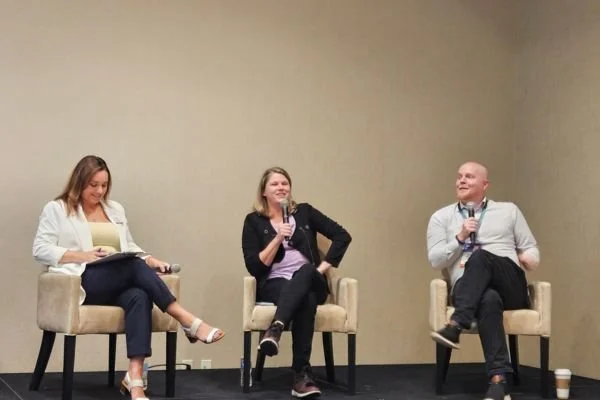
EPR Policy Realities: Stop waiting for the dust to settle on packaging rules. Progress in sustainable business requires embracing the discomfort of change.
I still have a few sessions left that I haven’t spoken at yet. I’m going to the Women Breaking the Mold Networking Forum. We’re shifting gears away from direct EPR talk and talking about career, transferable skills, the power of mentors, and the power of stepping outside of your comfort zone. Women-related conferences are always so encouraging, exciting, and energizing. I’m ending my tour with the Innovation Forum in Chicago where we’ll continue to talk about small-format packaging and hard-to-recycle packaging.
As I’ve been going to and will go to these events, some of the themes that I continue to hear, as I mentioned in the beginning, are that people think recycling isn’t happening. Everyone who’s in the recycling space and the packaging space gets a lot of questions about the efficacy of recycling. There are a lot of people and companies that are making recycling real in the United States. It’s a balancing act of encouraging and making people feel hopeful and unpacking the real barriers to progress that we have in this super fragmented system in the United States.
US plastic recycling topped 5.1 billion pounds in 2024. That’s a record total according to APR and the U.S. Plastics Pact. That’s even as bottle recycling rates slipped. Hopefully, we’ll see even more as CAA continues to infuse investment into the system. As they like to say and I like to reiterate, with them being CAA, it’s a dial, not a switch. You have to invest a lot in sorting technology and identifying places for these materials to go. I don’t think the gap is effort. I think the gap is economics, which EPR is trying to address only in seven states, and time and building trust that this material is turning into something else.
There are other things I’m learning through these conversations and in recent news. Voluntary action feels like it’s moving faster, but it is still a complementary action to EPR. EPR is only in seven states. Voluntary action at this stage, a lot of times, is maybe starting small, but it’s thinking about the whole system, full infrastructure, and impact across the nation.
When I was at Coca-Cola, the goal was to put 50% recycled content back into all of their packaging by 2030. That turned to 35% to 40% by 2035. You can criticize changing your goals, but one of the reasons I left is because I knew that Coke alone cannot solve the recycling challenges in the United States. I wanted to be a part of the bigger solution to this challenge. EPR is that bigger solution, at least at a state-by-state level. It’s the only way we’re going to see more available supply to then put back into the system and have companies like Coke reach their goal.
It’s still important to have these pledges. They move markets. EPR can be more durable than voluntary action because it funds infrastructure at scale within the confines of the EPR law. It can feel slow, but it also hasn’t been that long. We’ve only had two reporting cycles. As an outsider who’s not funding it, the best outcome is seeing both. It is seeing the industry proving that collection works and the fee schedule recognizing it.
Finally, the other key point that I’ve been learning as I’ve been going and attending these events is that recycling isn’t the only thing on people’s minds. It isn’t, but it’s the thing that’s most on my mind. Across these different events, I heard about carbon footprint goals. I heard about other types of diversion, like demolition diversion and construction diversion. I’ve also heard about ingredient impact, regenerative ingredients, regenerative practices, and labor shortages.
A while ago, everyone wanted to go to a four-year college. Now, there are fewer people to drive trucks to work and run the machines. There are a lot of fundamental conversations about how you attract talent into these types of jobs. It’s a broader conversation. It’s nice to be reminded that recycling is only one very specific sliver of the puzzle. When you’re in it all the time, it feels like what everybody is talking about. It’s one of many challenges that people are trying to solve. No duh, but it’s been a good reminder.
Reframing Uncertainty Into Tactical Circular Action
Here’s the mindset shift I’d offer. Stop waiting for certainty. I’ve offered that many times. It’s a cycle. We can’t wait around for all of the dust to settle and all of the beliefs to be there that recycling is working. Embrace these challenges. Embrace this mindset shift to believe that all things will change and the people building the system aren’t sitting around waiting either.
I’ve been in these conversations with so many different types of folks who produce the raw material, convert, sort, operate as a MURF, and are collecting. None of these different companies across the supply chain in the circular economy space are giving up on recycling. They’re doing the real, tactile, unglamorous work of making the circular economy work.
While everyone else is arguing about whether or not it exists, they’re making progress. They’re making it exist. They’re selling expanded polystyrene at a profit for their business. Change is uncomfortable, and we know that progress requires that discomfort. Thank you for being here. I interviewed a lot of people on this circuit, and I’m continuing to interview people. Some of my next few interviews will be at some of these events. As always, if you have any recommendations, send them my way. Thanks.
Important Links
NAW's Colorado EPR Challenge Enters Next Court Phase - Modern Distribution Management
Federal EPR could cut waste management costs in half: WWF | Packaging Dive
U.S. Plastic Recycling Volumes Top 5.1 Billion Pounds in 2024, New Industry Study Finds
Bottle recovery rates dropped in 2024, but other plastic rates rose | Waste Dive