

From Plastic To Purpose: How Cambio Roasters Is Reinventing K-Cups With Sustainable Aluminum Innovation With Kevin Hartley

What does it really take to disrupt a billion-dollar industry built on convenience—and plastic? In this behind-the-scenes look at the upcoming Cambio Roasters podcast interview, Kevin Hartley shares how a single idea—replacing plastic K-Cups with infinitely recyclable aluminum—turned into one of the fastest-growing coffee brands in the U.S.
But this isn’t just a story about packaging. It’s about living with intention, building a business around the triple bottom line, and taking real financial risks to create meaningful change. From supporting coffee farming families to navigating investor pitches and scaling a sustainability-driven startup, Kevin reveals the hard truths and surprising opportunities behind mission-led entrepreneurship.
If you’ve ever wondered whether doing good can actually drive business success, this conversation offers a compelling—and practical—answer.
---
Watch the episode here
Listen to the podcast here
From Plastic To Purpose: How Cambio Roasters Is Reinventing K-Cups With Sustainable Aluminum Innovation With Kevin Hartley
Keurig C-Suite Role And The K-Cup Landfill Problem
Welcome back to the show. I'm interviewing Kevin Hartley. He was in the room at Keurig Green Mountain as chief innovation and chief strategy officer, while the company scaled from a small operation into a $14 billion category-defining brand, which means he also watched twenty billion single-use plastic cake cups become an annual landfill problem.
That context is not incidental. It's the reason he left the Fortune 500 C-suite to co-found Cambio Roasters, an infinitely recyclable aluminum K-cup built to go directly at the plastic category he helped build. Here's where it gets uncomfortable. Aluminum is widely recycled across the US. The material case is sound, and the circular outcome is real. It still can't compete on cost against a plastic K-Cup.
EPR and circular economy frameworks talk constantly about rewarding better materials and better design, but the economics on the ground still favor the incumbent. Kevin is going to share with us how he addresses that challenge, still driving growth as one of the fastest-growing K-Cup brands out there right now. He's going to share a little bit of his wisdom from his years of experience. I’m excited to uh talk to Kevin.
I am excited to have this conversation, Kevin. Thank you for being here. We are going to talk about change. Everybody loves change, and you have experienced a lot of change. I am super excited to hear from you and about your journey. As always, we would like to start with the first question, which is how do you live with intention?
Living With Intention And The Triple Bottom Line
I love that starting point. That is definitely near and dear to my heart in a number of ways. Christine, when I think about living with intention, it is when I am by myself and talking to myself, not how I am articulating it to others. We all know what we are supposed to say. To me, it is a deep personal question, which is how aligned am I every day with my actual values? That begets a couple of questions, which are, “What are your values as the foundation?”
I care a ton, which we will talk about, not only about very strong values for my family and my children and my partner, etc., and my spiritual life, but it is super important to me since I have spent most of my life in business. How aligned is every minute of my daily business life with my values? A big change turning point for me, Christine, was when I first heard the term Triple Bottom Line in 1994. Are you familiar with that?
Yes, but we like to break down anything with definitions on this. Nothing is everything is approachable. Feel free to describe it.
The notion is really powerful. It is running your business or your brand, your company, with an eye toward three bottom line instead of just the bottom line of profit. The other two bottom lines are people and planet. When I care deeply about those second and the third, interestingly, my father was quite a difficult man. You either turn up really similar to your parents or you do the opposite. I like cultures that are filled with love and filled with no passive-aggressive behavior, etc.
I probably swung the pendulum too far, but be that as it is a blast. From a triple bottom line perspective, it is interesting. We all operate in capitalism or the market economy. There are three capital inputs to that system. Financial capital, human capital, and environmental capital. Those are the only three inputs. We are raised in the Western world to optimize financial capital creation at the expense of the other two. We are trained in how to talk our way out of that, so that it is okay somehow.
We all operate within a capitalist, market-driven economy with three core inputs: financial, human, and environmental capital. In the Western world, we’re often taught to prioritize financial capital at the expense of the other two.
A perfect little example is in my business. We are in the coffee business. In my life, coffee farming families are the human capital side. Coffee farming families around the world live on between $1 and $3 US per day. They have food insecurity issues for more than six months a year. If you care about the people capital bottom line, the question is, “What are you going to do about that?”
Triple bottom line means you are actually running your business with an eye toward all three bottom lines and being open about the problems and challenges that it creates. We will talk later about investors, but those are really interesting conversations. “Why are you giving me all the money back? Why are you giving 20% of profits to coffee farming families? This is nuts.”
For me, a key component of living with intention is, “Are my daily business activities and the companies that I work with or for or start in line with those values?” I stumbled on this. It was not as obvious 30 years ago to me, but what is really interesting about starting brands and companies that care about the other two bottom lines is that they end up having a purpose that is bigger than just ourselves or bigger than just profit.
What is fascinating about that is it attracts amazing employees because so many of us want to work for things that are bigger than just ourselves or money. Ironically, it attracts really interesting customers who are looking to align their values with their purchases. It is a different circular economy than you talk about. It is a fascinating circle. Have I succeeded at 100% alignment with values? No.
I can say that the vast majority of my working life, even through the struggles, has been highly correlated with activities that do align basically, or that my time is spent there. It is one of the things that I feel super proud of that I had the balls to do that and make the decisions to be that way. My friends and family will say, “You probably gave up a lot of money, Kev, to do this align-with-values thing.”
Maybe, but at the same time, there is a lot of data out there that says that companies that consider the triple bottom line are more resilient and are overperforming. I do not remember the latest number, but B Corporations in general outperform their counterparts. It feels that way in the near term, and when you are talking to people, looking at last quarter versus next quarter. The data says otherwise.
That is super powerful. When we are all feeling what we are feeling about ourselves, whether I was aligned and trying to make the world a better place matters to me. I was going to do that. I basically do not have a choice. I have to try. It is one of those things.
On your deathbed, you are not thinking about the meetings that you went to. You are thinking about the impact that you had and the stuff that you missed out on. I definitely agree. I found that even working at Coca-Cola, almost everyone I talked to had a passion for sustainability, or a passion for the people or the planet. It was a matter of how to go about doing it. When you tap into that passion, you do get such a different type of work ethic. Taking a step back, what is Cambio Roasters? What sets it apart from the original K-Cup that you also participated in?
The Keurig Backstory And 20 Billion Plastic K-Cups
The quick backstory that resulted in the founding of Cambio is that I started working with a little coffee company in Vermont called Green Mountain Coffee Roasters in the early 2000s. Green Mountain Coffee bought Keurig, which was a struggling little coffee maker company. It was a struggling coffee maker system maker. They had a little thing called the K-Cup. I am holding up a plastic K-Cup for those of you who are just listening.
The reason a K-Cup looks like a K-Cup is that when the three Boston entrepreneurs who founded Keurig were having dinner at their formation dinner, this is what Ken's salad dressing came in. They went, "That might be the perfect vessel to solve the office coffee conundrum where there is always that pot of coffee that is half burnt and too old."
Interestingly, the data around coffee consumption is that prior to Keurig, the largest consumer of coffee in the United States was the kitchen sink. Think about all those beautiful beans harvested and all that work, and half of it just gets disposed of because it sat on the pot for too long. That is what those guys were after. From that point until we sold Keurig Green Mountain in 2016 and 2017, I was always Chief Innovation Officer and Chief Strategy Officer.
Cambio Roasters' Solution: Infinitely Recyclable Aluminum
Now there are 60 brands of coffee and K-Cups, and over 800 different SKUs. Guess how many the US will drink this year of these little guys? Twenty billion. That means, speaking of things needing to change, more than 54 million go into landfills every single day. That fills up a huge professional football stadium like every five or six days. After we sold Keurig, Anne and I decided to hold our hands and pursue our triple bottom line dream, which was, in essence, to reimagine the iconic K-Cup for the next 25 years.
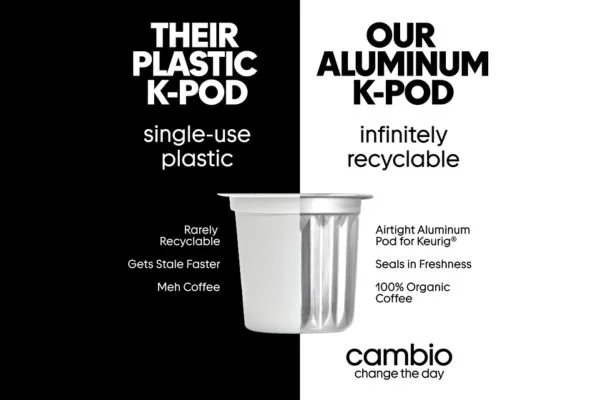
I will hold up the beautiful Cambio brand for those of you who are watching on YouTube. Reimagining the iconic K-Cup for the next 25 years, there were two huge problems that we had to solve. A lot of times, great brands and great companies are started to solve intractable problems. For K-Cups, there were two. One, the coffee actually does not like the plastic. We just use it because it is inexpensive, but it lets in too much oxygen to enable the coffee to keep its magnificence until the consumer brews it.
That is problem number one. Problem number two is, and this is the sad part, I am from Vermont, Christine, and we have been recycling since I was a little kid. It is hard for me to imagine not recycling. Unfortunately, for plastic packaging in the US, when we throw it in the curbside bin, less than 3% of the time it actually turns into another product. That is mostly economic. Recycled plastic resin is more expensive than virgin resin.
The pragmatics of it are that plastic is very difficult to upcycle or recycle. You usually have to downcycle it into Trek decks or brakes for polypropylene. That was not effective for the coffee. It certainly is not effective for our small spinning planet. As you and I discussed, coffee farming families struggle with food insecurity more than six months a year, which was another problem where change was needed to occur.
Anne and I assembled a dream team of our friends and colleagues who all ran Keurig together. We embarked on a multi-million dollar, multi-year innovation project and now have the only infinitely recyclable aluminum K-Cup brand for people's Keurigs. Interestingly enough, aluminum is called the magic metal for a couple of reasons. One, the molecule is eerily stable, and it is infinitely recyclable.
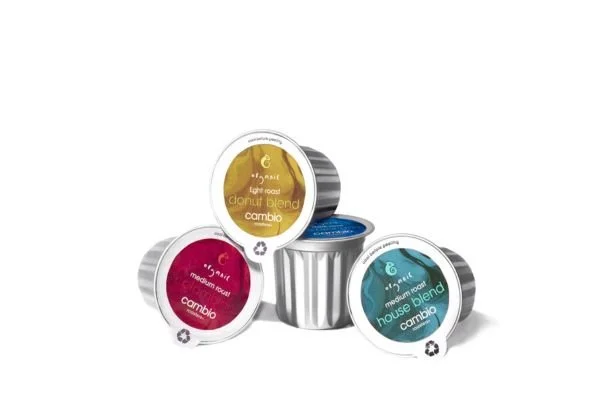
Cambio Roasters: Aluminum is often called the “magic metal” for a reason. In North America, when you put aluminum in the recycling bin, over 96–97% of the time it’s turned into a new product.
It turns into a Diet Coke can, a Bud Light can, an Airstream trailer, or whatever. It can be recycled tens of thousands of times. It can be remelted and reused, which is amazing. The two things are that the coffee loves it. The coffee loves it because it does not let oxygen in at all. The coffee retains its deliciousness until the moment it is brewed. When you throw aluminum in the recycling bin in America, actually in North America, over 96% or 97% of the time, it ends up as another product.
I like to see the little K-Cup going up to the Diet Coke can and saying, "Hello, son." We have brought Cambio to market. It is the fastest-growing K-Cup coffee brand now in the US, which is really exciting because a big block of consumers is passionate about the same solutions that we tried to do. We can talk about the consumer later, but we tried to make it her literal dream brand.
For those who do not know, can you tell us what Cambio means?
Cambio Roasters, we are Cambio. Cambio is Spanish for change. Our mission is to change the K-Cup industry one delicious aluminum capsule at a time.
That is so great. Thank you for sharing that. This is super exciting. I love it when recyclability meets function. Those were the two priorities. As you said, you are going after twenty billion plastic cups a year with an aluminum alternative that costs more to make. We talk a lot about trade-offs in this show. That means you have to convince investors that your target consumer will pay the premium. What does it actually take for you to stay committed to the bet when the math can seem troubling, or it seems like it is still catching up to the mission?
Pricing Strategy And Accepting Lower Margins
There are two things I would like to unpack there. The first part, we thought long and hard, and the dream with Cambio is an impactful outcome. Impacting the amount of K=cups that don't go into landfills and impacting the lives of coffee farming families. Anne and I and the team give 20%, not zero or 1%, but 20%, of profits to 10,000 struggling coffee farming families, which is really fun and powerful.
Because we are focused on impact and in research, I have been doing better-for-the-world branding and companies for a long time, and the research is so detailed that people are willing to pay a premium. Some of that is a little research bias. When we are filling out a survey, we know we are supposed to say that. In the real world, I have learned over decades of commercializing innovation that you have to be careful with that if you really want to scale quickly. You push those two things together. Where we ended up is with the consumer.
We keep it priced to be equal to a Green Mountain Coffee or Starbucks, or a Dunkin' K-Cup, so that we have the chance for the brand to grow aggressively and rapidly, and have its two components of impact be meaningful. My mom is no longer with us, but she, Anne, and I used to laugh. "Mom, if you are the only one drinking Cambio because you love us, we are not going to have a lot of impact.
Millions of people have to love Cambio." Number one, that is how we chose to think about the price to the consumer. On the cost side, we have two differences from a normal K-Cup. The first is that the aluminum K-Cup itself is about twice as expensive. The 100% organic coffee we put in the brand is probably 20% or 30% more expensive than run-of-the-mill premium coffee. What you could see is that at the same price and with a higher cost, we earn less per K-Cup or per box of beautiful K-Cups than is the industry norm. It is our company; we get to do that.
Hopefully, keeping that price parity on the shelf allows you to grow. Apparently, it is the fastest-growing right now, which is great. Nonetheless, you are taking a bet on this. Something that can be scary to folks when they are considering change is taking a bet on themselves. You are not just taking a bet on yourself. Now you are taking a bet on your future.
You have been investing your retirement savings into this, but you are not blinking at the vision. What did that moment feel like, taking that type of a risk, exposing the difference between believing in a mission and being willing to pay for it personally? That is something that I am struggling with as well, as I am building my own brand.
The Corridor Of Success: Daring To Chase Dreams
Yehey for you. Congrats. That is not everybody's cup of tea. There is some scary data when you think of how you are going to move forward. In my world, which is consumer packaged goods or the CPG world, it is basically everything in the center store grocery. Cookies, potato chips, soda, coffee, mayonnaise, and paper towels. Those are all consumer packaged goods. The scary part of the data is 95% of CPG brands that are launched fail.
Even if you have a wonderful idea, the odds are stacked against you. I am articulating this vis-à-vis whether you should spend your retirement savings or not. We were laughing at our press event in New York with Lisa last week before last. I was telling the story of how I have three adult children. They said, "Dad, you know how the interstate system can show a motor home that says we are spending our children's inheritance? You should put that on the Cambio packaging."
I said, "I wish that were not true." It is hard to get good help. For Anne and I, it was some powerful moments of reflection and saying, “How much do we believe in this dream? What is going to matter at the end if it does not work?” Truthfully, if Cambio did not work for us, it would be a big bite. We rolled the dice for sure. We felt that as an example to our five kids, we love the idea of being one of the thousand points of light, showing that triple bottom line companies can compete and win.
We care about whether our five kids think we had the courage to follow those dreams and what that looked like. In the spirit of transparency, people who dare to start things are wired a teeny bit differently. One of the ways, and with me it may be true, is that you have too much optimism about the future. You are able to subjugate the feelings of what might not work. Therefore, you dare to go forward.
Another positive thing I would share with the audience that I think is fascinating, I did not make this up. I have just observed it, and it’s powerful. People call it different things, but the way I like to think about it is it’s called the corridor of success. It is a really interesting concept. Sometimes people will talk about it as serendipitous and synchronicities. The corridor of success is when you dare with full-throated effort and with your heart on display to chase your dream to enter that corridor. Doors will then open in surprisingly powerful ways that would have never opened if you had not entered the corridor and dared to chase your dreams.
There are tons of examples of that, investors we would have never met, retail opportunities we never would have gotten, and things that we have learned. It is scary, and it is hard, but it is also a wonderful thing. The final thing I would say, and you have to be honest with yourself about it, typical saying "It is the journey, not the destination." When you are going to do a startup, you'd better really like the journey because it is hard and bumpy, and you may not get to a destination that you were hopeful for.
I like this corridor of success idea. I think people have said about luck like serendipitous, as you said, but sometimes that rubs me the wrong way because it's not necessary. It's usually not luck. It's backed by a lot of hard work, experience, prioritization, and grit. To your point, the stars start to align, and the doors start to open. It is usually not because of some random happenstance. There is a lot of work that goes into it.
Manifestation And The Requirement Of Daily Effort
You are familiar with the manifestation concept. The notion is that your thoughts create, so you have to be careful what you are thinking. In your physical world, you are experiencing what your predominant thoughts are. If you want to have a different experience, you need to change your predominant thoughts. That is basically the concept. What is interesting, building on what you were saying, is how powerful that corridor of success is and the way you were articulating it.
No matter how you change your thoughts, let us say you want to make more money or you want to make an impact on your family or your world, you cannot just sit there on your couch and wait for it to happen. The whole thing requires you to put in the effort, and then you are in the corridor of success. Yes, manifesting and changing your thoughts are important, but you have to be making that daily effort. By the way, changing your thoughts is not easy either.
I have found that when I am feeling less confident, I let that lack of confidence cloud some of the decisions I am making. Those decisions do not usually work out. When I reground myself, I started a playlist called "You Are Not a Commodity." It was helping me reground on this idea that I am not a commodity and I am valuable. That has been leading me into more confident decision-making. It’s incredible what you are doing and changing something, and disrupting something that has become such a household name is a big endeavor.
It is exciting to see that you are starting to see successes, back to recycling. Aluminum is infinitely recyclable and widely accepted, which is awesome. On paper, it should be the obvious choice. As you said, there is an in-market value to it because aluminum itself, as a material, is infinitely recyclable. There is no price disparity between the recycled item and the new item in the same way that you find it in plastic. Why is this obvious circular solution still an underdog?
Why Aluminum Is Still An Underdog Against Plastic K-Cup Cost
That is a great question. The answer is a teeny bit multivariant. The big ones are in regular organizations, cost of goods matters so much. If you are building twenty billion of them and they are $0.10 more expensive, that is $200 million of extra cost. In your large corporate experience, you could see how well adding 200 million extra costs to something would go over. In our senior team, we always say that one way to think about our decision-making at Cambio is that we do everything we would have gotten fired for in our old lives.
You cannot put 100% organic coffee and give away profits to coffee farming families and have the pod cost more. One of the answers is that on that scale, the lowest-cost packaging for most organizations is going to win out. In all fairness, in the heyday of Keurig, we had to put in an $8 million manufacturing line that was the size of a small house. We had to put one up in North America every ten business days for more than four years. It was just crazy fun.
When you are scaling that aggressively, you cannot keep changing the technology. You have to lock it down and make decisions so that you can scale. In fairness, that was part of what was going on. It is a combination of having to lock down the technology and a cost exposure. That is the reason that the current capsule is in plastic. This is the fun part. When you are not changing, you are technically standing still because everything evolves. By holding your ground, you are actually standing still.
If you’re not changing, you’re standing still—because everything else is evolving. Holding your ground is, in effect, staying stagnant.
In our industry, in the world of K-Cups, as in many other industries, the innovators who are there to go out and perform without a net and try to make an impact with their products, if the consumer falls in love with it on a large scale, eventually it becomes ubiquitous. One of our big dreams would be that twenty years from now, there is no such thing as a plastic K-Cup. They are all either paper fibers from bamboo plants, aluminum, or whatever.
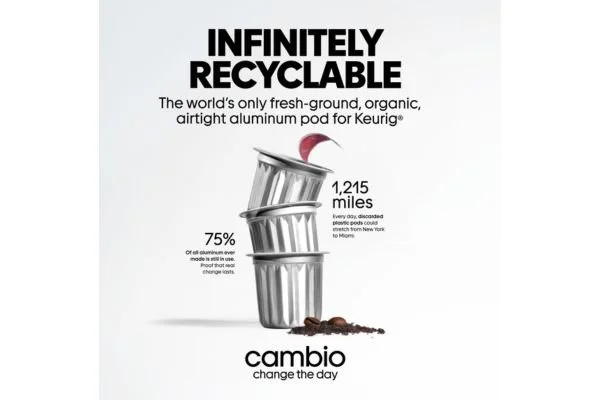
Cambio Roasters: One of our biggest dreams is that, 20 years from now, plastic K-Cups no longer exist—replaced by materials like bamboo fiber, aluminum, or other sustainable alternatives.
If you have that dream, let us see if you are right with product-market fit. Let us see if you and the consumer agree, and it can take off. If you are just pitching your idea, I have been in a Chief Innovation Officer role for decades in large organizations, and I have started a bunch of our own triple bottom line companies. That is a funny combination. The company executive and broke-ass founder. In large organizations, if you have an idea, you could pitch it without proof of concept until you are blue in the face, and they are not going to do it.
It is when they say, "That works. The consumer loves it, and retailers love it. I am going to swoop in and do something similar." That is a concept around how you get a large structural change to occur. I cannot just have an idea and pitch it to big companies. You have to put your big boy and big girl pants on for Anne and me and get out in the world and try to create something and show that the consumer loves it. We are getting really good indications. You can actually have your big change dreams become orders of magnitude more probable.
I had a lot of that experience too. A lot of startup companies would come saying this would be great for Coke. Yes, but what Coke really needs is something that can scale quickly and make a dent in the 20 billion K-Cups a year. It needs to be meaningful. There is a lot of pilot fatigue going on, especially in the sustainability space. On the flip side, you are pitching investors. We talk a lot about talking to the CFO because they are the ones making a lot of the decisions as far as where investments go.
Especially if you are bringing something that is not investing for growth, like sustainability often is, how do you convince them? You have a higher cost of goods, which is a liability. It is a new product, but it is growing. When you are pitching investors to keep those margins the same, where are you able to move the needle to get them to invest? Where do you still struggle as far as building that argument?
The Investor Proposition: Unmet Need And Terminal Value
I love those questions. The way we think about it, when you are interfacing with the capital part of the market economy, is when you are an innovator in a large organization that the CFO distributes capital. When you are a startup founder, it is investors, venture capitalists, and private equity people who make the decision. The investable proposition has to be different. On the intrapreneur side, when you are innovating in a large organization, certain things are non-negotiable to free up capital.
The investable proposition is made up of non-negotiable elements that the owner of the capital has to be comfortable with. In the startup market, there is seed capital, and then private equity and venture capital, which you use to scale. We are clearly in the latter. This is a startup. Because we spent our retirement savings, we actually had to raise money. We just completed our Series A round of fifteen million at the end of last year, which is really exciting. These are real-world questions, not hypothetical or theoretical questions.
The way we address the investors in the capital markets is to create the investable proposition. The first thing is that we had powerful quantitative data to show that there was an unmet need with the consumer. One of the non-negotiables is, I get that you want to launch X, Y, or Z, but is there a real market need that you are trying to fit? There is a distinction there that is really important in the unmet-need world.
Does the consumer think she has one, or do you need to convince her she has one before you show her the solution? If it is one of these product ideas where you have to convince them they have a need, that is way more difficult. Regarding K-Cups, there is a huge market segment/unmet need that we call Hope. She is our avatar. In the data, she is about 23% of Keurig households. She represents five billion K-Cups of purchasing power. Hope is really interesting.
This is US quantitative research study data. She is looking to align her purchases with her values, and not everybody is. I am not saying it is good or bad, but this particular segment is looking to make a difference with her purchases. You can picture her going to Whole Foods and Trader Joe's and buying Method detergents, Kind bars, Seventh Generation, and Ben & Jerry's. You can picture her shopping basket. Retail grocers and mass merchants also pay attention to this customer.
Kroger, the largest grocer in the US with 2,300 doors, calls her HENRY, High Earner, Not Rich Yet. Target calls her the emerging modern consumer. Walmart calls her the emerging purpose-driven consumer. They are all feeling this type of consumer. She is called Hope for that reason, but she has a very pragmatic side to her. Hope is not chaining herself to nuclear power plants. Keurig consumers are pretty mainstream consumers. They are not just out doing wild and crazy environmental things.
The data-driven AHA is fascinating. When she can move a product from the yucky column to the better column, she gets a dopamine hit, especially when she does not have to sacrifice taste or price. Cambio was precision-crafted to be her dream coffee brand. The number one step for investors is a provable, quantitative data-driven unmet need, and then a brand roadmap to show that none of the existing brands perfectly line up with her values.
She indexes really high on caring about the supply chain, like coffee farmers. She indexes high on wanting to buy from brands started by real people, not big companies trying to do a marketing spin. Certain things this market segment cares about are interesting in K-Cups. Think of the brands, Starbucks, Dunkin', Green Mountain, Peet's, Lavazza, Eight O'Clock, and Folgers. They are beautiful brands, but it is the only shelf center in the US center store grocery that does not have a brand specifically targeted to the purpose-driven consumer.
Step number one was, is there a data-driven unmet need? Step number two is showing the brand that we have created to fill that need. Step number three is you have to do a financial model over the next ten years, assuming how many retailers we would get in and what share of the business we would have because of that consumer. Ramping up slowly and conservatively, does the business end up having a big enough terminal value, exit value, that you are creating at the end of the ten years to make it an investable proposition?
Cambio scores very highly there. Though Cambio's costs are more expensive than a normal K-Cup, it is still a very nice margin business. We call it unit economics. When you scale it up and get to 100 million or 200 million cups, it is actually quite an exciting business. That is the process of what an investor would have to believe to invest. There are other secondary things, like what is the investor's perspective of the senior team? That turns out to be a really important one.
Investors will always say they would rather invest in an A-team with a B-idea than in a B-team with an A-idea because the A-team has industry credibility and knows what they are doing. They will figure it out because it’s bumpy. It is called the messy middle. It’s not called the easy middle between the idea and the success. Here’s a bumpy story. For our initial Kroger load last summer, we had to ship 1.5 million K-Cups.
Cambio Roasters: Investors often say they’d rather back an A-team with a B-idea than a B-team with an A-idea. An A-team has the credibility and experience to navigate the “messy middle” between idea and success—because it’s never easy.
That is five tractor-trailer truckloads of K-Cups leaving the factory. We made it within two days of the shipping window to not short-ship them, which would have been a huge problem. Eight hours after the last truck left the plant, 20% of our product was stolen. The truck was stolen. Never to be seen again. It is bumpy in the real world. Is the senior team capable of communicating with the world's largest grocer and not getting fines?
Is the senior team capable of having enough capital that it can remake that tractor-trailer truck and get it there on time? Performing without a net is what creation feels like. That is why they care about senior teams so much, because there are always pivots. B-ideas with A-teams rather than A-ideas with B-teams.
Practical Tips For Leading Uncomfortable Change
That is great advice. What are three practical tips for someone stepping into or leading uncomfortable change like you have experienced?
Leading uncomfortable change. Let us say you are having to do a reorganization in your big company, and you are the leader. There must be key big rocks in there that really help. The first is that you are changing from a comfortable status quo to something else. Maybe there is enough fear in the organization that everyone knows you need to change. Maybe there is not. Either way, step number one is that humans are funny.
At the end of the day, with change, they have to be able to emotionally lock onto a new vision of the future that they think is tenable. Job number one. It does not matter if you think it is tenable or exciting. It matters if they collectively do. It is like product-market fit. It does not matter if you think it is a cool product. Does America think what you are building is a cool product?
This vision thing is really important and oftentimes misunderstood and undervalued. I am sure you were in organizations where, in the conference rooms, after the CEO left, half the people said, “She does not know what she is doing,” or “That is the stupidest thing they have ever heard. I’m not doing it.” That is how real employees are. Another really important part of change management is in the process. Are there ways that you have operationalized that people can get there?
For me to see a new vision of the future takes about eight minutes of convincing, and I am ready to tear the roof off the place. Your strength is your weakness. For most people, that is not true. Is there a process where their feelings can be genuinely heard? Is there a way for them to voice what they are concerned about?
Are there ways that their concerns could be legitimate and built into the steps to the new vision? Another really important component is whether the leader creates a culture where real information will come out. Do the people actually feel safe, or do they know they just have to pretend to go along while they start job hunting? Is there a culture, which is rare but really important, in accurately addressing change? Humans really want to know what a win looks like.
What does victory look like for this organization or this team? What are the KPIs? How are we measuring that? Most people want to evaluate whether they think that is doable and exciting, then they will normally come on board. This makes one as a leader have a lot of clarity around what a win looks like and where we are going to go. I think those are powerfully important parts of thinking about executing against change as a leader.
Those are great tips. You shared a lot of nuggets that I want to do a quick summary of. You summarized it well with walking into the vision, showing the steps to get there, and making sure people understand the win. Those are good reminders, especially when people are trying to drive sustainability changes. Having that vision aspect can really be powerful in framing up the why behind what you are pushing for.
You brought up a lot of other things I want to highlight. I really loved that at the beginning, you started out with not just the triple bottom line, but the three types of capital as inputs into reaching that bottom line. People, financial capital, and environmental capital. Bringing those things into how you think about the business, I really resonate with this idea of including function alongside recycling or function alongside the environment.
Thinking about those three inputs and then how those inputs become part of the solution that you are innovating against or delivering? I thought that was a really powerful way to think about business value in a way that we have not generally talked about. Also, I am going to bring it up again, the corridor of success. I am going to start using this language. These and investible propositions are the phrases I probably take away the most. Corridor of success, marrying up manifestation with action so that it opens the doors. It is a really powerful way to change your mind about pushing through something that seems hard or far away, or difficult to achieve.
Is it appropriate to add a thought?
Sure, go.
One interesting thing in my own personal journey that I think is helpful is that when you are in the corridor of success, because you are daring to chase your dreams, doors will open that will surprise you. Another thing that is really easy for us humanoids to trip on is that we are so trained that you have to know the how if you are going to get something done in all its glory and detail before you dare to start. In the corridor of success, there is this element of just daring to go. Not knowing all the hows will normally stop people from starting something.
They cannot start until it is all perfectly predictable. Nothing great was ever started that is perfectly predictable. It is just not how it works. That is why it takes balls. It is really interesting to add to the notion that the corridor of success is sometimes the hows will reveal themselves to you, and they will be one of those doors that open that you were thinking about.
Nothing great was ever started with complete predictability—that’s just not how it works. That’s why it takes guts.
I love that. I will just end with, I love that you said we are doing everything we would have gotten fired for in our old jobs.
That is actually true.
I know I think about that a lot in my current experience, where I am pushing for things that would have probably gotten a lot of pushback in my old life. Thank you for sharing all of your stories and your advice and for talking about driving change. I am excited for Cambio to grow. Good luck on your journey, and thank you for your time.
You are so welcome. It was a blast. Thank you.
Important Links
About Kevin Hartley
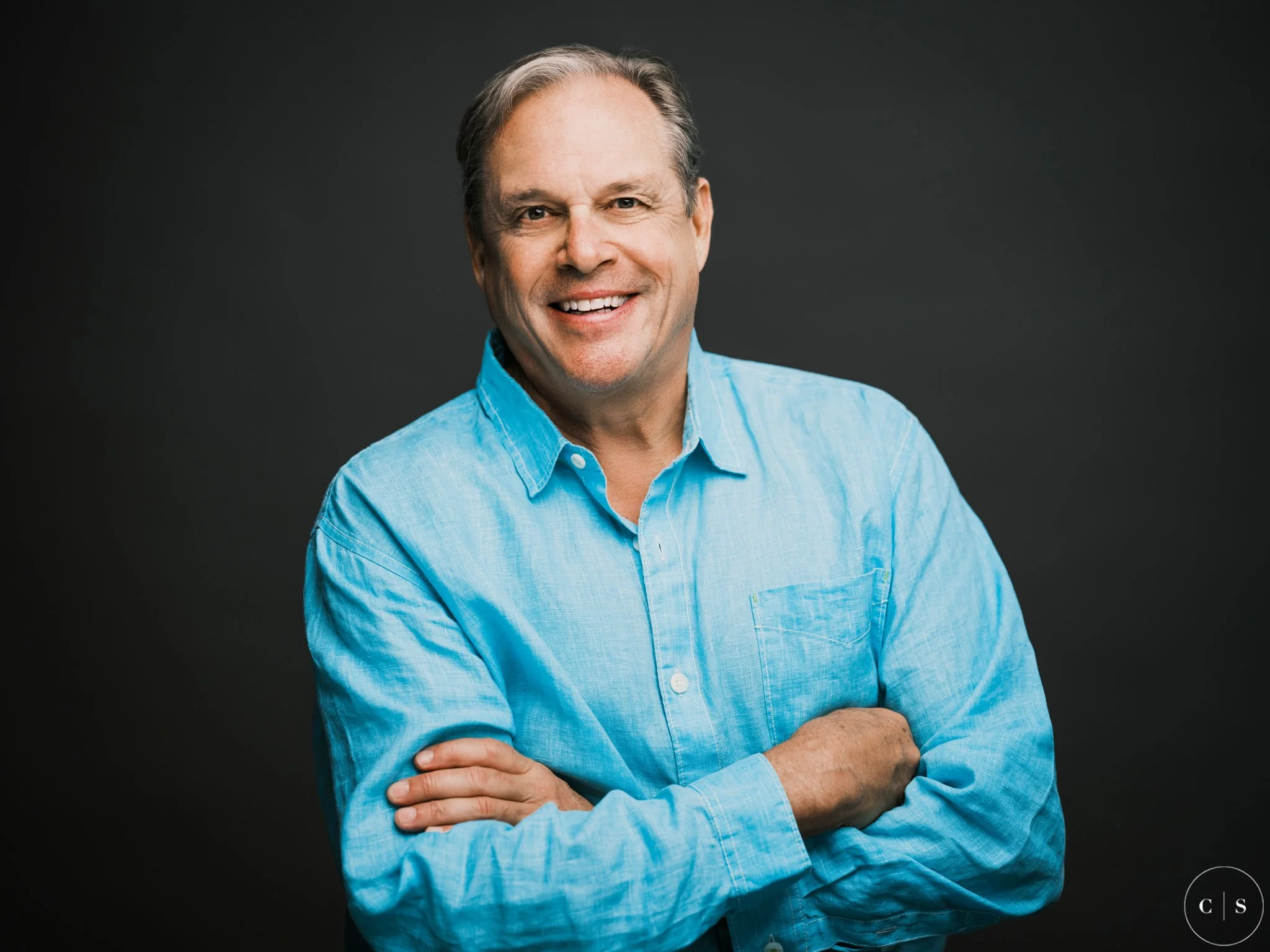
Kevin has spent 15 years in the fortune 500 c suite and 15 years as a serial entrepreneur. His passion is triple bottom line companies that consumers can fall in love with. Prior to Cambio, Kevin was the chief innovation and chief strategy officer for Keurig Green Mountain as it grew from a small company to the $14 billion behemoth it is today.