

April News Round Up: Change Cycle Podcast Returns With Major Policy Insights
After a brief two-week pause due to spring break, work travel, and illness, Christine Yeager returns to the Change Cycle Podcast with a packed update on the rapidly evolving world of Extended Producer Responsibility (EPR) and recycling policy.
In this episode, Christine previews an exciting upcoming guest lineup featuring leaders from the Association of Plastics Recyclers, innovators in recyclable K-Cups, and voices reshaping fashion reuse—while also inviting listeners to recommend future guests at podcast@csyimpact.com.
Beyond the podcast updates, she dives deep into major EPR developments across the U.S., including Oregon’s first curbside expansion in Dallas, new producer portal deadlines across California, Colorado, Oregon, and Washington, and emerging compliance requirements shaping the industry. Christine also breaks down legal challenges impacting packaging and textile EPR laws, highlighting ongoing lawsuits and regulatory uncertainty in California, Oregon, and Colorado.
From infrastructure investments and rural recycling expansion to market pressures in recycled PET and real-world compliance strategies, this episode offers a timely, actionable look at where EPR policy is headed—and what producers, recyclers, and brands need to do right now to stay ahead.
—-
Watch the Episode here
Listen to the Podcast here
April News Round Up: Change Cycle Podcast Returns With Major Policy Insights
Podcast Update: Behind The Scenes, Guest Lineup & What’s Coming Next
I'm going to be straight with you. I'm a little behind. A couple of reasons. Spring break happened, work travel happened, life happened, and I'm not practicing the best intentional living right now because I'm under the weather and still recording this episode. I felt the clock ticking, and honestly, there's been a lot going on in the last couple of weeks that I don't have a full episode for you, although it's shaping up to be a little bit longer than I anticipated. I thought it'd be helpful to do a little bit of, "What are the headlines?" "What's going on?" and then I can go back to resting.
Before I get into it, I want to give you a little preview of what's coming, because even though I'm not feeling great and I am probably too hard on myself for missing a couple of weeks, I am excited about all the stuff that's been happening, and I think hopefully you will be too. After this episode, I actually have a pretty strong lineup of guests coming in, which is super exciting for me because you never know when you're a solopreneur and you're doing your own show where things are going to come from. I have somebody coming from the Association of Plastic Recyclers, and then I’ve had a couple guests coming to me, which I feel like is a big milestone.
I have somebody who's innovating against that Keurig K-Cup that you may have heard of for Keurig coffee machines, they're trying to innovate a recyclable version of that. I have somebody coming on who's going to be talking about fashion and reuse in a new and innovative way. I’ve got a couple of other founders that are planning to potentially come on the show. A lot is coming, so the break has maybe been worth it because I’ve been able to secure a lot of good guests that I think will make the next couple of months exciting for everybody. The news will also be interesting, and there's a lot happening in the EPR space that I’ll get to in a minute.
If you know someone who should be on the show an operator, a policy person, a service provider, someone who's leading a lot of change, someone who inspires you to change send them my way. The email is Podcast@CSYImpact.com and I read every pitch. Maybe one day I’ll get big enough to have someone else do that, but right now it's just me. Thank you all again for being readers.
Oregon EPR Expansion, Producer Portal Deadlines & State Recycling Policy Updates
All right, so it was really just about hot topics, news segment, and a couple of pending deadlines that are really important if you're in the EPR space. I'm going to work through six stories and then I’ll have a CAA update that is genuinely important if you're a producer or service provider right now. Story one, a little bit about some good news. Oregon EPR, Extended Producer Responsibility, is funding its first curbside expansion, which is exciting. The city of Dallas in Northern Oregon, not in Texas, is rolling out nearly 5,000 new 90-gallon recycling carts to customers.
This was made possible through the funding from Circular Action Alliance, which is coming from producers who have paid their invoices. The EPR program is starting to take shape and starting to put and infuse funding back into the market. This is what EPR is supposed to do. It's supposed to move money from producers into infrastructure that actually improves collection. Now, Dallas is not Portland, it's not a major metro, it's a smaller community in Northern Oregon, but that's really where a lot of this is needed. They need expanded services because it's easier to service a place like Portland where the hub-and-spoke collection model really works.
Major Policy Insights: The EPR program is starting to take shape and is beginning to infuse funding back into the market. This is what EPR is supposed to do: move money from producers into infrastructure that actually improves collection.
Going out to these smaller communities is by design the direction that EPR funding needs to go. Keep an eye on whether other smaller Oregon communities see similar investment, because that will be the test of whether EPR is reaching the places that have historically been underserved by recycling infrastructure. One expansion is just a signal, so we're looking for the pattern, and I expect it will come soon.
Keeping with recycling and EPR updates, I'm going to go deep on the CAA update. The Producer Portal is open and deadlines are pending, they're not very far away. There are some things here that are for the producers so those that make and sell the packaging and then some here things here for the service provider.
First, Producer Reporting Portal is open. If you are a producer and you have access to the portal and you've registered, then you can go in and start to see what is required of you. If you are not registered, then you need to go get registered and you will have to report last year's reporting and then this year's as well.
The timeline. The deadline for reporting is May 31st. This is going to hopefully be the new annual supply report deadline for California, Colorado, and Oregon, and eventually the other states. CAA is doing something where they're asking for some data that they weren't able to do with the other states. By providing this data from the producers, it will really help make sure that the program plan and future fees are a lot more accurate.
CAA is requesting additional data that it wasn’t able to obtain from other states. By providing this information, producers will help ensure the program plan and future fees are much more accurate.
They've asked for simplified supply reporting for Minnesota, Maryland, and Washington. Those are all the states that they've been selected in, and they haven't yet been selected in Maine. If you haven't looked at the portal, now is the time to dive in and see what those requirements are. You saw that Washington was on the list because Washington has named CAA as its PRO, Producer Responsibility Organization.
The Washington Department of Ecology officially designated CAA to lead implementation of the Recycling Reform Act. Washington's EPR law for residential paper and product packaging. The Producer Portal for Washington opened on April 23rd, so you should be able to get in and see more about Washington, but they've already posted a lot of guidance in the portal about what to expect for reporting in Washington. The state has already held its first advisory council meeting and is forming committees for equity, needs assessment, and the statewide collection list. That's exciting, we'll start to see more information from Washington and what's required.
A few other state updates. In California, calrecycle resubmitted the SB 54 regulations in the Office of Administrative Law on March 19th. May 1st is the latest expected effective date. We're still waiting for those regulations to go live, I guess they have to go live by May 1st. Once regulations go into effect, producers have 30 days to register with CAA and report 2023 baseline supply data. Now, they've already asked for the baseline supply data, so you may have already reported your supply data, but it will be required within 30 days of the regulations being approved.
In Colorado, starting in April, CAA Colorado is launching the reimbursement process. This is for those service providers out there so those that provide collection, hauling, processing, recycling. If you're a hauler, a non-profit collector, a processor, or a compost facility operating in Colorado, this is the mechanism through which you can get reimbursed for eligible services. The interest form for open-market collectors opens April 1st and you have to provide the information by April 30th. The formal application will open May 15th and is due July 1st. This is how the funding will happen.
So again, Colorado's law is different than Oregon's in that 100% of recycling services have to be covered by the EPR fees. That's where this is how that happens. You have to request for it. It doesn't just like automatically show up. They need to know who to send it to. In Oregon, CAA submitted an updated Responsible End Markets Program Plan amendment to DEQ in February. It strengthens interim verification requirements while building toward a nationally harmonized third-party certification standard. Also, new Recycle On drop-off centers. These are the drop-off centers that they launched in 2025, which are for what they call PRO-recyclable materials.
If you look at the list, there's like the. Anyone can recycle these materials and these are supposed to be collected by the PRO, the Producer Responsibility Organization. They're called Recycle On drop-off centers. They opened some more in Klamath Falls, Harney County, Baker City, Hermiston, and Pendleton. Again, rural communities that didn't have easy access before.
In Minnesota, the state Pollution Control Agency released its draft needs assessment for public comment late 2025. Rulemaking is expected to begin in 2026, and CAA must register with the state by July 1st of 2026. Producers need to register with CAA so that they can register on your behalf. A full stewardship plan is due by July of 2028. Minnesota is still in early stages.
The bottom line is that all of this is converging on May 31st for a reporting deadline across all of the states. If you're a producer operating in California, Colorado, Oregon, Minnesota, Maryland, or Washington, you are supposed to be delivering data to CAA by May 31st. If you're a service provider, then in Oregon, you should have already been requesting reimbursement, gone through that process if you haven't yet, you should start and you have to do monthly reporting with that. In Colorado, the reimbursement process is opening up now, so if you operate in multiple states, then you should be requesting reimbursement for those eligible services.
California Textile EPR Lawsuit, Packaging Legal Challenges & Recycling Market Pressures
All right, so moving on beyond CAA's updates and beyond packaging EPR, California's textile EPR has a lawsuit. California SB 707, the Responsible Textile Recovery Act of 2024, established EPR for textiles. Now, the lawsuit isn't necessarily against the law itself, but it's against the selection that CalRecycle made. CalRecycle selected Landbell as the sole PRO to administer the program, and the American Apparel & Footwear Association filed a legal challenge arguing that Landbell isn't meeting the statutory requirements, specifically that it wasn't formed by producers and doesn't have adequate producer representation.
I want to be a little transparent, and I think I shared this already on the show, that I was part of the application process that AAFA, American Apparel & Footwear Association, was involved in, which means I have a potentially financial interest in how this plays out. I don't want to pretend that doesn't exist, I just wanted to share that this is happening because you deserve to know that it's happening and to know where I sit. It is news nonetheless. The legal question itself is real and worth watching regardless of who benefits.
There's still legal pressure building on packaging EPR as well. While there's already a litigation going on, I shared that they're going to be going to court in July. Oregon's packaging EPR. That preliminary injunction issued against back in February that was brought forth by the National Association of Wholesalers. The legal challenge was and the judge threw out a few of the motions but kept some, and there is now an injunction. A few other organizations have joined or moved to intervene in the National Association of Wholesalers' Oregon lawsuit. The American Forest & Paper Association filed to join the lawsuit. Oregon Business & Industry filed a motion to intervene the same day, citing high costs, supply chain impracticality.
The Northwest Grocery Retail Association also filed to intervene, and then Food Northwest filed alongside the other two. Four additional organizations have piled a lawsuit into a lawsuit that started with one, and in my home state, the Independent Lubricant Manufacturers Association filed a lawsuit challenging Colorado's packaging EPR law. The pattern is clear. EPR shifts costs, and industries carrying the most exposure are going to fight it legally and legislatively.
A couple of things worth noting. A lawsuit doesn't pause program operations unless a court orders it to. Colorado and Oregon are still building registrations, fee setting, and the regulatory infrastructure continues. The operational skills you're building right now at your company like data mapping, internal alignment, fee modeling are transferable regardless of which specific program survives legal scrutiny. I would just encourage you to not let a lawsuit become a reason to de-prioritize your compliance work. Courts move slowly, but the invoices won't, and they are charging late fees at CAA if you haven't paid them.
Another headline worth knowing is around the recycled material markets. There's been a few headlines in the recycled material markets and I don't want to go too deep into them. The recycled PET market is under real pressure right now. Domestic rPet capacity has dropped significantly a lot of closures, a lot of reclaimer closures cheaper imported virgin PET, oversupply of collected material, and the loss of federal grants are all hitting at once.
The Recycling Partnership CEO described this as a really tough moment. Separately, brands that made recycled content commitments when rPet was more available are now finding these commitments harder and harder to meet. This is exactly why responsible end-market requirements matter in EPR program design. Not just collection funding, but getting materials into a bin is only half of the system. I will dive in more onto the rPet market or recycled content market in a future episode. If you have recycled content commitments on the books, this is a moment to pressure test your supply agreements.
This is exactly why responsible end-market requirements matter in EPR program design. Not just collection funding—getting materials into a bin is only half of the system.
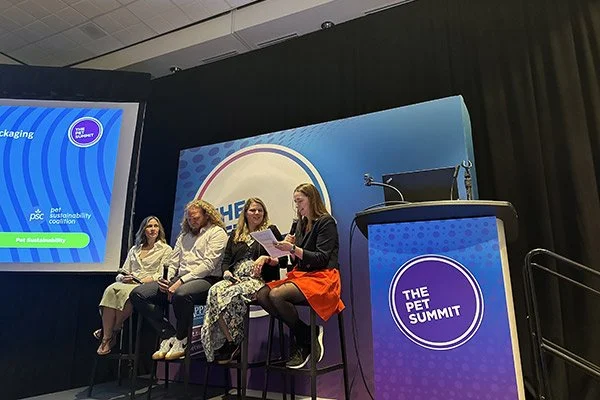
Another disclosure. I'm quoted in this article, but I didn't even know it was coming, so I'm excited. The pet food industry is waking up to EPR. There is a piece from the pet food industry making the case that EPR should be framed as an innovation driver, not a penalty. It's based on a panel that I was a part of with a few other folks at the Pet Summit.
The reason I'm framing it is that it's the audience. The pet food packaging industry is recognizing that multilayer film in stand-up pouches, trays, a lot of their materials that they use in that industry are not recyclable under current infrastructure. If that industry is publicly engaging with EPR, it means EPR is reaching categories that haven't historically been a part of this conversation. That's a meaningful signal. It means that people are waking up to the long-term impacts of this 2032 California regulation that everything has to be recyclable in order to be sold into that state, alongside the increasing EPR fees against non-recyclable materials.
Denver C&D Recycling Facility Launch & Final EPR Policy Wrap-Up
I want to end with a story that doesn't suck. Genuinely good. It is local. A Denver-based company called Iron Women Logistics just received a grant from Colorado Circular Communities to build a construction and demolition recycling facility here in the Denver metro area. It will be the first full-scale construction and demolition recycling facility in Colorado. The facility is designed to support Denver's universe of recycling and composting ordinance and regional diversion goals. Construction and demolition debris is one of those waste streams that rarely gets attention in circular economy conversations.
Most of the focus goes to packaging and consumer plastics, but construction and demolition is the largest waste stream in Colorado, and the infrastructure to divert it has been very thin historically. I love that it's a women-owned building company that's creating infrastructure locally, and it's just a fun, exciting progress forward in circularity. It's not in EPR, it's not federal policy, but it's a physical building that is getting built by someone who decided to build it, and that is like a non-sexy maybe story, but a very exciting story for me.
That's the roundup. The short version, EPR is real, it's funding infrastructure now, it's starting to get that money back into the infrastructure. It's getting litigated against, which I think many people expected, in multiple states at the same time, and the reporting deadlines are now weeks away, not months. That's what I talked about it being operational, this is what it looks like. Major policy shifts look like this. They're messy, contested, and still moving forward.
My advice for navigating this moment is don't let legal uncertainty become operational paralysis. The companies that will be at the best position when the dust settles are the ones that keep building their compliance foundations regardless of who filed what. If you're a producer that hasn't entered the portal yet, I recommend registering and getting into the portal, especially if you haven't registered. If you have registered, just go check it out.
Stay tuned for future interviews that I think you'll enjoy. Thank you always for being here, embracing the messiness that is me being off the air for a few weeks. I guess at the same time I was living intentionally, because I was trying to really be in the moment with my kids while I was on spring break, even though it was just a short trip.
Nonetheless, thank you for being here. Again, if you have a guest idea somebody who's doing real operational work or somebody who's really leading a lot of change email Podcast@CSYImpact.com. Feel free to share this episode if you know of anyone that's also trying to keep tabs on what's going on in EPR right now. Thank you.
Important Links
First Oregon community expands curbside recycling with EPR funding
Oregon judge grants wholesalers preliminary injunction in packaging EPR case
Recycling Partnership CEO on navigating ‘really tough’ moment for recycling
Extended producer responsibility may be innovation driver, not ‘penalty’
Iron Woman Logistics awarded grant for Denver construction waste recycling facility