


Closed-loop packaging demands viable solutions for hard-to-recycle materials. In this conversation, host Christine Yeager sits down with Christian Bruey of PureCycle Technologies and Melissa Vettleson of IPL Schoeller to unpack the mechanics of Polypropylene Recycling. As Extended Producer Responsibility policies reshape packaging mandates across the country, brands face mounting pressure to incorporate post-consumer recycled content into rigid food packaging. Christian explains how dissolution technology purifies polypropylene back into a virgin-like state without breaking polymer chains. Melissa shares the operational realities of qualifying this material for commercial food containers like the SnapPack Square Evo and Cleveland Kitchen tubs. Together, they demonstrate why circular transitions require cross-industry alignment, patience through trial batches, and an ongoing commitment to progress over perfection.
—-
Watch the Episode here
Listen to the Podcast here
How Dissolution Polypropylene Recycling Transforms Food Packaging With Melissa Vettleson And Christian Bruey
In this episode, I am interviewing two people working on the same problem at opposite ends of the plastic value chain. Christian Bruey has led communications, government relations, investor relations, and sustainability work at PureCycle Technologies. He sits on the Plastics Industry Association's Recycling Committee Executive Board and the US Plastic Pack Advisory Council.
Melissa Vettleson brings a master's from the University of Pennsylvania and a background in chemistry, materials engineering, and polymer physics to a company that makes both durable circular products and food packaging. Between them, they sit right on the fault line EPR is exposing. Recycled resin only matters if someone can design it into a product. That product only matters if it performs. They are here to show us what it takes to move recycled content from just a press release to a purchase order.
The Drive to Transform Packaging
How do you live with intention? Funny enough, that was actually a hard question to answer because a lot of times it is just easy to fall into your routine. On reflection, it's funny as it sounds, like the values that we have for our company. One of the reasons I like working here is because they really resonate well with me. Be driven, make sure you are moving yourself towards a goal, own it. Be accountable for the choices you make, and really be true to yourself. Have empathy and be mindful of where others are. I feel like if you start there, no matter what you are building towards, at least you are starting from a positive ground point to move into your day.
I have always had a competitive mindset from life growing up in sports. I joined PureCycle about four years ago, and I had never been a part of a “startup” or a young company that is trying to do something new. That has helped me a ton because there are a lot of different hats that we have to wear, whether it is okay. Now, government relations are an issue. Let us go chase that.
Commercial is something we need to lean into to get this off the ground, or education for policymakers and regulators and even customers. Every day it is okay. There is a new challenge because we are a small team, and we are trying to lead the way with this dissolution recycling technology. It is every day getting out of bed and realizing things like, “It may be tough. We have to conquer it and let us go out and try and win.”
I love that. Can I add a thought to that?
Absolutely not.
Too bad the mic is in my hand now.
You had it.
I did. Your point on being driven, being competitive, we are working in a really challenging field where, like, everything is always uphill. There is always a challenge. It always feels like you are having to push really hard. That is probably one of the reasons.
I like setting a goal. I love that. I am not really a sports person, I now have children that are wanting to play sports. I am like, “I guess I need to get into it.”
Circular packaging transitions aren't easy. You have to wake up ready to solve the operational hurdles every day.
There are a lot. You do not realize it as a kid when you are playing a sport that you are learning something like it is respecting the coach or respecting the opponents. Also, at the same time, it does feel good to come out on the winning end of that. What did it take? Was it hard work at practice? Was it watching something? Where did I learn something that helped me take that next step? Honestly, that is why you come to these conferences. You take something from it to influence a policy or make a difference. There is always something out there for your kids to learn as they are going through this right now.
For me, because I am having to tell them what to learn.
That is true.
Tell me about your partnership.
That is when you talk about the conferences we come to. That is one of the reasons why these are so important. That is where you meet other people facing the same challenges and start having those deeper conversations to find solutions. We actually met at one of these conferences a few years ago. We both had a very similar dream or thing we wanted to compete towards. We started working together and building from there.
Recycled polymers don't behave like virgin plastics. Precise qualification and testing make or break performance.
Dissolution as a Polypropylene Solution
At PureCycle, we recycle polypropylene in a fairly new way known as dissolution, as I mentioned. We produce a high-quality, virgin-like recycled plastic that can go back into food contact containers, which Melissa and IPL produce. There has been an interest in using sustainable materials for a very long time. In polypropylene, there has never been a critical mass of a package, so to speak, that gets recycled. PET has water bottles. HDPE has milk jugs. For polypropylene, it is so versatile.
It is used in yogurt cups and quick-serve restaurant cups and bumpers and ropes and so many different things where there was not just, “We all put this one thing in the bin, and it is going to make a nice, clean, mechanically recycled content.” That is where our technology is a differentiator, and we have been able to go through all the trials and tribulations that go with switching over to a new material. Now we have the SnapPack Square Evo that they have launched just in the past month or so that will allow any brand owner to come to them and say, “I want a sustainable package,” and they have it in seven different sizes that they could use.
Just for the audiences, like, why does it matter that it is one particular type of package versus multiple different types of packages?
Navigating Narrow Operational Windows
From the processing side, more operations side, there are very narrow windows. There are lots of different materials out there, HDPE, polypropylene, PET. Within those, there is lots of sub, how is it going to flow or move through our process? The windows in which it works well can be very narrow. As he said, when you have a very specific stream coming in on that front end, it is much easier to collect only this or only that. You can also get materials that fit in those windows a little bit better.
When you talk about propylene, everyone had their own special recipe when they made it the first time. All those recipes are now in a big mix. How do we get something that fits that narrow window? That is where their material was especially exciting for us because it does have that extra level of filtration. Not only from a food safety perspective, but also from a processing perspective, it is also something that we could rely on a little more.
We started sampling it. We have been doing a lot of front-end work. That is something else I think customers miss is this takes time. The qualification process takes time. There are all sorts of testing you need to do to make sure that it really is as food-safe as you need it to be. That partnership, part of that partnership is trying to get a lot of that work done in the front end so our customers can say, “I am ready.” We are like, “Here you go.”
That is great. Thank you. That is helpful. Can you share, maybe in the past recent years, maybe some of the programs that you have run, or maybe a take-back program or something like that did not behave the way the model said it would and what broke.
Progress Over Perfection in Scaling
We almost went in expecting it to break. Part of living with that intention is like you wake up knowing it is going to be hard. Even in cases like Take Back, you are like, great, we have now got that narrow stream. It is still hard. Especially any time you scale anything up, even if you are cooking at home. It worked really great in that small batch. Now you want to make a giant bowl of soup for your whole family. You are like, “This is not right.” That happens a lot in our field is you and you just go back and you tweak it a little bit more and you go back and you tweak a little bit more. That is the status quo for us.
I would say honestly, we sell recycled resin, and there is a lot of pushback to that because Virgin runs as virgin runs. It is also what they have been using for years and years. You are disrupting the apple cart a little bit. Some of them are interested because of regulations or their own internal goals. It is also going to be different than what they have had before. That is where the technology trying to get it as close to Virgin-like as possible is important. Our technology has helped us to get there. Once again, it is not exactly what they have run before.
There is also a lot of testing. Shelf life testing is very important for food contact items. Those can take 3 to 6 months, and the whole process can take 3 to 6 to 12 months. It is a lengthy process where you have the opportunity for things to maybe need to be tweaked, an update needs to be made, or something goes wrong, and you have to fix it. As you said, you go in expecting some hiccups and just have a team that is ready to barrel through and find a way to win. Once again, to go back to my earlier point.
Remembering that, progress is hard in spaces like this, but perfection is not required for progress. A lot of failure has to be in there. Things not working out the way you expect them to. That is with almost every aspect of sustainability.
We have put 25% in one of their containers. We have put 20% in another. Those are both massive wins. I think some people would be like, that is not 100s, 100's an A plus on a test or whatnot. It is like, once again, we need to crawl, then walk, then run, and maybe eventually we get to 100%. 20% is still a massive, massive difference from what it was before.
You have to push it a little bit. We are running our testing at higher percentages to make sure that we have that room to continue to grow, continue to move. You start that scale-up process. This small batch here, it works real good. What can we do from there? Finding that win and then building off that win is something that is really important if you try and dive right in sometimes. You are going to get hurt when you hit the bottom.
Sustainability initiatives often have a higher bar that they need to achieve than virgin or, because there is a perception or reality related to cost. What do you do when somebody is raising that bar, and how do you overcome that?
It is great to set a high bar. It allows you to chase something and to strive for something. As Melissa said, we are just at the beginning of this collaboration, and there will be ways that we can build upon it and execute and get higher percentages. It is great that there are some of these mandates out there that feel lofty. You look across the pond sometimes at what Europe is doing, and they are hitting those. They can be a blueprint. I am sure they did not set it at the lofty goals that they have right now. They did not get to the percentages that they got to right away. They had to grow into that. That is what we are doing here.
They have the material to supply into it, because back to that partnership piece too. We are just two pieces of the puzzle. We are in the middle. On the front end, the Mervs are investing there, and they are. Sorting it better, getting more materials in. We need the consumers to care and to sort things and put them in the right bins. We need the brands that want to join us and make that investment because it is more expensive. People look at it. They are like, “It is trash.” Look at all the work and all the steps that had to go into getting it here. Circularity takes work. It takes investment. The further we get down that path, the more that comes down, and it gets a little easier.
Christian, can you share, like, it is a new product. It is a new output of polypropylene. Can you share how you got it recognized, how long did it take, what were some of the criticisms, points?
Overcoming Advanced Recycling Scrutiny
I would say the advanced recycling space is new. There are a lot of different technologies under that umbrella term. Dissolution is one of them. At first, we were being lumped all together. It was like, “We are just not going to allow any of these to count as recycled content specifically in New Jersey.” We had to go in and educate and show them that dissolution is a physical process. We just changed the state of the polypropylene, much like you would change your water into ice. It is still HTO. It is still polypropylene through our process the entire way.
Physical recycling processes like dissolution retain the polymer structure while slashing emissions compared to virgin plastic.
We are not breaking it down to its basic building blocks. We have polypropylene in, and we have polypropylene out. That is why we are also able to get APR certification, which we have, which is very important with our regulations in California. It has been a process. It is one of those things where I think if you have enough time with the people who are trying, and they are willing to open their minds and learn and not just listen to maybe some of the publications or whatnot that have been put out there or something that is on social media, we have an opportunity to educate them and show them that it truly is different than what they have heard about.
I know California has a lot of similar requirements around the environmental impact of the process. I guess the output has to be as environmentally friendly as the input.
That is another benefit of our technology is because we are not breaking down the polymer structure. We use significantly less energy than virgin polypropylene production, up to 25%. Greenhouse gas emission reduction versus virgin polypropylene. Those are extremely important. The other piece in California is that they do not want you to produce hazardous waste. We do not produce any hazardous waste through our process.
We have two co-products that we call them, and both are actually Green Circle certified for recycled content, and they can go back into other marketable applications. The pure five resin that we are selling to Melissa and IPL is the most important thing. It is the largest yield of the output. Other items can also be used as certified recycling content.
If somebody is leading an uncomfortable change, generally, the people who listen to this are leading it in the recycling space. I have some other people. I do not know. How do you lead through uncomfortable change?
Unifying Cross-Department Alignment
It is important that you let people be heard. You cannot just go in and say, “No, this is right. This is the solution.” It might be that you need to hear where their discomfort comes from. Are they concerned because it is new? Are they concerned because they do not know enough about it? Is it safe? Are they concerned because it is expensive? Are they concerned because there is some level of risk of investment and you need to come back with more information? Really being open-minded to what those challenges are in their eyes so that you can work together, try and build it up, and find a solution.
Nothing beats seeing your circular packaging on store shelves after years of collaborative engineering.
That is all part of the collaboration. There is going to be someone that is hesitant about some piece of it. Compared to the commercial process of getting a new material qualified, you are going to go through regulatory, and you are going to go through the processing of the material. Are there adjustments that need to be made? You are going to go through procurement. There is a premium to this product, and they are going to want to know why.
Does marketing get involved to show them, like, here is what we can do to offset some of that premium that you are going to have to pay, and we can put something on the package that shows to the consumers or to the customer the value-add that you have? Change is hard, but I think when you bring everyone together, and everyone is pulling in the same direction, it is much easier because they are certainly partnerships that are going to have those challenges where someone may be pulling the other way.
You just have to go get them through that to get everyone pulling in the same direction. Once you do, it is awesome because I will say, like, what we have been able to do with IPL to get the Cleveland Kitchen pickled containers out there and one of the largest retailers in the world like how cool and awesome is that. I had friends call me and tell me, “I love Cleveland Kitchen sauerkraut. I love their kimchi.” It's just that part of it, like once again, I have been in this space for four years. Never did I think I would be so excited to put a package on a shelf in a store. It really is awesome to see it all come to fruition.
It is super fun. My first job was working with Coca-Cola's packaging production team. It is so fun seeing the package that you worked on on the shelf. You are like, “Look, I did that.” You get some really weird habits in this space. When I go on vacation, I am like, “How is that package made?”
The number of pictures I have.
We went on vacation this summer. In my camera roll, there is like, "Look at this innovative package.” Do you have this or not? Just being open-minded like that, though, because sometimes you are the one who needs to sort. It is that part of having that empathy, and you want to be driven towards your goal. Sometimes you need to be self-aware and track yourself too and make sure that there is not something you missed so that you can get to that success and not be suddenly standing at the edge and be like, “We did not think about that.”
You end up with a stronger solution in the end.
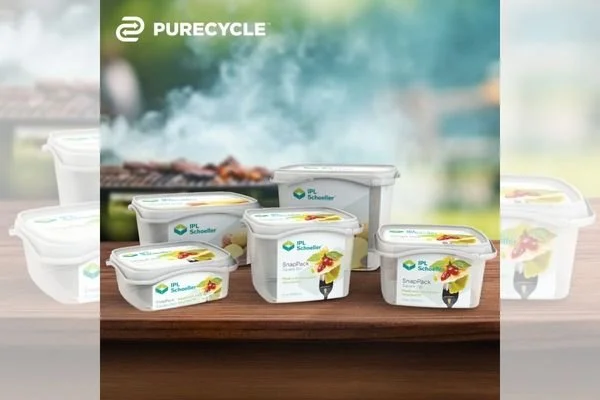
Polypropylene Recycling: Dissolution technology purifies polypropylene back to virgin-like quality, opening doors for recycled food containers.
The Thrill of Tangible Results
Sometimes you got to go back to square one, and that sucks. It is part of the process. That is how we got here. I’m very excited. This packaging, both the Cleveland kitchen package that is out there in the stores now and what we are doing with the SnapPack Evo line. We figured now is the time to invest, do that front end. It is very exciting for everyone on our team. It is something that for years we have been talking about, and thanks to this partnership, it is a reality.
Awesome. Thank you for talking about it with me.
Thank you.
Thank you very much.
---
What a great conversation with Melissa and Christian, who have been partnering to bring to the market a new, innovative, recycled polypropylene. One of the things that I really enjoyed about that conversation was that a couple of times they talked about how important it is to expect failure, to expect this opportunity to make mistakes and pivot so that you go into something that is hard, knowing that it is not going to be perfect. Having that type of mentality, being ready to pivot, is going to make you that much more likely to be successful.
We also talked about using technology to achieve progress, but knowing and accepting that it is going to be bumpy along the way, that it will not be a silver bullet, that there will be things that the technology can solve and things that it will continue to be challenged by, like using recycled material is likely never going to be as easy to use as virgin material in a machine that is built for virgin material. That does not mean you stop pushing the limits. They talked a lot about how they push their teams.
They push their leaders across the organization to think differently about how you can bring recycled polypropylene into packaging solutions. That started with having partners who were open-minded. Also, being ready to answer some of the tough, critical questions about your solution. I thought that Christian did a great job sharing some ways in which this technology is different from some of the other non-mechanical recycling solutions. I hope you enjoyed the conversation, and we will see you next time.
Important Links
IPL Schoeller Partner to Produce Sustainable Container for Cleveland Kitchen
Recycled Polypropylene Food Packaging: A Sustainable Solution with 25% Recycled Content
About Melissa Vettleson

Melissa Vettleson brings a distinctive blend of scientific expertise and manufacturing insight to sustainability initiatives across the packaging value chain. With a master's degree from the University of Pennsylvania and a foundation in chemistry, materials engineering, and polymer physics, she has built a career that bridges technical innovation and practical implementation. Representing a company with a diverse portfolio of durable circular products as well as food packaging solutions, she has broad exposure to sustainability issues across multiple markets. Melissa works at the intersection of materials innovation, product stewardship, and circular economy advancement.
About Christian Bruey

Christian Bruey is a communications, sustainability and external affairs leader at PureCycle Technologies, where he has held leadership roles spanning communications, government relations, investor relations and sustainability initiatives. He currently focuses on advancing circular economy solutions and helping organizations, municipalities, and industry partners address plastic recyclables through innovative recycling technologies.
Bruey is an active member of the Plastics Industry Association where he serves on the Recycling Committee’s Executive Board. He is also a member of the Association of Plastic Recyclers Communications & Public Affairs Committee and Market Development Committee. PureCycle is also a member of the U.S. Plastics Pact, where Bruey serves on the Pact’s Advisory Council and Communication/PR and PCR Content workstreams.
Prior to his corporate sustainability career, Bruey built a strong foundation in strategic communications and public-facing storytelling through sports broadcasting, media relations and live event hosting.