

The Power Of Embracing Change: Personal Transformation & Professional Strategy With Ashley Fahey

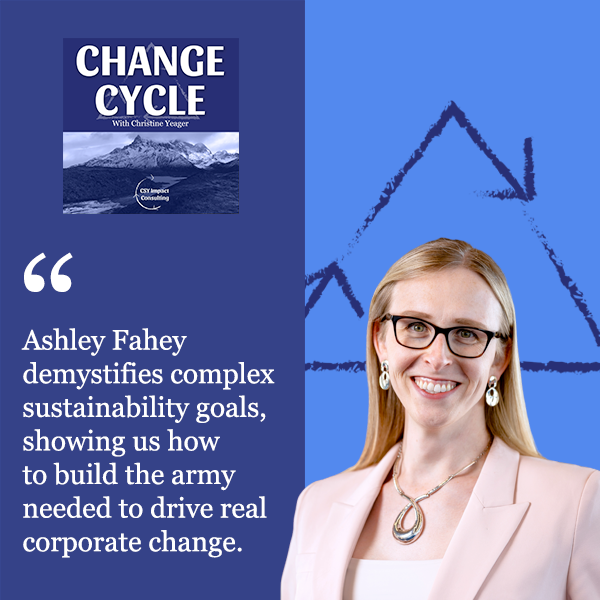
Why is embracing change so essential for progress, both in life and the corporate world? Christine Yeager welcomes Ashley Fahey, former Senior Manager of Global Product Sustainability at Kohler Company and incoming sustainability lead at MilliporeSigma, for a dynamic chat on personal and professional transformation. Ashley shares powerful insights from her journey as a transgender woman, applying that courage to her work in corporate sustainability to demystify complex goals and 'build the muscle' for change. Hear how she leveraged a "red-green" scorecard to rally the troops for the "Goodyear Better Future" strategy, and how reframing sustainability around health and the circular economy can bridge political divides.
—-
Watch the episode here
Listen to the Podcast here
The Power Of Embracing Change: Personal Transformation & Professional Strategy With Ashley Fahey
Optimism Vs. Fear: Key Themes From The Sustainable Brands Conference
Welcome back to Change Cycle. I know. It's been a while. Thanks to all of you who have continued to tune in to the show. As a woman, I try not to apologize for life getting in the way of other things, but it's a hard habit to break. I do want to clarify that this show is a priority of mine. It's just been a few various challenges, including a surgery that I thought I could bounce back from faster than I did, and some silly technical challenges with uploading this episode that you're about to read.
The next two episodes were recorded live. It's my first time recording live. They were great conversations. I hope you'll enjoy them. They're great topics. I was at the Sustainable Brands Conference a few months ago. It was a great conference for me. I hadn't been to a brand-specific conference in a while since working at Coca-Cola. I was joking that the last couple of conferences I've been to, I'm talking to landfill operators and MRFs about the real hard challenges related to recycling, which is super fun, in my opinion, as a waste nerd. It was nice to pick my head up and start to think a little bit more about the context from a market research standpoint, what's going on in the marketplace, and learning about consumer insights.
There are a couple of themes from the conference that I want to share with you before we dive into these next two episodes. There was a challenge to find a cause for optimism, not fear. In this tumultuous time, in the sustainability sector specifically, some people are feeling a little like the boulder is heavier, and the hill is steeper. There was a challenge at this conference to maybe think of laughter as a tool of resistance.
That also tied into another theme that they brought out through this conference, which is that even though the country can feel divided, the consumer research shows that it's not as divided as it may feel or be shown in the media. There's a lot more common ground. It's about, in many cases, how you frame your message. For example, they talked about the fact that maybe you think of yourself as a conservationist, not an environmentalist. I'm thinking that the way things used to be is more appealing than thinking about the innovation that needs to happen.
Thinking about the fact that we need to go back to the way that things used to be is a way to maybe speak with somebody who has a differing opinion about what the future should look like, but maybe has a lot more in common and how we get there than you think. That was good advice. Something I've been thinking a lot about is how to frame up in the context of health and how sustainability initiatives often are impacting human health, and how a lot of these initiatives are bringing us back to the way things used to be. Think about how people used to be very diligent about reuse because they didn't have the money to buy new things, and an encouraging message around finding common ground.
Finally, one thing I noticed at the conference, which you've seen now happening in the marketplace, is that the economy is hitting brands hard. Margins are squeezed because of tariffs and various other aspects of the economy. That caused a lot of travel budgets to be cut. There were a lot fewer people at this conference. Part of it could also be greenhushing. My read on the situation and on the fact that I was at that conference, many brands have announced layoffs. It's an economic challenge that's holding companies back from maybe speaking about things or participating in conferences. Those were some of my insights. I'll talk a little bit more about more insights in this episode. I hope you enjoy. Thank you.
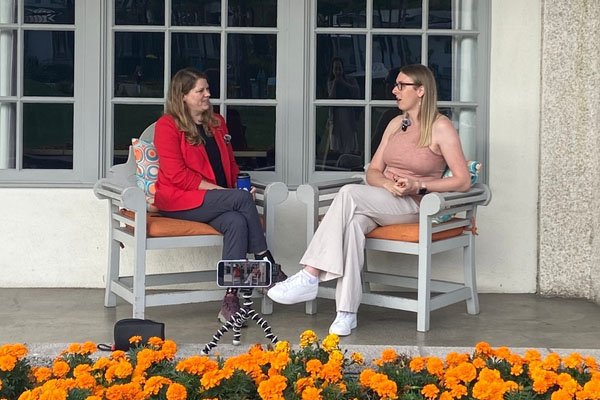
From Kohler To MilliporeSigma: A Career In Global Product Sustainability
Welcome back to Change Cycle. We are in sunny San Diego. It's a little cloudy, but that's okay. It's beautiful here. We're here at Sustainable Brands. I'm super excited to be here with Ashley. Ashley and I met at the Circularity Conference put on by Trellis, which used to be GreenBiz. Maybe it was still GreenBiz at the time. It doesn't matter. The point is that she gave an incredible presentation about bathtubs and other things. I was taken aback and enjoyed your presence and how you talked about sustainability and the work that you're doing. I'm excited to hear more. Why don't you tell everybody who you are and how you live with intention?
My name is Ashley Fahey. My pronouns are she, her, and hers. I am in the midst of a career transition. I served as Senior Manager of Global Product Sustainability for Kohler Company, kitchen and bath products space, which is why I was talking about bathtubs and design for the environment at the Circularity Conference. I'm about to start a new role with MilliporeSigma, a life sciences company. We'll also be working on product sustainability, supporting the types of products that are used in the manufacturing of vaccines and pharmaceuticals. I am interested in and excited to get started with that new role.
In my personal life and my background, I've been working in sustainability for over seventeen years now, which is crazy. I studied Sustainable Business for my undergraduate degree at Aquinas College. I also have an executive MBA from Michigan State University. I was with Steelcase, the office furniture manufacturer, for about seven years. I transitioned to work at Goodyear, a tire and rubber company in Akron, Ohio, for about three years before Kohler. I have been to a lot of different places and learned a lot along the way.
I am also a proud transgender woman and a lesbian. We're in this moment where we're seeing some anti-ESG and anti-DEI backlash. Sometimes, it feels like we're getting hit from both sides, both personally and professionally. I've had a lot of good, positive experiences along the way that give me hope that we have a brighter future still ahead. Regarding the living with intention piece, I was reflecting on this. I'm not much of a religious person anymore, but I grew up in a Christian household. A lot of what I learned through that time in my life has stuck with me. It has been foundational to the way I live my life and the values that I have, and even bleeds into my profession.
There are two things that have stuck with me from that time in my life. I don't do this as much anymore, although I feel like I internally feel it. Every night before I went to sleep, as I was lying down, I would reflect on gratitude, everything that I was grateful for in my life, like family, friends, relationships, and the fact that I had a roof over my head and access to transportation and education. That grounded me in that intentionality and that positivity that I have a lot to be thankful for. The second thing is the Serenity Prayer. Do you know what that is?
Yes.
I heard that for the first time at a young age and ran into it at various times, but it's stuck with me. It's essentially, “Grant me the serenity to accept the things I cannot change, the courage to change the things that I can, and the wisdom to know the difference.” I thought that was so profound, but it's so simple, too. There are some things in this world that are out of our control and that we're not going to be able to change. Sometimes, we need to let go and accept those. There are some things that we can change that are within our power. To the extent that we can affect positive change in this world, we should.
Personal Transformation: Finding Freedom Through Embracing Change
I love that. Good reminder. I did hear that a lot as a kid, too. It's hard to, especially in the sustainability space, feel like you're doing enough. We were talking about this. It feels like it's never enough. It's never fast enough. To your point, there's only so much you can change. You need to focus on what you can drive and the impacts that you can have. On that note, what advice do you have? You've experienced a lot of change in your life. I talk about opting into change on this show. Some you opted into. Some you've led. What advice do you have for sustainability professionals in trying to embrace change?
Change is often scary. In the conversation we were having, one of the things we were talking about was that we all have this momentum, where we're moving along in life, whether personally or professionally. The things that we know are comfortable. The status quo is comfortable. Any disruption to that, even if it's towards something positive, can be difficult. I also think that change is inevitable in our world. When you're faced with change or an opportunity to change, the faster you can rip that band-aid off, the better.
Change is inevitable in our world. When faced with change or an opportunity to change, the faster you can rip that band-aid off, the better.
In my personal life, I mentioned that I'm a transgender woman. I went through much of my life trying to meet other people's expectations of me or society's expectations of me. I did all the things I was supposed to do. I graduated from college. I met a girl. I got married and was planning on having kids. We bought our house and all of these things. There was something inside of me throughout most of my life. I've always felt more feminine than masculine.
I was taught to behave a certain way when I was younger. The idea of breaking out of that mold, embracing who I was, and showing my full self to the world was scary. It was something that I resisted for a long time as a result, because change is scary. Once I made the difficult decision to embrace who I was, to accept my identity, and to begin a transition, it was incredibly freeing. It was like a burden was lifted off my shoulders.
It wasn't something I had to think about anymore. I could live my life the way I wanted to. It wasn't easy. It's a process. It happens over time. There are a lot of difficulties, especially in our world today, for my community. Ultimately, that change was a positive thing. I am happier, more satisfied, and more fulfilled in my life in so many more ways than I ever was before I transitioned.
How To Lead Corporate Change: The Goodyear Better Future Scorecard
One of the things I noticed in opting in to change is that even if you want it, it's still hard. There are so many moments of self-doubt. Am I doing the right thing? Am I questioning? First, how did you make it through those tough times? What did you do to move yourself forward? On the flip side, are there things that you learned through this massive personal transition that you've been able to apply in other work scenarios or in other ways to have empathy with other people as they are going through change themselves and things like that?
For me, it's keeping a North Star, especially if you're leading change, either personally in your own life or professionally. It is understanding why you're doing that, having that goal in mind, to the extent that you're leading other people through change, and communicating that goal very clearly. Let them see the vision. Let them see the end result that's desired. That definitely helps to keep you going when you face those obstacles, the difficulty, or the resistance.
Some of my experiences in leading through change have been professional, too. One of the things that we talked about briefly was my time at Goodyear. I spent three years at Goodyear. I was working on corporate sustainability strategy, governance, and transparency, working very closely with our Director of Sustainability. We essentially developed a whole new strategy. We were rolling it out to the organization, except we didn't have the buy-in throughout the organization.
The senior leadership wasn't all that engaged in sustainability. We had a sustainability team, but most of the folks in all the other business functions either weren't aware or were not engaged. We had a big challenge ahead of us. One of the ways that we rolled this out is by implementing a new governance structure. Our strategy was called Goodyear Better Future. This was our Better Future governance structure. We had a Better Future working group that was working to implement change in various functions of the company.
In the next level above them, we had the Better Future Steering Committee. There was some accountability and prioritization happening. Ultimately, the work that we were doing was reported all the way up through the C-suite and to the board of directors. The way that we drove that change was by driving accountability and ownership of the goals, targets, programs, and processes that we were working on.
We developed a scorecard for each function. Everybody had a scorecard they filled out. What are the goals and targets that you want to set? What are the ambitions that you're driving toward? How are you measuring them with KPIs and metrics? What are the programs, projects, or processes that you have in place to work toward those goals? How are we doing? Are we on track or off track? Lastly, how are we communicating about this, either internally or externally? How are we being transparent?
We empowered each functional owner to develop their own scorecard and own it. We had a simple red-green scoring system. Are you meeting the expectations or requirements of this scorecard or not in each column? That rolled up to a dashboard where our senior leadership team could quickly see at a glance. How are we doing? Are we more green than red? Are we more red than green? What are the areas we need to focus most on?
Part of what drove that was accountability, but almost like a gamification in a way, because you see these mid-level and senior-level leaders from different functions almost competing against each other. They all wanted to be green. They don't like seeing the red. That helped to get us over that hump that allows us to drive change. It worked. I'll end this question by saying that by the time I left Goodyear after three years, the senior leadership team was talking about sustainability much more regularly.
The CEO was talking about it in his quarterly business updates and his quarterly investor calls. Our Chief Technology Officer had an internal town hall where he said sustainability was one of the top two things that kept him up at night. You saw so much more engagement from the core of the business. People knew what the goals were. They were all working toward them.
It breaks down and demystifies it when you can put it on that very clear scorecard because sustainability can be so polarizing and also difficult to break into if you don't come from that space. If you don't know the terminology, you don't know the words. You don't know what these goals mean. What do they mean to your business? I found that at Coca-Cola, we weren't short of people passionate about supporting sustainability. They didn't understand how to bring it into their everyday lives. They're like, “What is my role? How am I supposed to help?”
I found that a lot of people are engaged and energized by working on sustainability, even if it's not their core function and they've never touched it before. You talk about doing the right thing for the people in this world, our planet, and their children or grandchildren. That energizes people. It gives them a purpose to come to work and to do the things that they're doing. If you give them the tools, resources, and language to do those things, most people will jump on board willingly.
Embracing Change: A lot of people are engaged and energized by working on sustainability, even if it's not their core function and they've never touched it before.
Bridging The Divide: Unifying Language For Sustainability And DEI
We mentioned we're at Sustainable Brands. I don't know how exactly I feel about this, but I've noticed that they brought up this idea of talking about people's children and specifically their children's health in relation to sustainability as a way to approach people that you may think aren't always as engaged in sustainability as you may perceive. The reason I don't know how I feel about it is that not everybody has children.
What about those people? I'm always trying to be inclusive. Also, women are not just important because they have children. That's the other part that bothers me about the focus. I guess that is what the data is saying. It is true that women are increasingly having the purchasing power of a household. We are at a brand conference. That was a side note. Reiterating what you're saying is that that's something that's being talked about here at this conference. It's a very key, important aspect of the sustainability conversation.
The broader thing that gets at is how, in this moment in time, our country, at least in the US, is so politically divided. We're getting further to the left and further to the right, heading more toward extremes versus coming back to the center and meeting in the middle. You don't see as much bipartisanship. You don't see as much working or talking across the aisle. Things like focusing on the children are a common denominator that a lot of people can relate to, whether you're on the left, on the right, or in the center. Even if you don't have children and that's not a priority for you, you can understand why that would be important to somebody.
You understand that your generation is not going to be the last generation. There's a whole other generation of people that we are leaving this world to. We need to leave a better place for them. It's beyond children, too. The broader theme is the language that we can use the way that we can talk about sustainability or DEI, even though we need to move away from that acronym because it can be polarizing. How do we talk about those topics in a less polarizing way? How do we talk about it with a unifying language that appeals to a broader audience so that we can move our objectives forward in a shared way? There are a lot of common values between all of us.
There's a whole other generation of people that we are leaving this world to. We need to leave a better place for them.
Another one that I've heard a lot of talk about here, and my personal experience that I know resonates with a lot of people, is protecting nature or wildlife or protecting our lands. There are a lot of people on the conservative end of the spectrum who love spending time outdoors. They go hunting, fishing, hiking, or camping, whatever it is. Those are also experiences you can share with your family or your friends. You need to ask people about why they enjoy spending time outdoors. That's a common denominator. That's a place where you can find that common ground and help to move them in the right direction of protecting those resources.
Waste does that a lot. It was interesting in this conference that somebody was talking about how Republicans generally want to talk about the way things were. It is true that a lot of times, circularity solutions are actually going back to the way things were. In New York, when waste management was brand new as a thing, everybody sorted all of their waste. Eventually, somebody came up with the idea of a single bin, and here we are. Nobody knows what to put in the bin. It is very powerful to think about how to change your language.
It is interesting. In the conversation we were having, we talked about this. Especially some of the older generations and the Baby Boomer generation, they grew up with and still remember those times when you were finished with the glass milk jug or container in your refrigerator. You would set it out on your front porch. The milkman would come around, deliver you fresh milk, and take that container back. They would wash it out, refill it, and re-deliver it.
That is circularity, that reuse and getting away from these durable single-use plastics and things like that. That is circularity. It's not a new concept. It's maybe rebranded. Some of that generation, as we were alluding to, are saying, “How do we get back to that?” They're open to things like that because it's what they know. It's what they grew up with. That might be a way that we can help enable that change to bring about a circular world.
The Future Of Circular Economy: The Kohler WasteLAB And Built Environment
Speaking of the circular economy, can you share some of your experiences and maybe what you think is the future for the circular economy?
I wasn't working directly on circularity as much earlier in my career, but I loved and resonated with the concept. When I was at Kohler working on product sustainability, they had an existing product sustainability program called Design for Environment that I was inheriting and helping to continue and roll out. They weren't talking about circularity as a concept, even though they had some great circularity examples with the Kohler WasteLAB.
The Kohler WasteLAB actually uses waste materials from Kohler's own manufacturing operations, from vitreous china, like toilet and sink manufacturing operations, and also from their cast iron, like the bathtubs manufacturing. They are using those waste materials to then create something new, beautiful, and functional that can be sold as its own product. They started with decorative tiles for the kitchen and bathroom, and launched a new sink.
Kohler's got a great circularity story, but they weren't talking about it that way. A lot of the product development folks outside of the WasteLAB had not been exposed to this concept of circularity. One of the things I did was I organized a circularity workshop for over 100 people in the new product development organization, to even pull some of those existing concepts they were familiar with from Design for Environment, and introduce them in a way that this is what circularity means.
These specific types of design strategies will help to add more recycled content or design for durability, so our products last longer, or design for circularity at the end of life, so that this product can be easily disassembled or recycled. In that workshop, I brought in examples from within Kohler, like the WasteLAB, but also from outside of Kohler and other industries on how companies were advancing circularity. The more that we demystify this, talk about it in plain language, and explain the practical ways that we can advance circularity, the more it makes sense to folks. They're willing to get on board.
That was one way. I've also attended the circularity conference a couple of times that Trellis puts on. You mentioned earlier that's where we met. I love all of the workshops, the speakers, and the conversations I have there. In the one that we had in Denver in April-May of 2025, one of the things that was being talked about a lot was circularity in the built environment and the need for creating a demand, a backlog, or that pull for circularity across the value chain in the built environment.
With building owners, developers, architects, engineers, construction firms, and the folks that are occupying those spaces, if we are all getting on the same page in some way and demanding that circularity or pushing it in the right direction, offering up those circular solutions where they exist and then creating that that menu of options for designing circular buildings, that'll do a lot to advance the cause.
If we can all get aligned and push for circularity, offering solutions where they already exist and creating more options for circular building design, we’ll move the cause forward in a meaningful way.
Part of the challenge is that we don't have the infrastructure for it. We don't have a building products take-back and warehousing system that we can reuse and resell those materials. One of the concepts I was proposing and talking about was starting a circular buildings coalition. We can bring all those players together across that industry to drive that demand so that we can advance circularity in the built environment.
The city of Boulder has a city ordinance that requires that 60% of the materials when you tear down a building have to be diverted from the landfill. To your point, they also have to create a place where you can take those building materials. I know almost nobody except for maybe San Francisco can recreate what Boulder has because you need to have the income that they have in the city of Boulder, but they did have a city-owned MRF. Next to the MRF, they have a hard-to-recycle facility. Next to that, I don't know what they call it, but it's like a Home Depot of used items. You can go in there and get used countertops, cabinets, and refrigerators.
It is like a Habitat ReStore thing, but on a commercial scale.
Exactly. It's interesting. It's a city-funded. It is about having more of those available, but it is hard. You need to have the funds. I always joke. People are like, “Why are some states not as far along?” It's because they have major other infrastructure challenges that they have to pay for before recycling. Think about Louisiana and its abysmal recycling rate. You also drive through New Orleans. There are a ton of potholes. There are safety concerns. There are a lot of infrastructure challenges. Power goes out all the time. They have to fix it first.
The Boulder example, and there are other examples around the country and in other parts of the world, shows that it's possible. If the will is there, the political will is there to start. In an ideal world, we don't have to resort to regulation, to writing laws or ordinances to make this happen, but that may be the case in the short to medium term. It shows they were successful. They passed the ordinance and shared their results at the Circularity Conference. They exceeded their goals. They exceeded their expectations. Folks are getting on board. It goes to show you that it is possible. It's just that it's not the way that we've asked that industry to operate in the past. It's a paradigm shift. It's changed. It's hard.
Final Thought: Why Embracing Change Is Inevitable And Essential
It's uncomfortable. On that note, we always end with, “Why embrace change?”
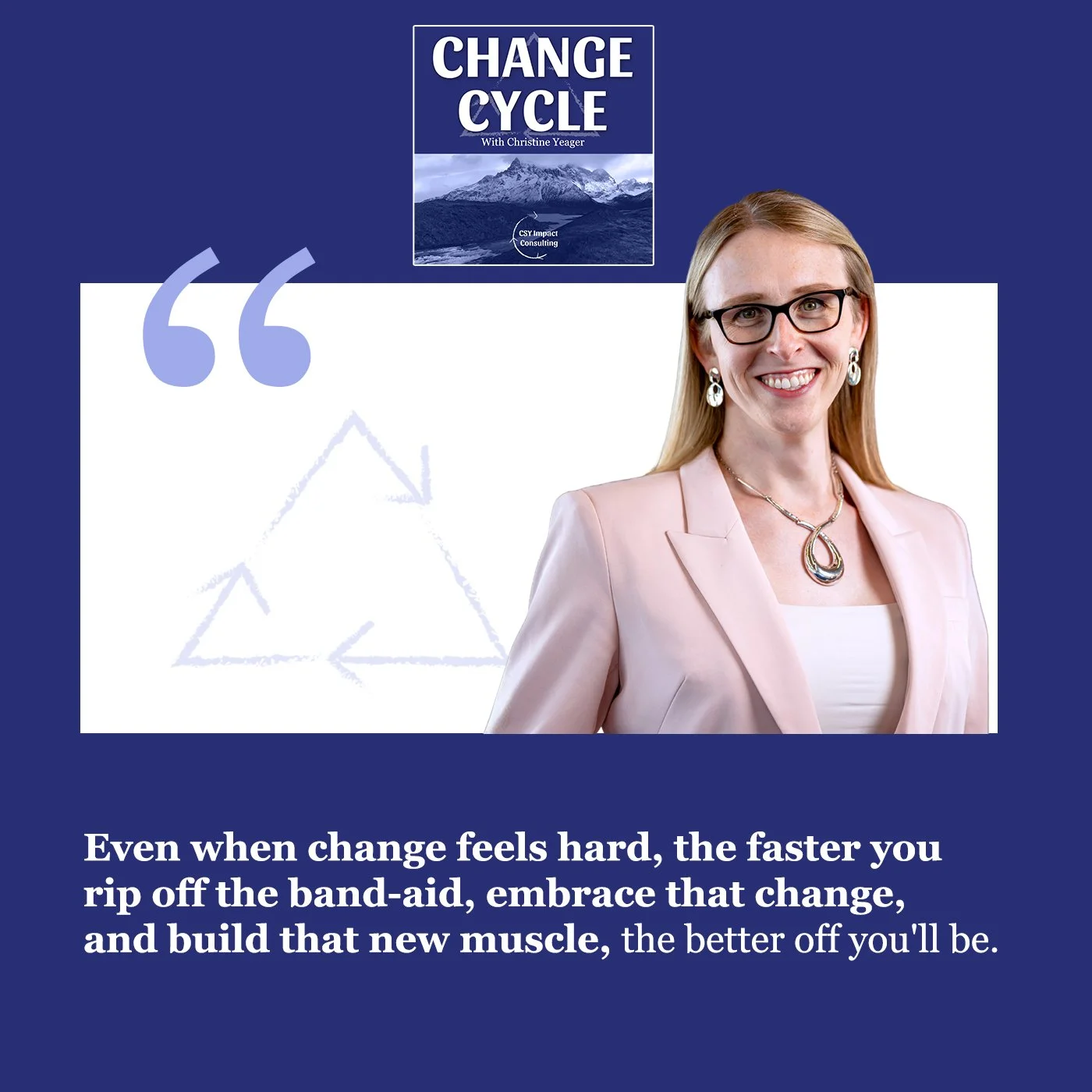
As I alluded to earlier, change is inevitable in our world. We are living in a time where technology is advancing so rapidly, with things like AI. Even with this show that we're talking on, it wouldn't be possible without change and embracing change. Even though it can be difficult to adapt when you're confronted with change, the faster you can rip off that band-aid, embrace that change, even if it's hard, build that new muscle, and get used to whatever that change is, the better off we will be.
Even like that, building the muscle is so good. I think about the feelings I get when I do something uncomfortable. The more I do it, the feelings don't necessarily go away, but the more comfortable I get with feeling that feeling of discomfort. Thanks. This was so great. I appreciated the Serenity Prayer aspect at the beginning, grounding us in this idea that there's only so much change we can drive, but that doesn't mean we shouldn't drive it, and giving ourselves that grace. You gave a couple of great examples about demystifying sustainability in a way that helps bring people along.
That's so important and critical in our industry. Sometimes, we forget that people don't know this stuff because we're talking about it all the time. This is true in a lot of industries. In Coca-Cola, you show up, and they give you an acronym, a dictionary. At the same time, it's so important for sustainability professionals to think in that manner. Otherwise, I would never host a show about it, but also because making it approachable means you get this opportunity of other people's ideas. As you said, it made it a competition.
Once they understood the red, the green, and their role, then you've built the army. That's what you need. You need the army because we can't be alone pushing this heavy boulder up this hill. There is reimagining circularity, thinking about the different ways to think about circularity. How do you bring some innovative ideas to the people who are already doing it in some cases? It is showcasing that and storytelling around that to inspire others. It's another good tool and lesson for everybody. All in all, thank you so much for being here. This was great.
Thanks, Christine. I had a great time.
Important Links
About Ashley Fahey

Ashley Fahey is a sustainability expert with over 17 years of experience, including over 14 years with large, global manufacturing companies.
Most recently, Ashley served as Sr. Manager, Global Product Sustainability for Kohler Company. Prior to Kohler, she spent three years as Sustainability Principal for The Goodyear Tire & Rubber Company and seven years in sustainability at Steelcase.
Ashley was featured in the GreenBiz 30 Under 30 list in 2019 and was an Environment & Energy 100 honoree in 2022. Originally from West Michigan, Ashley holds a Bachelor of Science degree in Sustainable Business from Aquinas College and an Executive M.B.A. from Michigan State University.
As a proud transgender woman, Ashley enjoys advocating for the LGBTQ+ community as a member of the HRC Cincinnati Steering Committee, and previously led the Goodyear Pride Network ERG and Kohler Proud BRG and served for five years on the Advisory Board for PFLAG Cleveland. Ashley and her wife, Laura, currently reside in Cincinnati, Ohio with their two dogs and two cats.