

Why Education Alone Can’t Fix US Recycling: The Systemic Barriers You Need To Know
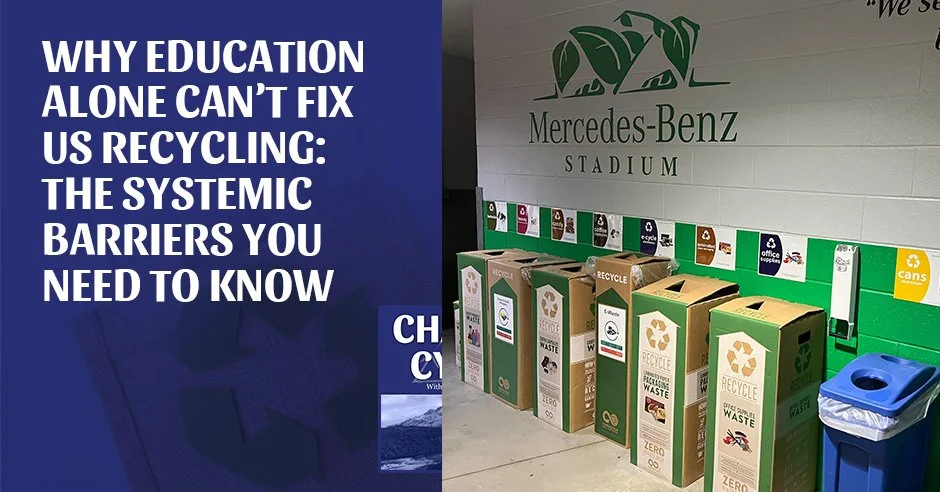
Why is recycling still broken in the U.S.—even when consumers are trying to do the right thing? The problem isn’t a lack of education or effort. It’s a fragmented system built on inconsistent state laws, conflicting definitions of “recyclable,” and outdated standards that confuse consumers and brands alike.
In this deep dive, Christine Yeager explains why blaming consumers misses the mark, how Extended Producer Responsibility (EPR) laws in states like California, Oregon, and Colorado are reshaping recycling rules, and why education can only work when the system itself is aligned. From the FTC Green Guides and APR testing standards to the reality of plastics, textiles, and flexible packaging, this conversation reveals what’s really standing in the way of higher recycling rates—and what needs to change to rebuild trust in the system.
If you’ve ever wondered why recycling feels so confusing, this episode breaks down the structural issues behind the headlines—and why fixing the system matters more than lecturing consumers.
---
Watch the episode here
Listen to the podcast here
Why Education Alone Can’t Fix US Recycling: The Systemic Barriers You Need To Know
Education Alone Can’t Fix Recycling
In this episode, we're going to dive into a topic that I think comes up a lot, I don't know, maybe just for me, but I think for lots of other people. I think if you've spent any time in sustainability, recycling, or in packaging, or in the circular economy space, you've heard the line before, “We just need to educate consumers better.”
This shows up in boardrooms, it shows up in policy debates, it shows up whenever recycling rates disappoint. If you're a recycling nerd, it can show up at parties or on the sidelines of kids' soccer games, or sometimes at the doctor's office when they're trying to distract you from a painful or long procedure, like, “Why can't consumers just do better?”
The Inconsistency Problem & The Role Of EPR
Here's the truth: recycling in the US is not failing because people don't care or aren't trying. It's failing because we built a fragmented system and then we asked education to compensate for it. Now, education does matter, but education can't fix inconsistency, missing infrastructure, or broken economics. EPR is trying to help change the narrative on that and take the burden off of the consumer or the person throwing the trash away.
Before we dive in, we'll do a quick vocabulary check per use. First, I'm going to start with recyclable. What do we mean? We're not talking about something that's technically recyclable in a lab, we're not talking about something that can be recyclable somewhere else, and we're not talking about something that's recyclable if conditions are perfect.
In this episode, recyclable means it's collected, sorted, and processed in your actual waste system now. Each state has a different definition, going back to the whole point about inconsistency. California says that it needs to be collected by recycling programs covering over 60% of the California population. It needs to be sorted into defined streams and reprocessed into new products at scale. This definition also is being applied to marketing claims, labels, the use of the triangles, chasing arrow symbol.
Oregon has a definition of something that is recyclable if it is collected, processed, and managed through a responsible end-market under the state program plan with this new EPR legislation. It needs to show up on the Universal State Collection List. If it is not on this Universal State Collection List, then it's not considered recyclable in the state. It may be still collected by the producer responsibility organization, but it's not fully statewide considered recyclable.
Colorado, similarly, has a minimum recyclables list, not to be confused with the USCL. This is the MRL, the statewide list of recyclable materials. These are minimally accepted, which means every place that accepts recyclable materials has to also accept these materials. They also have an additional materials list. These are similar to Oregon, also accepted in some places, but not everywhere. Both Colorado and Oregon have explicit criteria and processes for moving a material onto the minimum or universally accepted recyclables list.
Varying Definitions Of "Recyclable" Across US States/Organizations
APR, or the Association of Plastic Recyclers, also has a definition of recyclable, which is a package is recyclable if it is compatible with existing US recycling systems and does not negatively impact the recycling of other materials. Association of Plastic Recyclers has a laundry list of definitions and ways in which you can test your material to find out if it can be collected in the current US recycling system and make sure that it does not contaminate or degrade other streams.
The FTC Green Guides, Federal Trade Commission has green guides, which hasn't been updated in a really long time, and we're all hoping it gets updated soon as it was supposed to be updated years ago. Nonetheless, they have a definition of recyclable for what can be claimed as recyclable on pack. It must be collected, separated, and reused or reprocessed in a recycling program, similar to all the other definitions. Similar to California, in order to have a blanket claim across all of your packaging, it needs to be recyclable by the substantial majority of consumers in and communities in the United States.
Over 60% or 60% or more need to accept this package. If less than 60% have access, then you can claim recyclable, but you need to qualify the claim. Why did I go through all of that? It's because the definition of recyclable is different in various places. When I say education, I'm talking about education to consumers on where they can recycle something. This can be consumer-facing guidance, this can be labels, signage, outreach campaigns, or just like what goes where messaging on your bins.
Surely, if you're not new, you know what Extended Producer Responsibility, but EPR, or Extended Producer Responsibility, is that policy that shifts the funding mechanism of recycling systems away from governments and municipalities and onto the producers that make and sell the packaging or textile or mattress or batteries, depending on the market.
What is the state of recycling? What does the data actually say? According to the EPA, the most recent official national recycling rate published by the EPA is just over 32%. Now this data is a few years old, but there's no real evidence to say that the system has dramatically improved since then. Hopefully, we'll start to see some improvements as these EPR programs start to kick off, but nonetheless, that's only in seven states. Plastic recycling, which hit a bunch of headlines, is roughly around 9%. Flexible plastics, films, small items, these are basically zero.
The materials people are most confused about are the ones that are not consistently collected anywhere. That's the crux of what we're going to talk about because as I mentioned, Oregon and Colorado and California are creating these like consistent definitions of recyclable, at least within their state.
However, that's not the case in most states. That's also not the case across each EPR state. In California, Colorado, Oregon, the same material can be considered not collected in one state but maybe collected in another state. Some are labeled as recyclable in some states, some have just a higher fee in another. That's even within these new laws and definitions, which are meant to try to be consistent. It's because each state has their own infrastructure.
The Good: When Education Actually Works
The failure isn't on effort on the person or the consumer. The failure is structural in nature, is the supply chain, is the infrastructure for circularity. I’ve said this before, but this season, we're really trying to dive into the good, the bad, and the ugly. I'm going to start with the good. Education can work and it does work sometimes, especially if you give people very concrete examples of what they can and cannot throw into their bin. It can be very powerful, especially in like an office setting or a very closed specific environment or if you put a person standing over the bin.
The failure isn’t a lack of effort from individuals or consumers. It’s structural—the supply chain itself isn’t built for circularity.
Education can work and it works when materials are consistently collected, sorting rules don't change every mile, end markets actually exist and recycling fits into the day-to-day. That's why these closed systems, education can work a lot better. That's also why aluminum cans or cardboard or PET bottles, a lot of paper is consistently recycled because there's consistency like almost everywhere accepts aluminum, there's a high value to aluminum, almost everywhere accepts PET bottles, almost everywhere accepts cardboard.
Not everywhere, though, but almost everywhere. Nonetheless, you see that these recycling rates are higher for these consistently recyclable materials. EPR has a funding mechanism explicit for education to help standardize labels, to help bring about clear guidance on what goes where, and ultimately to reduce contamination where collection exists.
The "Bad": Why Education Fails (Inconsistency, Uncollected Materials)
Now we talked a little bit about the good, but here's where things break down. Education can't fix inconsistency. It's hard for people, consumers, me, you, to know what can and can't be recycled when the definition could be different down the street from you, on your way to work, in your house versus where you work, versus where you drop your kids off for school.
If the definition of recyclable isn't the same in all of those places, it doesn't matter how much you educate yourself, it's going to be hard to remember. Even EPR isn't going to have a consistent definition of recyclable across each state. It will give us a signal of what's not recyclable. If you know what's not recyclable, then you can stop wish cycling or throwing things in the bin hoping that they're going to be recycled.
What are some things that are not going to be collected likely in most of your places, including some EPR states or most EPR states? It'd be like flexible plastics, which includes garbage bags. Please stop putting your recyclables into a garbage bag. I know it keeps your bin clean, but it just messes up the sorting system at your local recycling facility.
Now, some flexible plastics can be recycled, and currently many places accept flexible plastics outside of your curbside bin. An example is Whole Foods will take your grocery bags and your cereal bags and some of those things. There are centers for hard-to-recycle materials that will take these things, but generally you cannot throw these in your bin at home at curbside.
Laminates, like things that are multi-layered, now there are some Tetra Paks or like cartons with a lid that can be accepted curbside depending on your location. If they are multiple materials and if they're flexible and multiple materials, they're likely not collected. Coated paper board, like a thick paper that has like a plastic coating on it, also not generally accepted. Small-format items, anything that's less than 2 inches on 2 sides, generally not accepted. Compostable packaging, generally not accepted at the curbside recycling bin.
Sometimes accepted if your city takes compostables, but for the city of Denver, not accepted in your compostable bin. Some states, like Colorado, there is a fee associated with compostable packaging, so there will be infrastructure built for it, but it doesn't exist now, mainstream anyway. These materials are generally not accepted, not collected, but a lot of them have a fee, like I mentioned with compostables. Sometimes the fee is higher than the other fees that you see for things that are considered recyclable.
This is true because they'll need more investment to drive infrastructure, but the investment hasn't started yet in most cases. These materials are often also still included in consumer-facing messaging to make sure people understand what is and isn't collected. That can make it a little hard, like having all of these materials that are part of EPR, sometimes collected, sometimes not, sometimes included in messaging, sometimes not, can create this loop of confusion.
It also creates headlines that state recycling is a farce, it's not working. Consumers then sometimes feel guilty, they're like, “Why should I even try recycling?” They wish cycle and they throw whatever they can in hopes that it gets sorted at the MRF. Brands are blamed for putting recyclable on their packaging when it's maybe recyclable 60% of the time, and so therefore, they're legally allowed to put that claim on, but it may not be recyclable in your recycling facility.
The "Ugly": EPR Fees As Signals, Not Immediate Solutions
Education can sometimes be overtouted as a solution to these problems. Education cannot overcome missing infrastructure, lack of in-markets, and then, like I said, rules that change by jurisdiction. Now I want to talk about what I'm going to call the ugly in this segment. The fees are signals, not solutions. EPR fees, just because a material has an EPR fee, doesn't mean that all of a sudden, it's going to be recycled tomorrow. I think CAA often describes EPR as a dial that we're turning up, not Circular Action Alliance, CAA, the approved PRO.
Education cannot overcome missing infrastructure, lack of end markets, or rules that change by jurisdiction.
They describe it as a dial that's being turned up, not a light that's being flipped on. This can be uncomfortable. EPR fees, especially for not-collected materials, are high and not yet funding recycling. Now they will, but it takes time. There's a lot of baseline things, so even everything on the minimum recyclables list may not have been collected consistently across the state. However, it's deemed as minimum recyclable or universally recyclable because the regulator and CAA identified a way to make them universally accepted or accepted across the entire state, but that takes some level of investment.
These steps in the program plan can't happen all at once, they have to happen sometimes sequentially and building upon each other. These fees are acting as signals. This material that has a higher fee may be detrimental to the recycling stream. The format that it comes in may cause system costs, may be that it's harder to process, harder to collect, whatever it is. It may be signals that the design needs to change or be managed differently.
EPR doesn't promise perfection. However, it's forcing a market shift in design, infrastructure, and then ultimately, the fees are driving a change in the economics of the material. This shift is also true for materials and packages that are easier to recycle. It's also happening for materials that have an easier to recycle alternative. If your material that you're using in your packaging has a high fee and there's a material that is easier to recycle and has a lower fee that in theory, you can replace it with easier economic shift.
Now it's costly, probably, but there is likely going to be some level of shift towards the use of these materials that are easier to recycle. There are materials out there that have a high fee that don't have an easier to recycle alternative. For those, what is going to happen? That time will tell. You can see these fees as signals on the marketplace.
One area that we've touched on briefly in this show, in past episodes, but I want to highlight in this scenario is textiles. I want to bring this up because I think textiles is just its own unique situation. Textile EPR only exists in California right now in the United States. There are a couple of European countries where it exists as well. Now textile companies are being hit by packaging EPR or textile and apparel companies packaging EPR and then also for the product themselves or for the shirt or the pants or what have you.
The textile recycling process is outside of your normal curbside bin. People don't throw a T-shirt into a recycling bin. They live outside this traditional waste stream. Now people will throw a T-shirt into a trash bag, don't get me wrong, but there's no like curbside standard for recycling. There's also no consistent collection for a reusable textile or clothing or shoe or what have you item. There's a lot of textile materials that use multiple blended fibers. We talked about laminate packaging because it's difficult to recycle because it's multiple layers. It's a foil layer with a plastic layer with a paper layer, whatever it is.
Think about that but in your clothing. You have wool mixed with a plastic stretchy material to make your wool more comfortable. You've got a lot of blended fibers happening in textiles, and then that makes it harder to properly sort and then recycle the fibers themselves. Textiles are going to force us to rethink recycling. Textile EPR isn't really taking recycling of textiles off of a municipality's budget line item because it's not there. It's happening outside this system.
People have a propensity to donate materials. There's a different emotional connection to the clothes that you wear than to the trash wrapped around the product that you're buying. You don't necessarily see it as waste in the same way. That does give it a leg up because people are more inclined to separate it. They don't think of it always as waste. They're more likely to take it somewhere and donate it.
Education can’t fix inconsistency. If your community has one definition of recycling, your workplace has another, and your child’s school has a third, you’re going to get it wrong. That’s where education alone just can’t fix the problem.
This allows us to consider parallel systems beyond curbside, like take-back programs, repair programs, reuse options, and in a way that's hard to comprehend for packaging. I know one toilet paper company was advertising as recycled toilet paper and people were grossed out by that idea. What they meant is that the paper itself was recycled material, not that it was used over and over again as toilet paper necessarily. Nonetheless, there's this different challenge.
It's true that some people feel that reuse can have its like cleanliness challenges, but then now you're seeing a lot of celebrities make reuse super cool. There's a lot of celebrities going into the like vintage catalog and wearing vintage clothing on the runway or there was that popular example where Amanda Seyfried messaged Julia Roberts and was like, "Can I wear your outfit tomorrow?" she wore the exact same outfit that Julia Roberts had worn the day before.
Rethinking Systems: Parallel Systems Beyond Curbside
There are ways in which reuse is from a clothing standpoint being made cool, if you will. I think this is a whole end-to-end system that we'll have to look at very differently. I don't have a ton of answers here. I just want to call out that it's just going to be a very different education and recyclable definitions conversation than we've seen with paper and packaging.
Another area that I think is similar to textiles but very different because it does go through the same waste stream as paper and packaging is like small-format packaging. I mentioned this earlier, but it's things that are less than 2 inches on 2 or more sides. These items are too small to go into a MRF. Mrfs are built with this mesh that is about 2 inches by 2 inches squares and anything smaller falls through these screens and then is generally taken to landfill or incinerated.
There might be a second level of screening for those items, but there's a high risk of contamination in those items, so a lot of times it's taken to landfill. There are people and organizations tackling this type of a challenge. There are groups like Close Loop Partners that's investing in thinking differently about how do you upgrade the MRF potentially to handle small package sizes.
There's groups like Pact Collective which has created a system outside of the traditional waste stream and has these drop-off locations focused where you bring your beauty product. Generally, beauty products are small, and so it's at Sephora or other beauty retailers, and you bring your package, you drop the empty package in the bin, and then you buy the other thing. It's capitalizing on this ritualistic behavior to get your beauty products. They're taking that material, they're processing it, and they're actually creating a responsible end-market and that recycled plastic is going back into products at Credo Beauty.
It is a loop and it is outside of the normal packaging waste stream. It's another parallel system that I think we'll start to see more and more of these innovative ways to think about our waste streams. Hopefully, they become scalable through EPR because now you have this shifted funding mechanism towards the fees on those materials that now can invest in scaling some of these efforts. It all points to not pretending that curbside's going to be able to do everything, but that if we can build a clear and separate system then that's consistent, then maybe the education supporting that can actually work and function.
I think the truth is that people will participate in systems that are clear even if it's inconvenient. Not all the time and not everybody, but you can see these examples where it is working. Confusion will kill participation faster than effort will. If you feel like it's you're not doing it right, it's too hard to participate in because you don't know what to do and how to do it, then you're just going to throw it away.
People will participate in systems that are clear, even if they’re inconvenient.
I do want to be clear about what EPR is actually funding in education because it is true that the program plans will fund some level of education. Education is still an important component of driving success in a circular economy. For example, Oregon and the Plastic Pollution and Recycling Modernization Act does call out that education and funding education is a required program cost. It's not something that CAA or the system can ignore.
However, it's not all of what they're funding. It's a smaller percentage, it's maybe 10%, 15% of the total annual program costs will be allocated to education, outreach, and contamination reduction. It is true that contamination reduction is very important. When you contaminate, and we're not talking forgetting to rinse your package, we're talking about putting the wrong types of material into the stream, that then contaminate the bale and make the bale less valuable. When you have that contamination, it makes the bale less valuable and it makes the end product less valuable. Contamination is a real problem. Education is a way to combat that. It's not the only way, but it is a way.
Another way is consistency. That's why these things have to work in tandem. Education is a part of the program costs and a planned portion of the budget. Education spending is explicitly tied to standardization, statewide recycling labels and messaging, a lot of consistency, being clear on pack, being clear at point of sale. In California, SB 54 is coupled with another legislation, SB 343, around how to claim something as recyclable. All in all, education, standardization, consistency, and behavior change campaigns is all part of the program success.
It's not the only thing, and it's not saying that consumers are the ones that need to change. It's saying that you need a consistent system, you need a consistent infrastructure, and then you need education to support that. It is also true that the regulator in Oregon, for example, requires that education be ongoing, measurable, and then linked to contamination outcomes. Which means you can't just throw money at education. You have to show that it's working.
Oregon is already implementing a statewide style messaging called Right Thing, Right Bin, which has uniform language, icons, color cues. They also have localized education funding and grants to help cities create mailers, increase multilingual outreach. There's already action being taken in this space, and this funding prioritizes communities with high contamination rates or a new service expansion.
As I mentioned before, just because they put the package on the universally accepted USCL, Universal State Collection List, then that doesn't mean that everywhere already accepted it. It means that they had to invest in a way to make it accepted everywhere and then they have to couple that with education for those where things are new.
All of this to say that education is a component, but it's a component to support consistency in the infrastructure. It's something as an "and." it's not the thing that's going to solve the problem. As I have mentioned a couple of times now, we're shifting the ending to these episodes to be not about why to embrace change because I think we really covered a lot in Season 1 about the fact that change is inevitable. Now I want to close with how to embrace change.
How to embrace the changes that come with trusting recycling again? I'm not saying that you need to blanket trust recycling again and I also don't think mistrust should be universal. It's true that trusting recycling is not something you can do across all states and jurisdictions. You need to know what your city actually collects, what your state is investing in, and what in-markets exist right now for the materials that you throw away.
Recycling seems to fail at the bin, but it’s really a system design problem.
I think blind dismissal is not fair and blind trust is not realistic, but if you have informed trust, then you can start to recycle what is actually recyclable in your area. Don't give up, but get specific. Yes, the system is failing in real ways, and there's lots of articles about that, and you can read them and send them to me. Many people have. That doesn't mean that we should give up completely. There are still things worth recycling. It's about precision, not perfection. Please don't wish cycle.
I think finally, know your role. What is your responsibility? Where does your responsibility get real? If you work at a brand or in the supply chain, help build the infrastructure that needs to be built. Fund the systems that need to be funded and make the innovation changes that need to be made towards recyclability and stop blaming consumers for doing it the “wrong way.” If you're a consumer, please don't wish cycle. I’ve said it a couple of times now. When in doubt, throw it out, unfortunately, is what they say.
Follow your local rules. Call your MRF. They might even give you a tour. I know that's super nerdy. Schedule a tour for your kids' school. Go take a tour on your own. Just follow your local rules and then focus on what actually works for where you live. Recycling works best when everyone plays their role and no one pretends it's someone else's job. Recycling seems to fail at the bin, but it really fails at system design.
In summary, education does matter, but it can't, doesn't and it shouldn't carry the whole load. Trusting recycling again doesn't mean going back to the old story. It means building something better with that is well-informed and founded on honesty. I know it's only a piece of the puzzle, but where we sit now, it is a large piece of the waste challenge puzzle and we can all do our part to see it change.
Thank you for your time. I'd love to hear your thoughts if you disagree with my stance on education for from a recycling standpoint, or if you have any ideas or examples of where things have been successful. Tune into our next episode. We're going to have another interview, which I'm super excited about, and we'll dive into textiles a little bit more. Thank you for your time.
Important Links